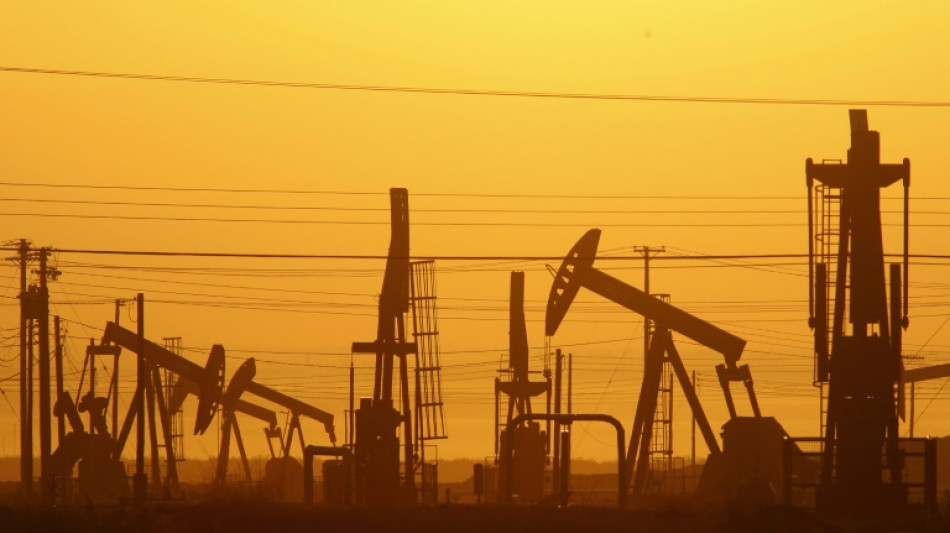
OPEC+ slashes oil output further to boost flagging prices / Photo: DAVID MCNEW - GETTY IMAGES NORTH AMERICA/AFP/File

 Arteta blasts 'unacceptable' Sunderland penalty despite Arsenal win

 Mbappe at the double as Real Madrid sink Rayo

 Arsenal extend perfect Premier League start as Chelsea, Liverpool held

 US survive Spain scare to book World Cup final clash with France

 Celine Dion makes long-awaited return to stage in Paris

 Werro crowned Ultimate queen, US sweep 100m races

 Venezuelans outside Caracas say capital not sharing blackout burden

 Danish WWII drama wins top prize at Venice festival
 Chelsea boss Alonso yearns for 'boring game' after Hull make their point

 Werro outguns Hodgkinson to win women's 800m at Ultimate

 Moreira leads AC Milan fightback in Lazio draw

 Chelsea boss Alonso for yearns for 'boring game' after Hull make their point
 'Tired' Liverpool must adapt to schedule, says Iraola

 Stunning US fightback sets up Solheim Cup singles showdown

 Monaco's perfect Ligue 1 start ends with Strasbourg draw

 Ukraine's economy hobbled by Russian strikes

 France sink Germany to reach first women's basketball World Cup final

 Hull hold Chelsea, Liverpool fail to beat Fulham in Premier League

 Nmecha and Silva keep Dortmund perfect in Bundesliga

 Norris snatches thrilling Spanish GP pole from Antonelli

 'Great to have a race at home': Fans celebrate F1's Madrid return
 French IT giant Capgemini sells subsidiary after row over ICE links

 Thousands rally in Kosovo ahead of ex-leader's war crimes verdict

 Zelensky ready to meet Putin at G20 in Miami

 Gaza film, 'irreverent' Malkovich drama vie for Venice top prize

Major oil-producing nations Saudi Arabia and Russia on Thursday announced they would further slash production in an effort to prop up volatile prices following an OPEC+ meeting.
The meeting also saw major producer Brazil declared as joining the grouping from next year, according to a statement by the Organization of the Petroleum Exporting Countries (OPEC).
Brazil's Energy Minister Alexandre Silveira, who attended the meeting, called it a "historic moment for Brazil", but added his ministry still needed to study "in detail" the invitation to join the group.
Following the virtual meeting of ministers from the 23-member OPEC+ alliance, Riyadh announced it would extend its voluntary oil production cut of one million barrels per day until March 2024.
Moscow said it would slash oil exports by 500,000 barrels a day -- up from 300,000 barrels a day so far -- until March, following tough, hours-long talks.
Other countries, such as the United Arab Emirates, Kuwait, Kazakhstan, Algeria and Oman, will also make smaller cuts, according to the Bloomberg news agency.
Amid stuttering global economic growth, analysts had largely expected OPEC+ producers to extend or deepen production cuts into next year to halt the recent slump in prices.
Around 1730 GMT, the price of Brent, the European benchmark for crude, fell by 0.31 percent to $82.84 per barrel, while that of WTI, its American equivalent, dropped by 2.47 percent to $75.94 despite the announcements.
- Intense negotiations -
Intense negotiations have continued in recent days as Saudi Arabia, which has borne the brunt of the supply cuts, sought to convince African countries to chip in by accepting lower production quotas.
But Angola and Nigeria were among those countries reluctant to sign up, seeking to step up production to secure vital foreign currency after they agreed in June to reduce their quotas.
At the June meeting, the United Arab Emirates received authorisation to increase production.
Since the end of 2022, the alliance has implemented supply cuts of about five million barrels per day (bpd).
In a boost to the grouping, OPEC said Brazil would join from next year. Brazil is among the world's top 10 producers and has been the largest oil producer in Latin America since 2016.
OPEC+ was born in late 2016 when Russia and nine others joined forces with the Saudi-led OPEC to prop up falling prices.
The cartel faced its biggest crisis in 2020 as countries locked down due to the Covid pandemic, sending oil demand plunging.
The group agreed in April 2020 to slash output by 9.7 million barrels per day in order to boost sagging prices.
It began to raise production again in 2021 as the market improved.
In the most recent meetings amid plunging prices, OPEC+ members have announced voluntary cuts to boost prices.
- Power balance shift -
But investors have warned that cutting production might not be enough to prevent prices from plummeting.
Oil prices are far from the near-$140 a barrel peak reached after the Russian invasion of Ukraine.
But they remain above the average of the last five years, currently hovering at around $80 per barrel after nearly striking $100 in September.
Concerns among producers persist about demand softening owing to slowing economies, particularly China's -- the world's biggest importer of crude -- amid mixed signals emerging from Europe and the United States.
On the supply side, crude production in the US and Brazil reached record levels, triggering what some analysts called a shift in the balance of power.
According to analyst Neil Wilson of Finalto, OPEC "doesn't have the iron grip on the market it once commanded".
E.Rodriguez--AT

