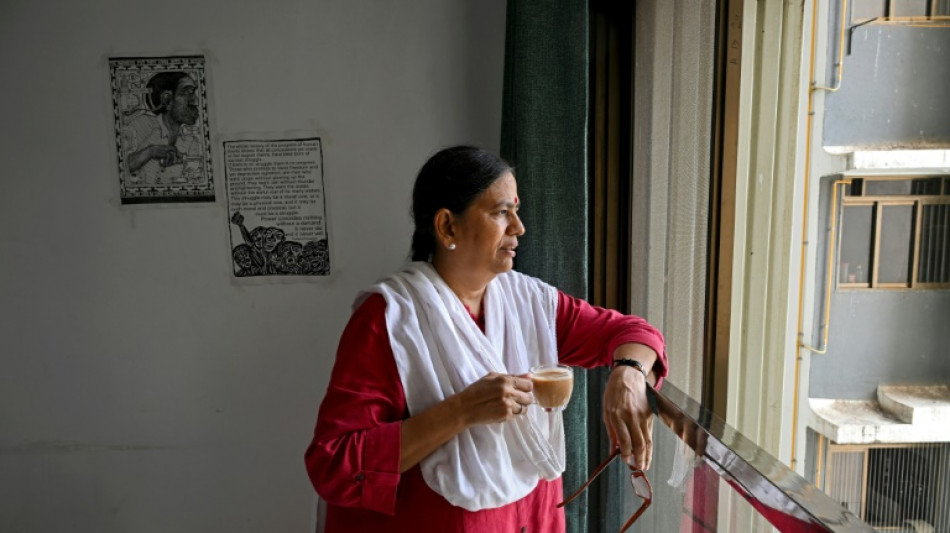
'Sea of misery': Indian rights lawyer spotlights plight of jailed women / Photo: Indranil MUKHERJEE - AFP

 Arteta blasts 'unacceptable' Sunderland penalty despite Arsenal win

 Mbappe at the double as Real Madrid sink Rayo

 Arsenal extend perfect Premier League start as Chelsea, Liverpool held

 US survive Spain scare to book World Cup final clash with France

 Celine Dion makes long-awaited return to stage in Paris

 Werro crowned Ultimate queen, US sweep 100m races

 Venezuelans outside Caracas say capital not sharing blackout burden

 Danish WWII drama wins top prize at Venice festival

 Chelsea boss Alonso yearns for 'boring game' after Hull make their point

 Werro outguns Hodgkinson to win women's 800m at Ultimate

 Moreira leads AC Milan fightback in Lazio draw

 Chelsea boss Alonso for yearns for 'boring game' after Hull make their point

 'Tired' Liverpool must adapt to schedule, says Iraola

 Stunning US fightback sets up Solheim Cup singles showdown

 Monaco's perfect Ligue 1 start ends with Strasbourg draw

 Ukraine's economy hobbled by Russian strikes

 France sink Germany to reach first women's basketball World Cup final

 Hull hold Chelsea, Liverpool fail to beat Fulham in Premier League

 Nmecha and Silva keep Dortmund perfect in Bundesliga

 Norris snatches thrilling Spanish GP pole from Antonelli

 'Great to have a race at home': Fans celebrate F1's Madrid return

 French IT giant Capgemini sells subsidiary after row over ICE links

 Thousands rally in Kosovo ahead of ex-leader's war crimes verdict

 Zelensky ready to meet Putin at G20 in Miami

 Gaza film, 'irreverent' Malkovich drama vie for Venice top prize

After three years in detention experiencing the "sea of misery" endured by women in Indian jails, one of the nation's best-known rights lawyers warns that society's prejudices are amplified behind bars.
Unable to raise funds or complete complicated paperwork for bail, many women are incarcerated for years while awaiting trial in India's glacial judicial process -- especially those at the bottom of the country's millennia-old caste hierarchy, said Sudha Bharadwaj.
"The legal aid system has more or less failed most of the poor prisoners", said the activist, who was herself released last year.
"The patriarchal bias goes very deep," she told AFP in an interview.
Women make up less than five percent of India's prison population.
Of them, more than two-thirds are yet to be convicted and are in detention awaiting trial, according to government statistics from 2015, the latest available.
- 'Prejudices and discriminations'-
"All the dynamics which play out in society are reflected even more sharply in the prison," the 61-year-old said.
"So whatever prejudices and discriminations you see outside in the society, they are very much reflected there."
US-born Bharadwaj, a committed lawyer of the poor, moved to India and renounced her US citizenship to support underprivileged communities in Chhattisgarh.
But the trade unionist was arrested in 2018 and accused of giving speeches that allegedly incited violence, charges she has denied.
"I was still a much more privileged person than most of the people around me," she told AFP from her home in Mumbai.
"Most of them were of course poor, and a lot of them were uneducated -- some of them were completely illiterate.
"They didn't know what was happening. They were abandoned by their families most of the time. So, I was really in a sea of misery".
Three bail applications were denied before Bharadwaj was released under strict conditions that barred her from discussing her case.
But in a book researched while behind bars, she has detailed the situation of the women she met and tried to help.
Titled "From Phansi Yard", or, the "hanging" yard, the book details stories from inmates at Yerwada jail in Pune.
There were many cases where the women she wrote about could have been granted bail.
"Either they were too poor to afford a good lawyer, or the legal aid lawyer didn't really bother to even come in meet them," she said.
Bharadwaj wrote "hundreds" of applications for older women in poor health, but all were rejected.
"Only those who you very much require to be in jail should be in jail," she said, adding that bail should be "the rule and jail the exception".
Bharadwaj wrote of jailed women being treated as second-class citizens, and within that, those who are members of India's 200-million-strong Dalit castes -- once subject to the discriminatory practice of "untouchability" -- facing an extra challenge.
- 'Much harsher' -
Among the people she met was a Dalit woman jailed after her employer accused her of stealing jewellery.
One woman was accused of murdering her landlord, despite no clear evidence provided and her pleas of innocence.
Another was arrested for the suicide of her daughter-in-law simply because she was in the house when she died.
A widow was arrested after her son allegedly killed her lover in a fit of rage. The son was bailed, but not his mother.
Bharadwaj also wrote of how the Pardhi people, stereotyped as troublemakers by police, were often picked up for a minor offence, then charged with more serious crimes.
"The police are trained to basically round up all the Pardhis around whenever there is a crime which has not been solved," she said.
"You could see that the sentencing appeared to be much harsher when it came to lower caste people."
D.Johnson--AT

