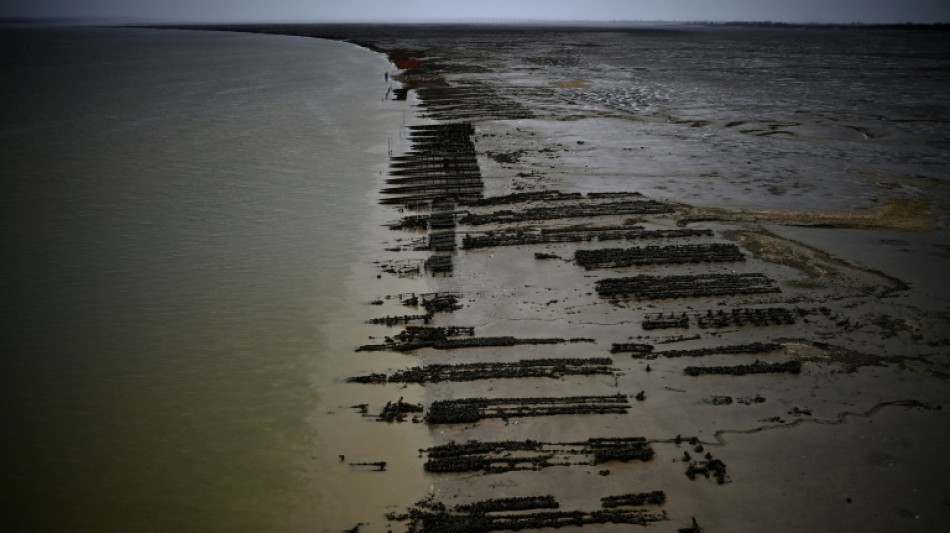
Climate change gets in the way of French oyster culture / Photo: Christophe ARCHAMBAULT - AFP

 Arteta blasts 'unacceptable' Sunderland penalty despite Arsenal win

 Mbappe at the double as Real Madrid sink Rayo

 Arsenal extend perfect Premier League start as Chelsea, Liverpool held

 US survive Spain scare to book World Cup final clash with France

 Celine Dion makes long-awaited return to stage in Paris

 Werro crowned Ultimate queen, US sweep 100m races

 Venezuelans outside Caracas say capital not sharing blackout burden

 Danish WWII drama wins top prize at Venice festival
 Chelsea boss Alonso yearns for 'boring game' after Hull make their point

 Werro outguns Hodgkinson to win women's 800m at Ultimate

 Moreira leads AC Milan fightback in Lazio draw

 Chelsea boss Alonso for yearns for 'boring game' after Hull make their point
 'Tired' Liverpool must adapt to schedule, says Iraola

 Stunning US fightback sets up Solheim Cup singles showdown

 Monaco's perfect Ligue 1 start ends with Strasbourg draw

 Ukraine's economy hobbled by Russian strikes

 France sink Germany to reach first women's basketball World Cup final

 Hull hold Chelsea, Liverpool fail to beat Fulham in Premier League

 Nmecha and Silva keep Dortmund perfect in Bundesliga

 Norris snatches thrilling Spanish GP pole from Antonelli

 'Great to have a race at home': Fans celebrate F1's Madrid return

 French IT giant Capgemini sells subsidiary after row over ICE links

 Thousands rally in Kosovo ahead of ex-leader's war crimes verdict

 Zelensky ready to meet Putin at G20 in Miami

 Gaza film, 'irreverent' Malkovich drama vie for Venice top prize

Rising sea temperatures due to climate change are forcing oyster farmers in France's southwest to take a break from summer maturation, traditionally a key step in the production of the tasty molluscs.
Starting next year, producers in Marennes Oleron, France's biggest oyster bay, will no longer be able to steep oysters in shallow clay beds in salt marshes, known as "claires", during the summer months.
Oyster farmers in this region traditionally keep oysters in the oyster beds for the final weeks before their sale, a treatment that gives them a less salty and iodic taste than if they had come straight from the sea, and earns them the "fine" label, recognised by the EU's protected geographical indication (PGI) category.
But climate change is negating the effects of the oyster beds.
Scientists have found that because of fast-evaporating water, the salt concentration has become too high between early June and late August, leading to the ban during those months.
Human consumption of oysters, which are animals, goes back thousands of years. They come in a wide variety of flavours and textures depending on water salinity, alkalinity, mineral content and nutrition.
"We're going to have to accept change," said Henry Schaller, a local farmer using the "claire" method for which the Marennes Oleron oyster region is famous.
But the 37-year-old, in the business since 2010, said he had already cut down on summer maturation even before the new rule. "The oysters had become too salty," he said. "We had a weaker, lower-quality product."
- On the frontline -
The water temperature in the clay oyster beds, filled with sea water thanks to the tides and rhythm of the ocean, can now reach 35 Celsius (95F) in the summer months, well above the comfort zone of 32C for oysters, which cannot regulate their temperature.
This puts them more on the "frontline" of climate change suffering than ocean mammals or fish, said Fabrice Pernet, a scientist at the Ifremer oceanic research centre.
"There is as much reason for concern for oysters as there is for corals. Their fragility is similar," he said.
Producers in the Marennes Oleron sell up to 60,000 tonnes of oysters per year, of which 17,000 tonnes are of the "fine" variety.
Rising ocean temperatures, which in July set a new world record at 20.96C, make oysters more vulnerable to disease, and expose them to falling oxygen content in the water and rising acidity.
"We noticed, because of a changing climate, that the maturation could no longer be carried out in the same way," said Laurent Chiron, an oyster farmer and president of the GQHMO association that awards the industry's quality label.
According to the new rules, farmers are encouraged to go beyond the traditional winter and summer methods for oyster bed maturation, adopting a more flexible approach.
"We are telling oyster farmers: based on how you perceive the climate, you can operate one maturation method or another," Chiron said.
Philippe Morandeau, president of the oyster industry committee in Poitou-Charentes which includes Charente-Maritime, said he believed any impact on sales figures would be small, given that most oysters are sold for end-of-year festivities when ocean temperatures are low.
L.Adams--AT

