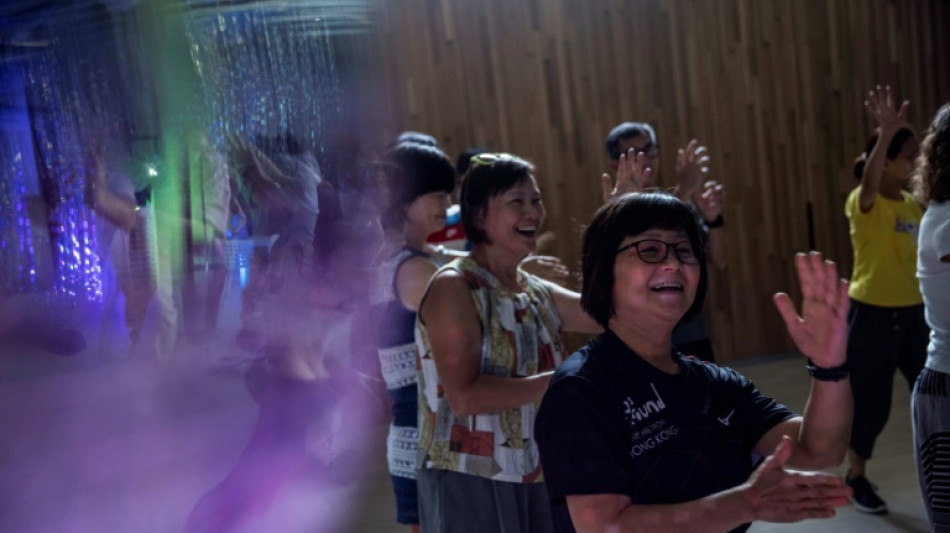
Disco, dogs help Hong Kong's elderly out of post-Covid isolation / Photo: ISAAC LAWRENCE - AFP

 Rybakina reigns serene as new world number one

 South Africa defeat New Zealand 43-28 to complete 3-1 series victory

 Rybakina triumphs in US Open, denies Sabalenka three-peat

 Akron fan's honorary play-calling stint ends with opening-drive fumble

 Louisiana's developing roster faces USC as Trojans enter as heavy favorites

 Christa Pike seeks clemency before September 30 execution in Tennessee

 Utah hosts Arkansas as both programs begin seasons under new coaches

 Maryland groups seek statewide data center pause after local moratoriums spread

 Winston County trash-debt prosecutions face challenge from civil-rights lawyers

 Fifth Circuit upholds dismissal of Jackson residents' constitutional water claims

 Anthropic details Claude misuse as US targets major illicit online marketplace

 Japanese floating parking platform is designed to lift cars above floodwater

 Arteta blasts 'unacceptable' Sunderland penalty despite Arsenal win

 Mbappe at the double as Real Madrid sink Rayo

 Arsenal extend perfect Premier League start as Chelsea, Liverpool held

 US survive Spain scare to book World Cup final clash with France

 Celine Dion makes long-awaited return to stage in Paris

 Werro crowned Ultimate queen, US sweep 100m races

 Venezuelans outside Caracas say capital not sharing blackout burden

 Danish WWII drama wins top prize at Venice festival

 Chelsea boss Alonso yearns for 'boring game' after Hull make their point

 Werro outguns Hodgkinson to win women's 800m at Ultimate

 Moreira leads AC Milan fightback in Lazio draw

 Chelsea boss Alonso for yearns for 'boring game' after Hull make their point

 'Tired' Liverpool must adapt to schedule, says Iraola

Eyes closed, hips swaying, retiree Polly Chan danced like no one was watching at a community centre in Hong Kong, where experts warn of a loneliness epidemic among the ballooning elderly population.
The 71-year-old and about 30 others were part of a pilot programme called "Noon-D" -- for "afternoon disco" -- intended to reach out to an increasingly isolated group in the fast-paced city.
A self-proclaimed "rebel" who has been clubbing since she was a teenager, Chan said she struggles to express her unhappiness to her family -- and finds the dance floor to be the best cure.
"I don't have many people to talk to," Chan told AFP. "When I dance, I feel very relieved."
Kicked off in July, the disco sessions take place weekly at a community centre that is made over with spinning mirror balls and floor-to-ceiling shimmering tassels.
Programme curator Lai Sim-fong told AFP the idea was born out of workshops held with elderly Hong Kongers in the wake of the Covid-19 pandemic, when the city enforced some of the world's harshest social restrictions.
"It's mainly designed to address the loneliness suffered by the elderly and their lack of social life," she said.
"Some elderly people said they avoided going outside and they observed many others had lost interest in leaving their homes."
And while the disco sessions were fully booked, Lai said the programme meets only a fraction of the need for socialisation among a Hong Kong elderly population that can all too often feel invisible.
- World's oldest city -
Hong Kong is forecast to become the world's oldest city by 2050, according to the United Nations, with the population of people aged 65 and older reaching 40.6 percent.
Adding to the issue is an exodus of younger people -- partially triggered by a sweeping national security law Beijing imposed in mid-2020 to quell political dissent -- as well as the lingering effects of the pandemic.
A survey conducted by the University of Hong Kong in the first half of 2022 found that a third of the nearly 5,000 elderly respondents were suffering from at least one of three conditions -- depression, anxiety and loneliness.
That poll was taken when the city was still struggling to curb a fatal coronavirus wave that hit seniors the worst.
Another poll from later in 2022 found that among seniors whose children and grandchildren had left the city -- a group classified as "left behind" -- nearly 70 percent showed a tendency toward depression, while nearly 80 percent were "under a high risk of social isolation".
The number of suicides in the city hit a decade-high 1,080 last year, according to the Samaritan Befrienders Hong Kong, with more than 40 percent of victims aged 60 or older.
"Elderly people are often less capable of seeking help and often tend to consider themselves a burden when they suffer mentally," said Samaritan chairman Heymans Wong.
Caregivers should help older people to "expand their social circles", he said.
- 'Hidden elderly' -
But doing so is easier said than done, according to Adeline Tsang, elder care director at Hong Kong's Christian Family Service Centre.
She struggles to convince her wards to leave their homes.
Pandemic lockdowns "affected both their cognitive and physical conditions", Tsang told AFP.
"The separation anxiety and sense of interpersonal distance have also become stronger for them since many of their young relatives have left the city in recent years," she said.
At an elderly daycare centre Tsang oversees, she enlisted a special troop of caregivers to socialise with seniors -- volunteer therapy dogs.
Retired driver Ho Yiu-keung, 70, melted with joy when Rally, a labrador and former guide dog, allowed him to pet her golden hair.
"It's better than hanging out with people," Ho told AFP. "They (the dogs) don't talk back."
He had started going to the centre after spending much of the pandemic locked down at home, making him "feel like I was being jailed", he said.
Meeting friends, exercising, and playing mahjong at the daycare have brightened his daily life, he said, advising carers to draw out the "hidden elderly" using more fun activities.
"Make them happy, make them feel that they can have some attention here, then they would be interested to come out," Ho said.
E.Flores--AT