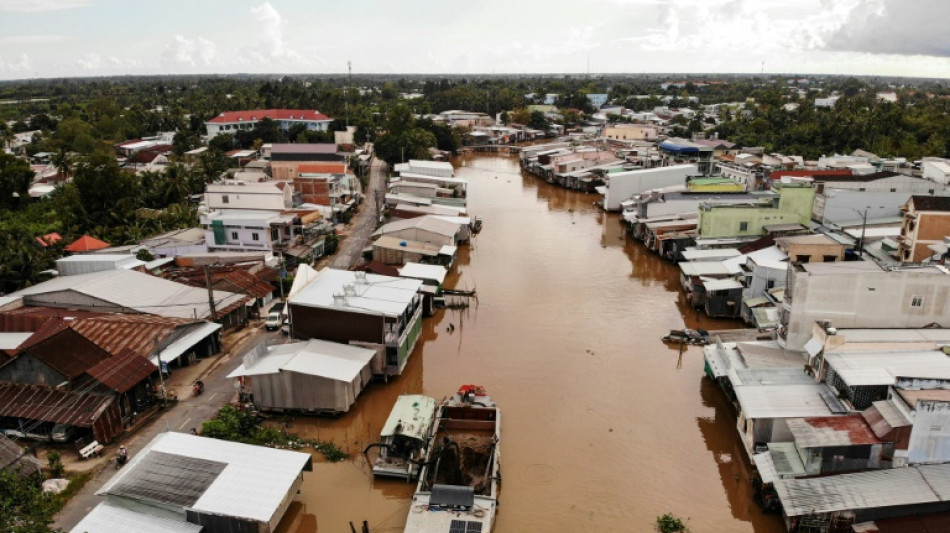
Sand mining in Vietnam's Mekong Delta sinks homes, livelihoods / Photo: Nhac NGUYEN - AFP

 Rybakina reigns serene as new world number one

 South Africa defeat New Zealand 43-28 to complete 3-1 series victory

 Rybakina triumphs in US Open, denies Sabalenka three-peat

 Akron fan's honorary play-calling stint ends with opening-drive fumble

 Louisiana's developing roster faces USC as Trojans enter as heavy favorites

 Christa Pike seeks clemency before September 30 execution in Tennessee

 Utah hosts Arkansas as both programs begin seasons under new coaches

 Maryland groups seek statewide data center pause after local moratoriums spread

 Winston County trash-debt prosecutions face challenge from civil-rights lawyers

 Fifth Circuit upholds dismissal of Jackson residents' constitutional water claims

 Anthropic details Claude misuse as US targets major illicit online marketplace

 Japanese floating parking platform is designed to lift cars above floodwater

 Arteta blasts 'unacceptable' Sunderland penalty despite Arsenal win

 Mbappe at the double as Real Madrid sink Rayo

 Arsenal extend perfect Premier League start as Chelsea, Liverpool held

 US survive Spain scare to book World Cup final clash with France

 Celine Dion makes long-awaited return to stage in Paris

 Werro crowned Ultimate queen, US sweep 100m races

 Venezuelans outside Caracas say capital not sharing blackout burden

 Danish WWII drama wins top prize at Venice festival
 Chelsea boss Alonso yearns for 'boring game' after Hull make their point

 Werro outguns Hodgkinson to win women's 800m at Ultimate

 Moreira leads AC Milan fightback in Lazio draw

 Chelsea boss Alonso for yearns for 'boring game' after Hull make their point

 'Tired' Liverpool must adapt to schedule, says Iraola

One summer morning, Le Thi Hong Mai's home collapsed into a river in Vietnam's Mekong Delta, where shoreline erosion caused by sand mining and hydropower dams threatens hundreds of thousands of people.
Sand -- needed to produce concrete -- is the world's second most exploited natural resource after water, and its use has tripled in the last two decades, according to the UN environment programme.
Vietnam's "rice bowl" delta region, where the Mekong empties into the South China Sea, is predicted to run out of sand in just over a decade.
But losses to the riverbed are already devastating lives and harming the local economy.
Mai told AFP she "lost everything", including the small restaurant business attached to her house in the suburbs of Can Tho City.
"I heard a bang, I rushed out and everything was gone," recalled the 46-year-old, who was sleeping close by. "I have nothing left".
Over the past two decades, hydropower dams upstream on the Mekong have restricted the flow of sand to the delta.
And sand mining to feed Vietnam's construction boom is also fast depleting resources, according to a major WWF report published earlier this year.
By 2040, the amount of sediment could be reduced by up to 97 percent, a 2018 Mekong River Commission study said, with serious consequences for people living and working on the shores of the river.
With less sand, river flows become lighter and faster and hit the banks at greater speed, accelerating erosion.
Between 2016 and August this year, at least 750 kilometres (466 miles) of riverbank and nearly 2,000 houses in the Mekong Delta region have sunk into rivers, government figures show.
- 'Last grain of sand' -
Along the Mekong, diggers and boats work around the clock, dredging sand from the riverbed.
According to Vietnam's ministry of transport, the Delta region needs 54 million cubic metres of sand for six major national highways before 2025.
The river system can provide less than half, the ministry says.
Important projects have already been delayed while authorities debate alternatives, including sea sand or imports from neighbouring Cambodia.
In Can Tho, cows sit next to unmanned excavators, and sections of a road that will eventually run to Ca Mau province are still underwater -- awaiting sand to cover them.
"We haven't had enough sand since the beginning of the year, so we don't have much to do," one worker, who declined to give his name, told AFP.
Vietnam banned exports of sand in all forms in 2017.
But given high domestic demand, the amount dredged still exceeds what comes downstream, Mekong expert Nguyen Huu Thien explained.
At the current extraction rate of 35-55 million cubic metres a year, there will be no more sand by 2035, according to the WWF-led study.
"These are the last grains of sand we are dredging," Thien warned.
- 'Nowhere else to go' -
In Hau Giang province, 60 kilometres from where Mai lost her home, Diep Thi Lua awoke in the middle of the night to see her front garden disappear into the water.
"We all jumped out of bed after hearing a big noise," the 49-year-old told AFP.
"We could feel the ground was shaking. We were so, so scared."
She said the river had widened over the decades by dozens of metres.
Since 2016, Vietnam's government has spent over $470 million on 190 projects to prevent erosion in the Mekong Delta, according to state media.
But "many of these expensive structures have collapsed into the river", Thien said.
A single $4.7 million embankment built in 2016 was washed away three times between 2020 and 2022, state media reported.
Half the delta could be gone by the end of the century, Thein warned.
"After that, the delta will disappear altogether and we will have to redraw our map and rewrite our geography books."
Around 20,000 households need to be resettled because of the risks, according to the General Department of Natural Disaster Prevention and Control.
The WWF puts the figure much higher, saying half a million could lose their homes.
But resettlement "requires lots of money, which our government will never have", said an official from Hau Giang province who did not want to be named.
"We know that they could lose their lives, living in those high-risk areas, but we have no solutions," he said.
Residents like Mai and Lua are left gripped by fear.
"I have not slept well since the erosion. We have nowhere else to go. We just have to accept it," Mai told AFP.
A.O.Scott--AT