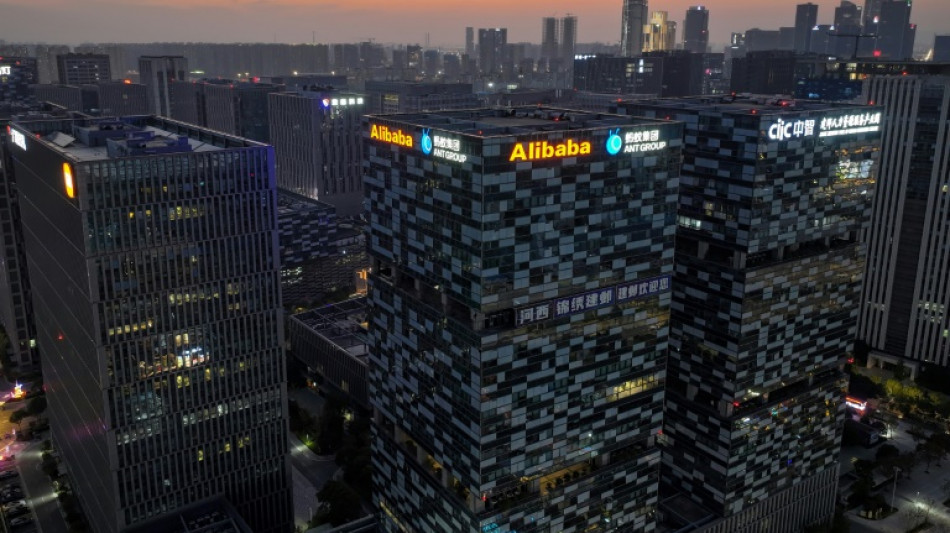
US chip curbs trip up China's AI-hungry tech giants / Photo: STR - AFP/File

 Rybakina reigns serene as new world number one

 South Africa defeat New Zealand 43-28 to complete 3-1 series victory

 Rybakina triumphs in US Open, denies Sabalenka three-peat

 Akron fan's honorary play-calling stint ends with opening-drive fumble

 Louisiana's developing roster faces USC as Trojans enter as heavy favorites

 Christa Pike seeks clemency before September 30 execution in Tennessee

 Utah hosts Arkansas as both programs begin seasons under new coaches

 Maryland groups seek statewide data center pause after local moratoriums spread

 Winston County trash-debt prosecutions face challenge from civil-rights lawyers

 Fifth Circuit upholds dismissal of Jackson residents' constitutional water claims

 Anthropic details Claude misuse as US targets major illicit online marketplace

 Japanese floating parking platform is designed to lift cars above floodwater

 Arteta blasts 'unacceptable' Sunderland penalty despite Arsenal win

 Mbappe at the double as Real Madrid sink Rayo

 Arsenal extend perfect Premier League start as Chelsea, Liverpool held

 US survive Spain scare to book World Cup final clash with France

 Celine Dion makes long-awaited return to stage in Paris

 Werro crowned Ultimate queen, US sweep 100m races

 Venezuelans outside Caracas say capital not sharing blackout burden

 Danish WWII drama wins top prize at Venice festival

 Chelsea boss Alonso yearns for 'boring game' after Hull make their point

 Werro outguns Hodgkinson to win women's 800m at Ultimate

 Moreira leads AC Milan fightback in Lazio draw

 Chelsea boss Alonso for yearns for 'boring game' after Hull make their point
 'Tired' Liverpool must adapt to schedule, says Iraola

US restrictions on advanced computer chips are forcing China's tech giants to rethink their ambitious AI-powered projects, analysts say.
E-commerce titan Alibaba on Thursday became the latest Chinese firm to admit to feeling the bite of US sanctions, as it abandoned a plan to spin off its multi-billion-dollar cloud computing arm.
It followed gaming giant Tencent's acknowledgement this week that its ability to sell advanced cloud services has been hit by the restrictions, which were introduced by Washington last year to prevent China's access to cutting-edge chips.
"What this (Alibaba) episode tells us is that US restrictions of chip supply to Chinese tech firms will have the potential of disrupting consequential business decisions," Ni Tao, founder of the Chinese robotics and automation portal cnrobopedia.com, told AFP.
"This is a rude awakening that they will have to speed up adjustment of their operations to offset the blow of a chip crunch, which will only become more acute going forward."
Washington has said the export controls are a national security measure, aimed at cutting off China's access to advanced chips critical to the development of AI tech as well as cutting-edge weapons such as hypersonic missiles and stealth fighter jets.
Beijing has dismissed these concerns, with President Xi Jinping telling US President Joe Biden this week that such actions "seriously hurt China's legitimate interests".
The chip controls were strengthened on October 17 to close loopholes that had allowed Chinese firms to acquire chips that were powered down to stay within the limits imposed by Washington.
The curbs now also target cloud computing to prevent Chinese companies from accessing powerful AI chips hosted elsewhere.
"The US is sending a clear signal to the world's cutting-edge chip developers: don't even bother... developing a high-performance computing chip for the China market. The rules will catch up," the research firm Rhodium Group said in a report this month.
"China's tech champions face an uncertain future in the wake of the October 17 controls."
- 'Recalibrate their bombasts' -
The US chip controls are yet another blow to China's tech sector, which was already suffering from the economic impact of the Covid pandemic and Beijing's regulatory crackdown against some of the country's biggest firms.
They have kneecapped the AI-driven ambitions of many companies, which had relied on a steady supply of powerful imported chips to train their AI models and develop advanced cloud-based products.
Alibaba said Thursday that US controls have not only hit its lucrative cloud business, but will also limit its ability to upgrade technologies in the future.
And despite boasting one of the largest inventories of AI chips in China, Tencent -- operator of the super-app WeChat -- admitted in an earnings call this week that it will need to find ways to use them more efficiently and seek other sources.
Advanced cloud services, however, are an important business alongside the large sums they are investing in AI models to rival the likes of ChatGPT.
Bloomberg News quoted Alibaba's Joseph Tsai as saying last month that its cloud arm hosts half of the generative AI firms in China.
While US curbs have put Chinese companies at a major disadvantage, analysts said their AI and cloud businesses could bounce back in the longer term, pointing to the billions being spent by the government to develop the domestic chip industry.
But the impact of the sanctions has been brought into sharp focus by the cloud spinoff scrapping by Alibaba, and China's once high-flying tech companies are facing major uncertainty going forward.
"With tensions between the US and China unlikely to abate significantly anytime soon... and heightened regulatory oversight at home and not to mention an economy in a downward spiral, they cannot but scale back their ambitions and recalibrate their bombasts to their real capabilities," said cnrobopedia's Ni.
Ch.Campbell--AT