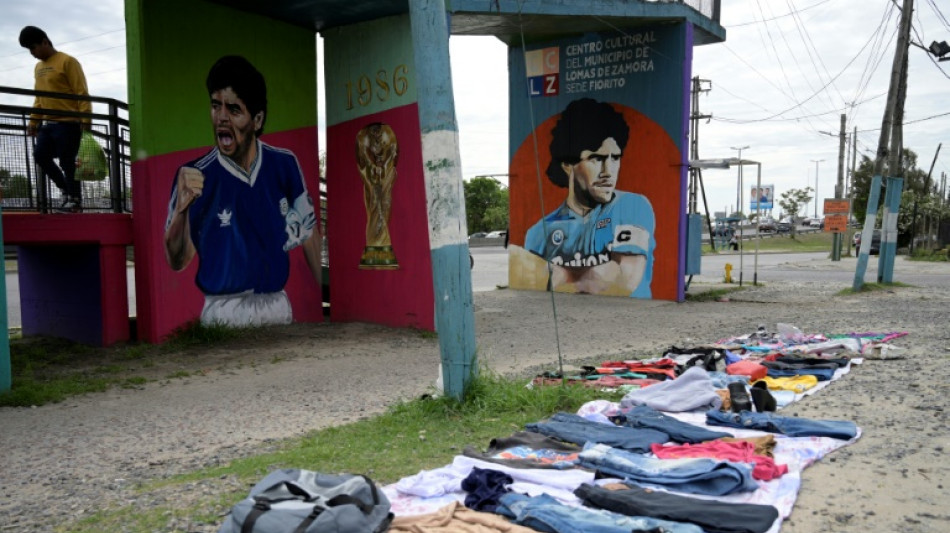
A shirt for rice: bartering to survive in inflation-battered Argentina / Photo: JUAN MABROMATA - AFP

 Rybakina reigns serene as new world number one

 South Africa defeat New Zealand 43-28 to complete 3-1 series victory

 Rybakina triumphs in US Open, denies Sabalenka three-peat

 Akron fan's honorary play-calling stint ends with opening-drive fumble

 Louisiana's developing roster faces USC as Trojans enter as heavy favorites

 Christa Pike seeks clemency before September 30 execution in Tennessee

 Utah hosts Arkansas as both programs begin seasons under new coaches

 Maryland groups seek statewide data center pause after local moratoriums spread

 Winston County trash-debt prosecutions face challenge from civil-rights lawyers

 Fifth Circuit upholds dismissal of Jackson residents' constitutional water claims

 Anthropic details Claude misuse as US targets major illicit online marketplace

 Japanese floating parking platform is designed to lift cars above floodwater

 Arteta blasts 'unacceptable' Sunderland penalty despite Arsenal win

 Mbappe at the double as Real Madrid sink Rayo

 Arsenal extend perfect Premier League start as Chelsea, Liverpool held

 US survive Spain scare to book World Cup final clash with France

 Celine Dion makes long-awaited return to stage in Paris

 Werro crowned Ultimate queen, US sweep 100m races

 Venezuelans outside Caracas say capital not sharing blackout burden

 Danish WWII drama wins top prize at Venice festival

 Chelsea boss Alonso yearns for 'boring game' after Hull make their point

 Werro outguns Hodgkinson to win women's 800m at Ultimate

 Moreira leads AC Milan fightback in Lazio draw
 Chelsea boss Alonso for yearns for 'boring game' after Hull make their point
 'Tired' Liverpool must adapt to schedule, says Iraola

An old T-shirt for a handful of rice or some eggs: ever more Argentines are relying on barter to survive in a fast-worsening economy dominating the debate ahead of presidential elections Sunday.
On the side of a dusty road in the impoverished Villa Fiorito neighborhood in Buenos Aires province, locals display old clothes, shoes or used household items on blankets spread out on the ground.
Articles of clothing are exchanged for a bag of pasta, some sugar, a few biscuits. Some items sell for a few hundred pesos -- the equivalent of a few dimes.
"Food is very expensive," 25-year-old Luz Lopez told AFP from behind her makeshift stall on the edge of a small square of Villa Fiorito -- celebrated for giving the world Diego Maradona, whose image oversees the bustling trade from numerous large murals in his honor.
In and around the teeming Argentine capital, it is an increasingly common sight for people to knock on doors asking for second-hand clothes to wear, barter or sell.
"Sometimes you're out walking, you find things, you wash them and bring them here" to trade, Lopez, a mother of two small children, said about her frustratingly limited options for making ends meet.
Elsewhere on the square, 28-year-old Maria Fernanda Diaz told AFP she sleeps under a pedestrian bridge and lives mainly on alms.
"Let the politicians come here to see how we live!" she exclaimed.
Four in every ten Argentines today live below the poverty line, according to official figures, with year-on-year inflation at 143 percent.
"Every day there are new prices," said Emilce Elisabeth Bravo, a 35-year-old mother of two who also tries to get by selling odds and ends she collects where she can.
"Diapers are very expensive -- previously a pack cost 2,600 pesos, today it is 4,500 pesos (almost $13)," she said, in a country where the monthly minimum wage was equal to about $420 in November.
- 'Great precarity' -
Bravo administers one of numerous Facebook groups with thousands of members on the lookout for barter deals in the vast capital and its many suburbs. She also works at a soup kitchen.
"We wanted to preserve the idea of bartering, we don't want to lose that camaraderie," she explained. "In the worst moments for the Argentine economy, it has helped us a lot."
Notebooks for cookies. Tea cups for eggs. Every day hundreds of negotiations take place on social media groups. Once a deal is concluded, the exchange is made on a street corner or at small neighborhood fairs.
"Poverty in Argentina is really dramatic but a very large part of what stops this situation becoming really unbearable is the vast network of support groups that exists," sociologist Mariana Luzzi of the Conicet research institute told AFP.
She said bartering became common in the difficult years of the 1990s, then exploded with the economic crisis of 2001 when Argentina was responsible for the biggest debt default in history -- around $100 billion -- followed by a banking collapse and deadly social unrest.
Now, in 2023, "in a context of great precarity, the barter is back," said Luzzi.
As economy minister, presidential candidate Sergio Massa has overseen Argentina's slide into triple-digit inflation.
He unexpectedly scored the most votes in a first voting round last month, with many seemingly scared off by Massa's rival Javier Milei, a self-described "anarcho-capitalist" who has vowed to "dynamite" the central bank, dollarize the economy and slash public spending.
"Argentines have a strong capacity for resilience," said Elisabet Bacigalupo, an economist at the Abeceb consultancy which expects inflation to reach 190 percent by year-end.
But whoever the next president is, she said, the country will likely go through more "months of recession and rising poverty."
O.Gutierrez--AT