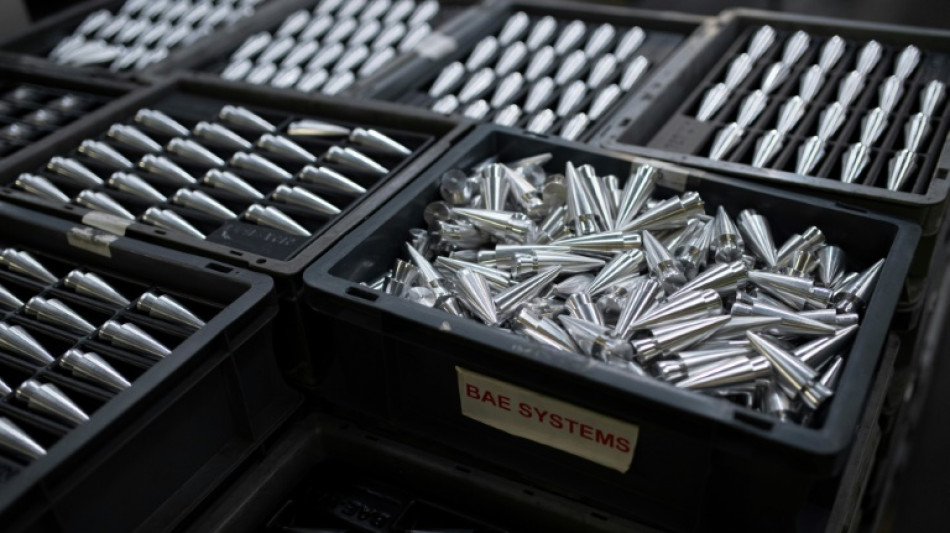
At BAE factory, Ukraine war fuels munitions output / Photo: Oli SCARFF - AFP

 'Be careful what you wish for': 'Obsession' director and star reflect on success
 Messi scores but Miami held by Nashville

 US Open champ Rybakina on top of world after injury scare

 Rybakina reigns serene as new world number one

 South Africa defeat New Zealand 43-28 to complete 3-1 series victory

 Rybakina triumphs in US Open, denies Sabalenka three-peat
 Japanese floating parking platform is designed to lift cars above floodwater

 Anthropic details Claude misuse as US targets major illicit online marketplace

 Fifth Circuit upholds dismissal of Jackson residents' constitutional water claims

 Winston County trash-debt prosecutions face challenge from civil-rights lawyers

 Marmot research gains over $140,000 from meme-coin fees alongside wildlife contest

 Queens residents seek renewed enforcement along Roosevelt Avenue

 United States beats Spain 76-66 to set up World Cup final against France

 Cristian Mungiu's Fjord examines a family's conflict with Norwegian child authorities

 Gilbert Arenas questions Jonathan Kuminga's decision to join Minnesota

 Arteta blasts 'unacceptable' Sunderland penalty despite Arsenal win

 Mbappe at the double as Real Madrid sink Rayo

 Arsenal extend perfect Premier League start as Chelsea, Liverpool held

 US survive Spain scare to book World Cup final clash with France

 Celine Dion makes long-awaited return to stage in Paris

 Werro crowned Ultimate queen, US sweep 100m races

 Venezuelans outside Caracas say capital not sharing blackout burden

 Danish WWII drama wins top prize at Venice festival

 Chelsea boss Alonso yearns for 'boring game' after Hull make their point

 Werro outguns Hodgkinson to win women's 800m at Ultimate

At a munitions factory in northeast England run by BAE Systems, production is running at full speed thanks to the war in Ukraine and an increasingly dark outlook for geopolitics.
Inside the large factory in Washington -- filled with the smell of sulphur and dust -- 14 machines and 340 workers forge and paint artillery, mortars and tank ammunitions.
Observing blocks of metal heated to 1,100 degrees Celsius (2,012 degrees Fahrenheit) and which are handled by gigantic metal pliers -- or watching workers carefully polish parts for hundreds of mortars -- one almost forgets their deadly purpose.
Empty shells are transported to BAE's Glascoed site in Wales, where explosive formula is added ahead of their delivery to customers.
BAE in August announced a record order book and half-year surge in net profits of 57 percent, as defence spending among Western governments has jumped following Russia's invasion of Ukraine.
Its shares have surged since the war between Hamas and Israel broke out last month.
"The world seems to be getting less stable rather than more stable," Steve Cardew, business development director at the British maker of military equipment, told reporters on a recent visit to BAE's Washington site between the cities of Newcastle and Sunderland.
"So that would suggest that the demand for munitions is going to increase and it's going to be a sustained sort of scenario for us."
- 'Unprecedented' orders -
BAE on Monday issued a bright earnings outlook on its "increasing exposure to structurally growing defence markets" and "a time of heightening geopolitical risk".
The group has ploughed more cash this year in "new investment in munitions manufacturing capacity", it added.
Cardew said production of 155 millimetre calibre shells will have risen eight-fold by 2025 compared with shortly before Russia's invasion of Ukraine early last year.
"What we've seen this year has been unprecedented, really 430 million (pounds) of additional orders. That's exceptional for us, and clearly is a reflection of the global sort of market we now face," said Cardew.
Two of the contracts concern mostly 155 millimetre calibres, widely used in the Ukraine conflict. The latest, worth £20 million ($24 million) is for small ammunition.
A much larger and long-term contract that kicked in this year -- known as the Next Generation Munitions Solution -- is worth £2.4 billion and sees BAE suppling munitions to Britain's Ministry of Defence over 15 years.
The UK government in September said it had delivered more than 300,000 artillery shells to Ukraine with tens of thousands more planned by the end of the year.
In northeast England, a former industrial heavyweight, the unemployment rate is higher than the national average, according to official data.
And that is why some do not think twice about working in a factory making weapons.
BAE has increased staffing to meet the surge in munitions demand. It currently employs more than 93,000 workers across 40 countries. Close to half of these are in the UK.
- Israel-Hamas war -
BAE's share price has almost doubled since Russia's invasion of Ukraine -- and by more than 10 percent in the wake of the Israel-Hamas war that began early October.
BAE and its peers are set to keep on benefitting.
"It is highly likely that they will continue to profit from an increase in conflict in the world, to the detriment of the civilians caught up in these conflicts, on the receiving end of their weapons," Sam Perlo-Freeman, research coordinator at Campaign Against Arms Trade, told AFP.
If London's support for Ukraine in its war with neighbouring Russia seems little contested by the British public, it is not the case regarding the Israel-Hamas conflict.
On Friday, dozens of trade unionists blocked a BAE Systems facility in Rochester, southeast England, accusing the company of making components for military planes used by Israel's army in its bombing of Gaza.
S.Jackson--AT