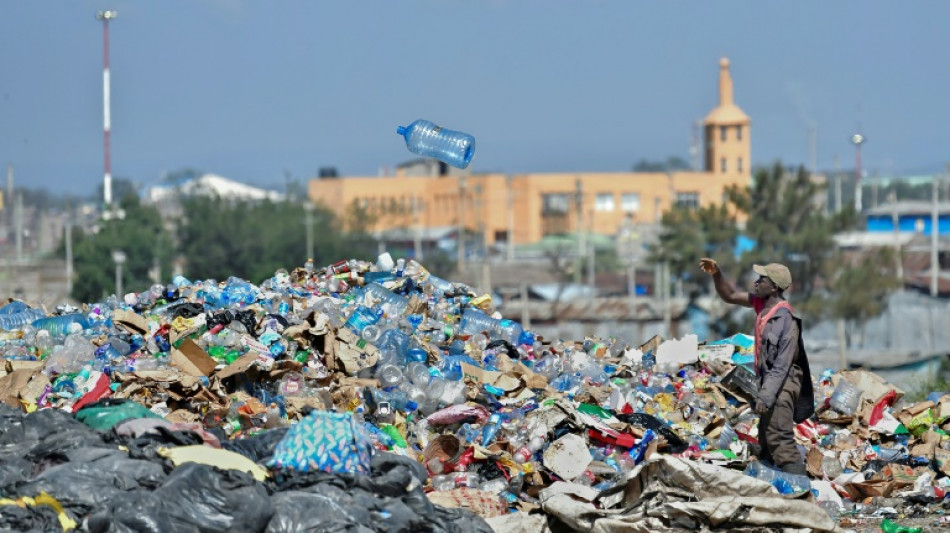
Nations negotiate terms of plastics treaty in Nairobi / Photo: Tony KARUMBA - AFP/File

 'Be careful what you wish for': 'Obsession' director and star reflect on success
 Messi scores but Miami held by Nashville

 US Open champ Rybakina on top of world after injury scare
 Rybakina reigns serene as new world number one

 South Africa defeat New Zealand 43-28 to complete 3-1 series victory

 Rybakina triumphs in US Open, denies Sabalenka three-peat

 Japanese floating parking platform is designed to lift cars above floodwater

 Anthropic details Claude misuse as US targets major illicit online marketplace

 Fifth Circuit upholds dismissal of Jackson residents' constitutional water claims

 Winston County trash-debt prosecutions face challenge from civil-rights lawyers

 Marmot research gains over $140,000 from meme-coin fees alongside wildlife contest

 Queens residents seek renewed enforcement along Roosevelt Avenue

 United States beats Spain 76-66 to set up World Cup final against France

 Cristian Mungiu's Fjord examines a family's conflict with Norwegian child authorities

 Gilbert Arenas questions Jonathan Kuminga's decision to join Minnesota

 Arteta blasts 'unacceptable' Sunderland penalty despite Arsenal win

 Mbappe at the double as Real Madrid sink Rayo

 Arsenal extend perfect Premier League start as Chelsea, Liverpool held

 US survive Spain scare to book World Cup final clash with France

 Celine Dion makes long-awaited return to stage in Paris

 Werro crowned Ultimate queen, US sweep 100m races

 Venezuelans outside Caracas say capital not sharing blackout burden

 Danish WWII drama wins top prize at Venice festival
 Chelsea boss Alonso yearns for 'boring game' after Hull make their point

 Werro outguns Hodgkinson to win women's 800m at Ultimate

The latest negotiations towards a global treaty to combat plastic pollution opened in Nairobi on Monday, with tensions expected as nations tussle over what should be included in the pact.
Some 175 countries agreed last year to conclude by 2024 a UN treaty to address the plastic blighting oceans, floating in the atmosphere, and infiltrating the bodies of animals and humans.
While there is broad consensus a treaty is needed, there are very different opinions about what should be in it.
As the talks formally opened, Peru's Gustavo Meza-Cuadra Velasquez, chair of the forum's intergovernmental negotiating committee, warned that plastic pollution posed "a direct threat to our environment, human health, and the delicate balance of our planet."
"We have the collective power to change this trajectory," he said.
Negotiators have met twice already but the November 13-19 talks are the first to consider a draft text of the treaty published in September and the policy options it contains.
Around 60 so-called "high ambition" nations have called for binding rules to reduce the use and production of plastic, which is made from fossil fuels, a measure supported by many environment groups.
It is not a position shared by many plastic-producing economies, including the United States, which have long preferred to focus on recycling, innovation and better waste management.
The draft presenting the various ways forward will form the basis for the high-stakes deliberations at the UN Environment Programme (UNEP) headquarters in Nairobi.
With more than 2,000 delegates registered, and advocates from environmental and plastic groups also in the room, the negotiations are expected to get heated as the details are hammered out.
Hundreds of climate campaigners, waving placards reading "Plastic crisis = climate crisis", on Saturday marched in Nairobi calling for the talks to focus on cutting the amount of plastic produced.
Kenyan President William Ruto described plastic pollution as "an existential threat to life, to humanity and everything in between."
"To deal with plastic pollution, humanity must change. We must change the way we consume, the way we produce, and how we dispose (of) our waste."
- Call for urgency -
The meeting to debate the future of plastic comes just before crucial climate talks in the oil-rich United Arab Emirates later this month, where discussions over fossil fuels and their planet-heating emissions are due to dominate the agenda.
As in the UN negotiations on climate and biodiversity, financing is a key point of tension in the plastic talks.
Rich economies have historically polluted more -- and for years exported trash for recycling to poorer nations, where it often winds up in the environment.
Some developing nations are concerned about rules that might place too great a burden on their economies.
Environment groups say the strength of the treaty depends on whether governments commit to capping and phasing down plastic production.
Plastic production has doubled in 20 years and in 2019, a total of 460 million tonnes of the stuff was made, according to the OECD.
Despite growing awareness of the problem surrounding plastic, on current trends, production could triple again by 2060 without action.
Around two-thirds of plastic waste is discarded after being used only once or a few times, and less than 10 percent is recycled, with millions of tonnes dumped in the environment or improperly burned.
The Nairobi meeting is the third of five sessions in a fast-tracked process aiming to conclude negotiations next year so the treaty can be adopted by mid-2025.
Campaigners say delegates in Nairobi must make considerable headway to remain on course and warned against time-consuming debates over procedural matters that caused friction at the last talks in Paris in June.
A.Williams--AT