Picture this: how a throwaway camera helps Europe's homeless / Photo: Attila KISBENEDEK - AFP

 'Be careful what you wish for': 'Obsession' director and star reflect on success
 Messi scores but Miami held by Nashville
 US Open champ Rybakina on top of world after injury scare

 Rybakina reigns serene as new world number one
 South Africa defeat New Zealand 43-28 to complete 3-1 series victory

 Rybakina triumphs in US Open, denies Sabalenka three-peat
 Japanese floating parking platform is designed to lift cars above floodwater

 Anthropic details Claude misuse as US targets major illicit online marketplace

 Fifth Circuit upholds dismissal of Jackson residents' constitutional water claims

 Winston County trash-debt prosecutions face challenge from civil-rights lawyers

 Marmot research gains over $140,000 from meme-coin fees alongside wildlife contest

 Queens residents seek renewed enforcement along Roosevelt Avenue

 United States beats Spain 76-66 to set up World Cup final against France

 Cristian Mungiu's Fjord examines a family's conflict with Norwegian child authorities

 Gilbert Arenas questions Jonathan Kuminga's decision to join Minnesota

 Arteta blasts 'unacceptable' Sunderland penalty despite Arsenal win

 Mbappe at the double as Real Madrid sink Rayo

 Arsenal extend perfect Premier League start as Chelsea, Liverpool held
 US survive Spain scare to book World Cup final clash with France

 Celine Dion makes long-awaited return to stage in Paris
 Werro crowned Ultimate queen, US sweep 100m races
 Venezuelans outside Caracas say capital not sharing blackout burden

 Danish WWII drama wins top prize at Venice festival

 Chelsea boss Alonso yearns for 'boring game' after Hull make their point

 Werro outguns Hodgkinson to win women's 800m at Ultimate

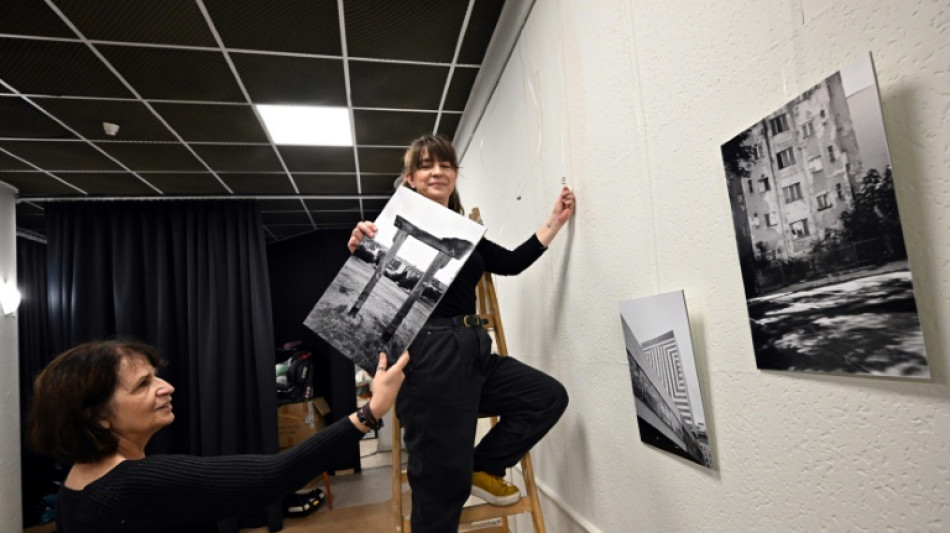
A disposable camera gave Daniel Skupio a voice as he kept his mind off drugs and alcohol and built a new life.
Pouring over a table covered with analog photos, the 27-year-old picked a highlight from the project that captured Central Europe through homeless eyes.
The picture showed his cousin with arms outstretched, smiling into the sun.
"She was standing on a pile of sand and I asked her to pose for a picture against the sky," Skupio, speaking through the chipped teeth that epitomise his years of hard living, told AFP.
"It's black and white but still shows a moment of joy, freedom."
Skupio participated in "Picture it!", a Central European initiative that handed out one-use cameras to dozens of homeless in Poland, Czech Republic, Hungary and Slovakia.
They captured everything from shared meals and playful pets to puddle reflections.
Skupio's picture is part of an exhibition in Budapest until November 27, aiming to change perceptions of homelessness.
Each person was given one or two disposable cameras and about three weeks to take pictures.
- 'Not heard or seen' -
Skupio was one of the more snap-happy, running out of film within days.
In his worst times, Skupio was drinking vodka, feasting on drugs, picking fights and sleeping rough.
Now sober for six years, looking after a stray cat, studying for a high school diploma and waiting to move into social housing, he said projects like "Picture It!" had been a major boost to his reform campaign.
"I'm really proud of myself for getting by. For looking for these ways to spend time so that I don't get any stupid ideas," said Skupio.
"I'm living proof that you can pull yourself out of anything. You can quit any substance and start your life anew."
The goal of the photo initiative had been to decrease prejudice against the homeless -- to show the positives that tend to be invisible for others.
"Most of the time these people are not heard or seen or even when they are seen it is in a very negative light," project coordinator Nora Bagdi told AFP.
"And based on the photos, we can look into their private life, which is full of colour and love and trips around the city."
Spearheaded by the Menhely Foundation -- a Hungarian non-profit to help the homeless -- the project was supported by the International Visegrad Fund.
- 'Me, photos?' -
When the organisers first distributed the cameras, some of the participants were ready for the challenge. Others felt they had nothing to offer.
"They were like, 'Me, photos? Why? What am I supposed to show?' Again, it was that lack of confidence," said Izabela Kruzynska, the local coordinator in Poland.
"We had to lift the burden off their shoulders, tell them that whatever's around you and catches your eye is fine... This is about your perspective."
Skupio and Slawomir Plichta knew each other from a now defunct theatre troupe for the homeless that -- like the photo project -- gave them respite from their problems.
A black and white photo by Plichta shows a ground view of a bike rack, the metal arches forming a tunnel with a tiny person at the end.
"I practically didn't part with the camera the whole time... Just rode around looking for interesting things to photograph," the 54-year-old recovering alcoholic told AFP.
That would not have been the case had he still been finishing bottles and sleeping rough.
"I'll be honest: I'm not sure the camera would've made it back. I would've either sold it or just left it somewhere," he said.
Now one year sober and recently back in his own apartment, Plichta is careful not to take his abstinence for granted -- "never say never" -- though he calls himself "a new person, open to people, smiling".
"Things are 150,000 times better now. I prefer this world. Not that one. I've left that one behind."
Ch.P.Lewis--AT