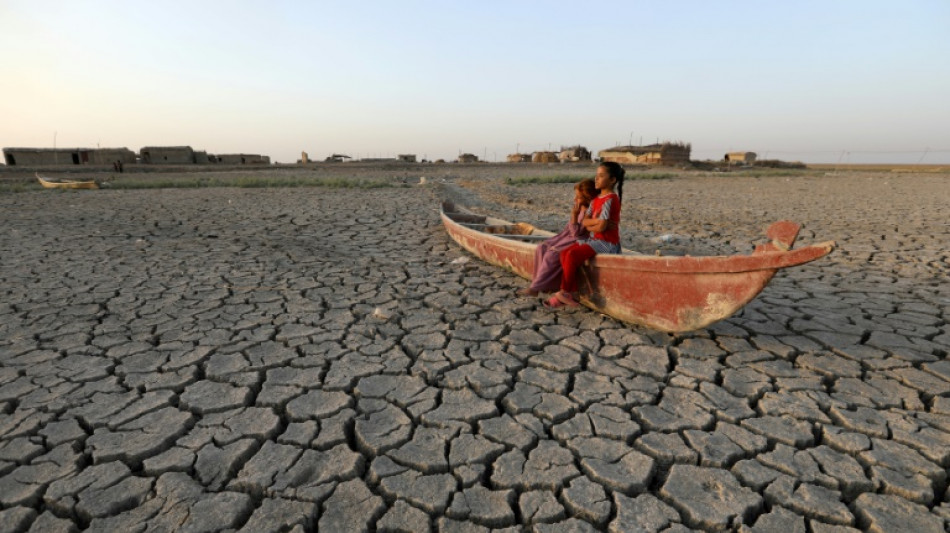
Scientists blame climate change for 'extreme drought' in Iraq, Iran and Syria / Photo: Asaad NIAZI - AFP/File

 'Be careful what you wish for': 'Obsession' director and star reflect on success

 Messi scores but Miami held by Nashville
 US Open champ Rybakina on top of world after injury scare

 Rybakina reigns serene as new world number one

 South Africa defeat New Zealand 43-28 to complete 3-1 series victory
 Rybakina triumphs in US Open, denies Sabalenka three-peat

 Japanese floating parking platform is designed to lift cars above floodwater

 Anthropic details Claude misuse as US targets major illicit online marketplace

 Fifth Circuit upholds dismissal of Jackson residents' constitutional water claims

 Winston County trash-debt prosecutions face challenge from civil-rights lawyers
 Marmot research gains over $140,000 from meme-coin fees alongside wildlife contest

 Queens residents seek renewed enforcement along Roosevelt Avenue

 United States beats Spain 76-66 to set up World Cup final against France

 Cristian Mungiu's Fjord examines a family's conflict with Norwegian child authorities

 Gilbert Arenas questions Jonathan Kuminga's decision to join Minnesota

 Arteta blasts 'unacceptable' Sunderland penalty despite Arsenal win

 Mbappe at the double as Real Madrid sink Rayo

 Arsenal extend perfect Premier League start as Chelsea, Liverpool held

 US survive Spain scare to book World Cup final clash with France

 Celine Dion makes long-awaited return to stage in Paris

 Werro crowned Ultimate queen, US sweep 100m races

 Venezuelans outside Caracas say capital not sharing blackout burden

 Danish WWII drama wins top prize at Venice festival
 Chelsea boss Alonso yearns for 'boring game' after Hull make their point
 Werro outguns Hodgkinson to win women's 800m at Ultimate

The "extreme" drought gripping Iraq, Syria and Iran would not have occurred without climate change caused primarily by burning fossil fuels, scientists said Wednesday, warning that punishing dry spells will become more intense as the world warms.
High temperatures due to human-caused climate change made the drought "much more likely to happen" -- about 25 times more likely in Syria and Iraq and 16 times more likely in Iran, according to the World Weather Attribution (WWA) group.
"Human-induced climate change has increased the intensity of such a drought such that it would not have been classified as a drought in a 1.2C cooler world," said the scientists.
It found that existing vulnerability from "years of conflict and political instability" also reduced people's ability to respond to the drought, sparking a "humanitarian disaster".
The research focused on the period from July 2020 to June 2023 in two regions where impacts have been most severe: Iran, and the basin of the Tigris and the Euphrates, the rivers that cross Syria and Iraq.
Both regions are currently experiencing an "extreme drought" as classified by the US Drought Monitor scale, said the scientists in a statement.
"After quite good rains in 2020 and good harvests, three years of very low rainfalls followed with very high temperatures led to a drought with very severe impacts on agricultural access to potable water," said co-author Friederike Otto, of the Grantham Institute at Imperial College London.
- 'Not so optimistic' -
In an online briefing, co-author Mohammad Rahimi from Iran's Semnan University, called for better resource management.
"Historically we didn't have a lot of rain so this is normal for our region, but the increase in temperature is a new topic," he said.
Rising temperatures in coming years threaten to evaporate much of the region's precipitation, according to Rahimi.
"We anticipate that we will have more evaporation and transpiration from the plants so am not so optimistic for the future," he added.
In Iraq, one of the world's leading oil producers, and in war-torn Syria, AFP journalists regularly observe the repercussions of climate change and the drought's impacts on the most vulnerable populations.
Both countries have seen a drastic drop in agricultural production in recent years, particularly among wheat farmers.
Reduced river flows and water pollution have left little catch for fishermen.
- Water stress -
By September 2022, the drought had displaced nearly two million people living in rural areas in Syria, according to the WWA.
In Iran, water shortages have "led to tensions with neighbouring countries" and soaring food prices, the statement said.
Conflicts over water are also on the rise in Iraq, where a recent UN report found one in five citizens in the country of 43 million people already suffered from water insecurity.
High levels of water stress are exacerbated by a multitude of factors, including inefficient irrigation methods, outdated water treatment plants and rapid population growth.
Key water systems are also increasingly sabotaged during conflicts.
The scientists warned that "long-lasting severe droughts like these are no longer rare events".
Instead, they can be expected to occur once every decade in Syria and Iraq, and twice every decade in Iran.
"With every degree of warming, Syria, Iraq and Iran will become even harsher places to live," said Rahimi.
O.Gutierrez--AT