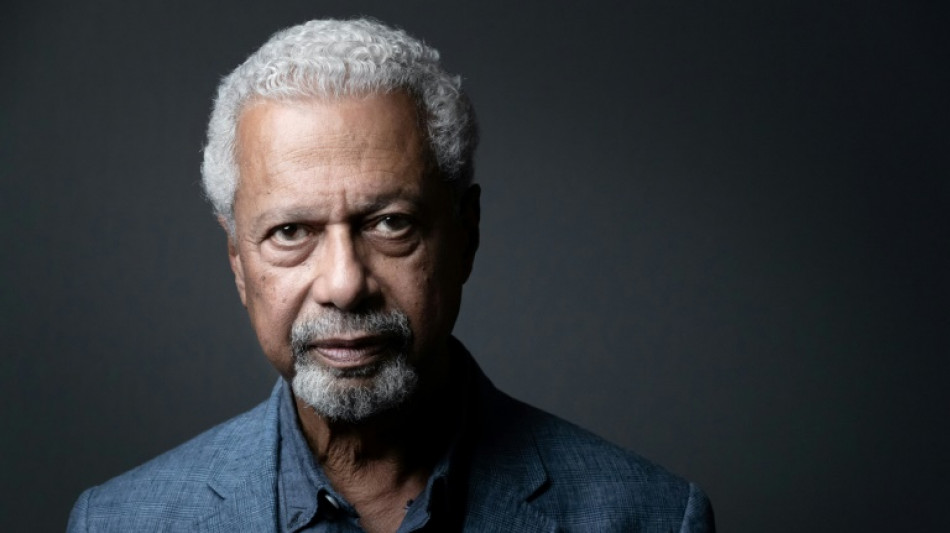
Nobel-winner Gurnah: UK imperial literature was openly racist / Photo: JOEL SAGET - AFP/File

 Garcia keeps WBC welterweight title by stopping Benn

 Lights out in Laos as electricity exports surge

 'This is the test': All eyes on US Fed to tackle high inflation

 Scars of Marawi siege linger as Philippines poll nears

 Trump turns to golf, family business on Irish visit's second day

 Best Online Gold Dealers in USA 2026 Rankings Released By Experts

 South Africa defeat New Zealand 43-28 to complete 3-1 series victory

 Rybakina triumphs in US Open, denies Sabalenka three-peat

 Mini 1998 GT pairs 161-hp engine with John Cooper Works chassis hardware

 GTA VI draws political criticism online as preorder estimates exceed five million

 Steven Strogatz weighs AI mathematics advances and their consequences for researchers

 Winston County trash-debt prosecutions face challenge from civil-rights lawyers

 Marmot research gains over $140,000 from meme-coin fees alongside wildlife contest

 Queens residents seek renewed enforcement along Roosevelt Avenue

 United States beats Spain 76-66 to set up World Cup final against France

 Cristian Mungiu's Fjord examines a family's conflict with Norwegian child authorities

 Gilbert Arenas questions Jonathan Kuminga's decision to join Minnesota

 Arteta blasts 'unacceptable' Sunderland penalty despite Arsenal win

 Mbappe at the double as Real Madrid sink Rayo

 Arsenal extend perfect Premier League start as Chelsea, Liverpool held

 US survive Spain scare to book World Cup final clash with France

 Celine Dion makes long-awaited return to stage in Paris

 Werro crowned Ultimate queen, US sweep 100m races

 Venezuelans outside Caracas say capital not sharing blackout burden

 Danish WWII drama wins top prize at Venice festival

Nobel-winning writer Abdulrazak Gurnah says removing offensive words from the likes of Agatha Christie is "futile", but says Britain did produce openly racist literature during the last century of its empire.
The British-Tanzanian author won the 2021 Nobel Prize for books such as "Paradise" and "Memory of Departure" exploring Europe's colonial legacy.
He is also a professor of English and post-colonial literature at Britain's University of Kent.
Asked by AFP about the recent trend of publishers rewriting books by Christie, Roald Dahl and James Bond author Ian Fleming to remove racist and other possibly offensive words, Gurnah was ambivalent.
"Certainly as a scholar, I think it's a futile thing to do," he said.
"I suppose one of the reasons why they're doing it is that the publisher wants to make their product more respectable."
Ultimately, he said, "I think there are bigger issues in the world to worry about."
While the current culture wars focus on tweaks to celebrity writers and hysteria over "cancel culture", Gurnah is more interested in the much more extreme racism that appeared in British literature when its empire was under threat.
"There is a certain period during imperialism when the language used to describe the colonised became harsher and harsher," he said.
He cited a study linking this shift to the mutiny in India in 1857, an uprising that showed Britain it was unwanted and vulnerable, and which sparked a brutal crackdown on dissent.
"There's a kind of out-of-control rage with which the British responded," Gurnah said.
"This is also a turning point in the way the language changes... There is a period from the early and mid-19th century, right through the middle of the 20th century, when there was no self-consciousness about being racist, and using racist language," he added.
Gurnah's response has not been to call for revisions to the past -- though he admits it can be "very hard" to read the racist literature of this period.
Rather he looks to augment our understanding of this period with his work.
He spoke to AFP in Paris for the launch of the French translation of "Afterlives".
It tells the story of a young boy stolen from his parents by German colonial troops in East Africa.
"When an account is incomplete, because it is only seeing one side, you can add to that... that is my idea," said Gurnah.
Th.Gonzalez--AT