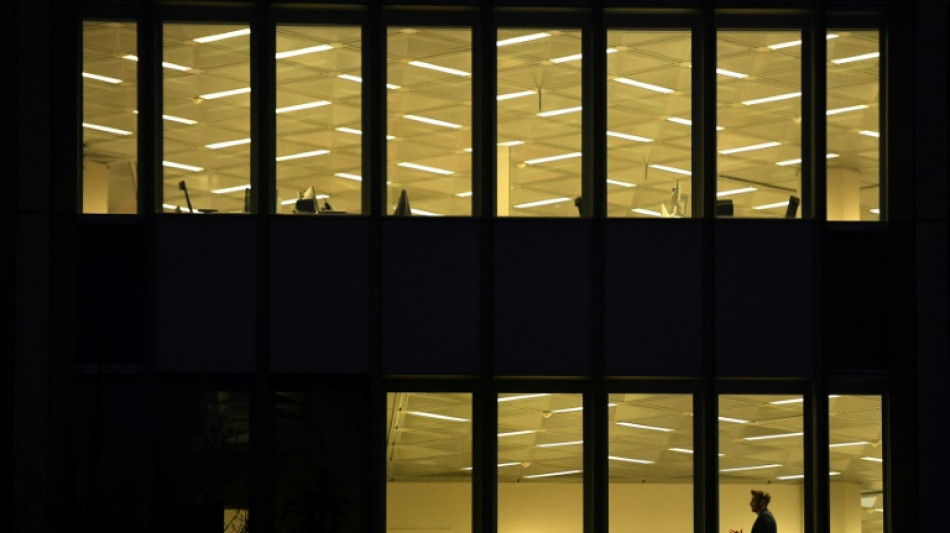
Europe's economic powerhouse tests a shorter working week / Photo: Ina FASSBENDER - AFP

 Garcia keeps WBC welterweight title by stopping Benn

 Lights out in Laos as electricity exports surge

 'This is the test': All eyes on US Fed to tackle high inflation

 Scars of Marawi siege linger as Philippines poll nears

 Trump turns to golf, family business on Irish visit's second day

 Best Online Gold Dealers in USA 2026 Rankings Released By Experts

 South Africa defeat New Zealand 43-28 to complete 3-1 series victory

 Rybakina triumphs in US Open, denies Sabalenka three-peat

 Mini 1998 GT pairs 161-hp engine with John Cooper Works chassis hardware

 GTA VI draws political criticism online as preorder estimates exceed five million

 Steven Strogatz weighs AI mathematics advances and their consequences for researchers

 Winston County trash-debt prosecutions face challenge from civil-rights lawyers

 Marmot research gains over $140,000 from meme-coin fees alongside wildlife contest

 Queens residents seek renewed enforcement along Roosevelt Avenue

 United States beats Spain 76-66 to set up World Cup final against France

 Cristian Mungiu's Fjord examines a family's conflict with Norwegian child authorities

 Gilbert Arenas questions Jonathan Kuminga's decision to join Minnesota

 Arteta blasts 'unacceptable' Sunderland penalty despite Arsenal win

 Mbappe at the double as Real Madrid sink Rayo

 Arsenal extend perfect Premier League start as Chelsea, Liverpool held

 US survive Spain scare to book World Cup final clash with France

 Celine Dion makes long-awaited return to stage in Paris

 Werro crowned Ultimate queen, US sweep 100m races

 Venezuelans outside Caracas say capital not sharing blackout burden

 Danish WWII drama wins top prize at Venice festival

Maximilian Hermann's weekend starts on Friday morning, when he puts his motorcycle helmet on and takes his bike out for a ride to the southern German Alps.
Like all his colleagues, the 29-year-old project manager shifted to a four-day week at the beginning of the year and is making the most of it.
His new, shorter working hours are part of a trend that is gaining traction in Germany, where companies are looking to balance between worker shortages and the need to stay competitive.
Among the pioneers of the four-day week is Hermann's employer KlimaShop, a purveyor of heat pumps and air-conditioning systems based near Augsburg in southern Germany.
Instead of working 40 hours a week across five days, Hermann now spends a total of 38 hours at work over four working days.
Otherwise put, each of KlimaShop's 30 employees works an hour-and-a-half more for each day they are in the office, while having an extra day to themselves each week.
Hermann's colleague Michael Pankoke sees the shift switch as "big progress".
"You work much more intensely, everything you do is more precise," the 58-year-old customer advisor told AFP.
- Test run -
Management consultancy Intraprenoer is leading the first large-scale experiment with the shorter schedule in Germany together with the organisation 4 Day Week Global, which has already run similar trials in other countries, such as the United Kingdom.
Starting in 2024, up to 50 companies of varying size are set to test the new hours, with the aim of avoiding a drop-off in productivity.
Intraprenoer, which already "abolished Friday" for its workers in 2016, said it has 33 interested candidates for the trial.
But an increasing number of businesses in Europe's largest economy have already taken the leap.
Wolfgang Schmidt, the founder of a manufacturing business near Hamburg, in the north, said he flipped his staff onto a four-day week at the end of 2022 to save his employees, some of whom commute long distances, "fuel and money".
In nearby Wedel, the town administration has introduced a four-day week to attract more "competent and motivated" workers.
During the annual round of wage negotiations in the steel industry, starting in November, Germany's biggest union IG Metall will call for the introduction of a four-day week with hours reduced from 35 to 32, for the same pay.
Beyond a better work-life balance and increased productivity, the move would reduce "one of the highest rates of part-time employees of Europe", said Sophie Jaenicke, working time lead at IG Metall.
According to a study by the Hans-Boeckler foundation, fully 81 percent of Germans would support a shift to a four-day week.
- Lukewarm -
While in Belgium workers have had the right to ask for a four-day week with the same number of hours since the end of 2022, in Germany, workers and employers agree their own work times up to a maximum 48 hours a week.
Enthusiasm for the idea of a shorter week is lukewarm among many managers and economists, however. A 20 percent reduction in working hours would have "a disastrous economic impact", according to economist Holger Schaefer.
While "limiting unproductive activities and condensing work" is still feasible in the office, all the options for increasing productivity in industry have already been exhausted, said Schaefer from the IW economic institute in Cologne.
With the labour supply already stretched by the exit of the baby-boomer generation from the work force, cutting hours would lead "inevitably to a reduction in the amount of goods and services produced", he warned.
A shorter week was, in short, an "unrealistic dream", said Michael Huether, also of the IW economic institute in Cologne. Instead the solution to labour shortages would be longer, not shorter hours, he said.
R.Garcia--AT