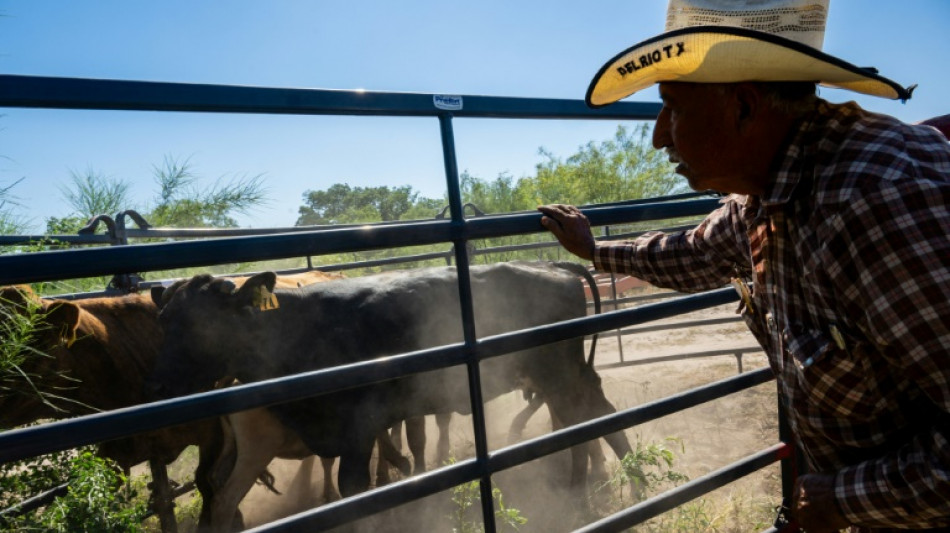
Drought and shrinking herds push US beef prices through the roof / Photo: Brandon Bell - GETTY IMAGES NORTH AMERICA/AFP/File

 Lettermen co-founder Tony Butala dies at 87

 James Talarico defeats Ken Paxton in historic Texas Senate result
 Commentator predicts possible US strike on Iran as regional tensions rise

 Jordan Bardella's Wealth and Financial Transparency Under Scrutiny

 India introduces four-layer motor insurance choice from December 15

 BHEL wins Adani Power projects valued at up to ₹28,000 crore

 India seeks threefold increase in coal stocks to prevent summer power shortages

 Indus Towers expands solar-powered network to 50,000 telecom sites

 Merz Pledges Winter Aid to Ukraine and Announces 'Coalition of the Willing' Summit

 Bharti Airtel revenue expected to grow at double-digit pace in second quarter

 Italy Claims Curling Silver at European Championships in Ostrava
 Kuwait finance minister holds economic cooperation talks at COMCEC

 Abdul El-Sayed declares victory in Michigan Senate contest

 Democrats Seize Congress in Midterm Sweep, Ending Trump Era Control

 Trump congratulates Democrats and signals willingness to cooperate

 Enel to Install Solar Panels at Niterói Waste Management Facility

 Qatar sees tentative opening for renewed regional diplomacy

 Qatar Tourism joins Pacific Asia Travel Association at London travel market

 Abdul El-Sayed Wins Michigan Senate Seat in Historic Election

 Qatar media bodies discuss support for humanitarian initiatives
A prolonged drought is shrinking livestock herds and driving beef prices to record highs in the US, even as consumption is growing stronger.
These days, Mary Skinner is finding it harder to get her daily meat intake.
"I have extreme need for protein and I need to eat meat that my doctor ordered," said the 69-year-old shopper outside Grand Central Market, in New York.
"I used to be able to sometimes buy ribeye steak but... I'm now eating a lot more ground beef."
The headline rate of inflation has slowed in recent months, with a 3.7 percent reading in September, year over year. But steak is still riding high, up 9.7 percent, according to the US Bureau of Labor Statistics.
The average price for this American staple has risen 27 percent over the last three years.
"It's gotten to a point where I've started buying more things that can be slow-cooked, because from a price perspective, you're getting more affordable stuff," said another patron, who declined to share his name.
- Increasing demand -
While inflation has been a dominant theme over the last couple years, beef is on a trajectory of its own.
Though America is often seen as home to giant herds and sprawling ranches, it is short of cattle.
"We're at the lowest beef cattle numbers since the 1960s," said Scott Brown, a specialist in farm and livestock issues at the University of Missouri.
Herds have dwindled by 10 percent over the last five years, according to the US Department of Agriculture (USDA).
"The primary driver has really been drought in many parts of cattle country. That's been a multi-year event," said Brown.
He dates the decline back to the autumn of 2020.
Pastures have decreased in size due to the lack of rainfall. Faced with less grazing land and skyrocketing hay prices, ranchers have dramatically reduced their herds.
"You look at 2022, that was the highest beef cow slaughter that we've seen since the early 1980s," said Ross Baldwin, a hedge strategist at AgMarket.Net.
The contraction since then was amplified when hundreds of cattle succumbed to brutally hot and humid weather in August.
Genetic selection has helped make up for some of the loss by improving output.
"We're more productive today. We don't need as many beef cows today as we needed 10 years ago to generate a given level of production," Scott Brown said.
But meantime, demand for red meat has increased.
In 2022, Americans ate, on average, 59.1 pounds or 26.8 kilograms of beef, slightly up from 2021.
Beef consumption has increased by nearly 10 percent since 2015, per USDA's numbers.
In this tight market, cattle prices have more than doubled since March 2020 (up 133 percent).
Incentivized by record prices, many breeders are parting with their heifers earlier, which prevents the herd from growing, according to Baldwin.
"We are a year out from starting to see meaningful heifer retention," he said.
"And when you start retaining heifers, those heifers are still three years out from when the herd starts really increasing in size across the country."
On top of it, holding on to female calves for breeding "means even less beef production and even higher price short-term, because those cattle aren't entering the beef production stream," said David Anderson, a livestock-market specialist at Texas A&M University.
Another challenge is finding pastures to accommodate growing herds.
"The Southeast part of the US has seen some dry weather, but not as dry as the rest of the country," said Brown.
"Could beef cows move there as a another way to generate a bigger national herd? Those kinds of shifts could try to happen."
The USDA forecasts a further decrease in beef production for 2024.
From then on, Baldwin warned, "you will see retail prices be extremely firm. And ultimately it'll force the consumer to choose if they want to continue paying those high prices."
F.Ramirez--AT