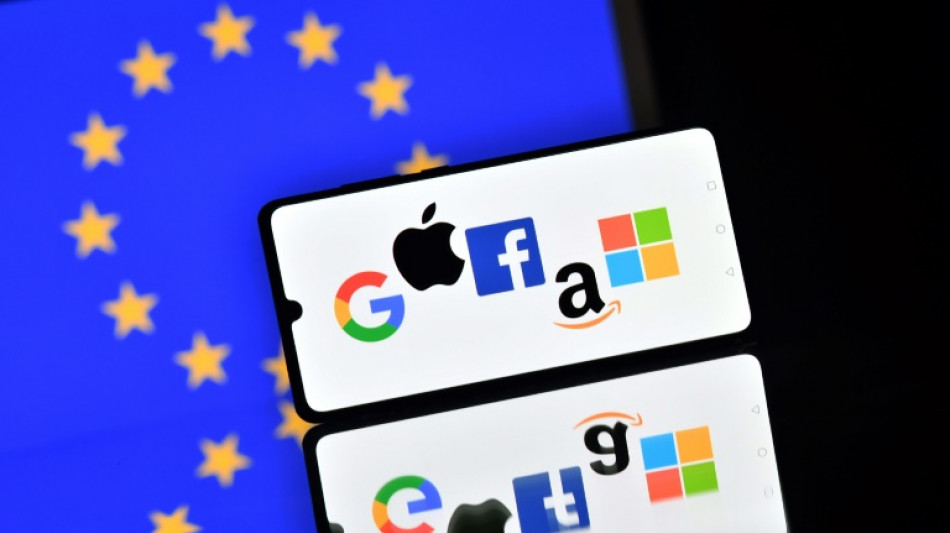
What to know about the EU's landmark digital content act / Photo: JUSTIN TALLIS - AFP/File

 Crash and burn: Pakistan cricket at a new low after England humiliation

 'Second life': Nepal tunnel survivor recalls ordeal

 Hong Kong homes flattened for US$28 bn high-tech hub

 'Be careful what you wish for': 'Obsession' director and star reflect on success
 Messi scores but Miami held by Nashville

 US Open champ Rybakina on top of world after injury scare

 Rybakina reigns serene as new world number one

 Defiant Sabalenka motivated by US Open defeat

 Houthis say hit Saudi base after renewed fighting with Yemeni govt forces

 Maryland groups seek statewide data center pause after local moratoriums spread

 Japanese floating parking platform is designed to lift cars above floodwater

 Anthropic details Claude misuse as US targets major illicit online marketplace

 Fifth Circuit upholds dismissal of Jackson residents' constitutional water claims

 Winston County trash-debt prosecutions face challenge from civil-rights lawyers

 Utah hosts Arkansas as both programs begin seasons under new coaches

 Christa Pike seeks clemency before September 30 execution in Tennessee

 Louisiana's developing roster faces USC as Trojans enter as heavy favorites

 Akron fan's honorary play-calling stint ends with opening-drive fumble

 Marmot research gains over $140,000 from meme-coin fees alongside wildlife contest

 Attissogbe double inspires Pau to Top 14 summit

 Guimaraes strike lights up Arsenal win over Sunderland

 Israeli-made Gaza documentary wins Venice special jury prize

 De Zerbi apologises to fans after Spurs' stalemate extends goal drought

 Lowry takes four-shot lead as Trump jets in for Irish Open

 Harrison, Skupski win US Open men's doubles title

The EU's milestone legislation, known as the Digital Services Act, demands digital giants crack down on illegal and problematic content.
Brussels is bearing its teeth, launching investigations into X, formerly Twitter, as well as Facebook parent Meta and TikTok following Hamas' assault on Israel on October 7 and its aftermath.
The DSA is a mammoth law that will force digital giants to aggressively police content online in the European Union and could see them hit with major fines.
Here are the regulation's key elements:
- Rules for all platforms -
The law kicks in for all platforms from February 17, 2024, but since August it already applies for very large platforms with more than 45 million active monthly users.
Among their obligations, all platforms must quickly remove illegal content or make access to it impossible as soon as they are aware of the issue.
The companies must also rapidly inform the authorities when they suspect a criminal offence that threatens people's lives or the safety of others.
Every year the platform must publish a report that provides details about actions taken on content moderation and how long they took to respond after notification of illegal content. They will also report on the decisions taken in disputes with users.
The law also tells platforms to suspend users who frequently share illegal content such as hate speech or fake ads, while online shopping sites must verify the identities of users and block repeat fraudsters.
There are also tougher rules on targeted advertising, with a ban on such ads for children aged 17 and under.
The EU also wants users to see how their data is used. The law bans targeted advertising based on sensitive data, such as ethnicity, religion or sexual orientation.
The law does not apply to very small companies.
- Extra rules for large platforms -
The EU has named 19 "very large" platforms including Apple, Amazon, Facebook, Google, Instagram, Microsoft, Snapchat, TikTok and clothing retailer Zalando.
Amazon and Zalando have launched legal challenges to their designations.
These large platforms must assess the risks linked to their services with regards to the spread of illegal content and privacy infringements.
And they must also set up structures internally to mitigate such risks, such as improved content moderation.
The platforms must also give regulators' access to their data so officials can see whether they are complying with the rules.
This access will also be shared with approved researchers.
They will be audited once a year by independent organisations -- at their own expense -- to ensure compliance, and also establish an independent internal supervisor that will keep an eye on whether the platforms are in line with the rules.
- EU, national coordination -
Under the law, the EU's 27 member states must assign a competent authority that has the powers to investigate and sanction any violation.
These authorities must work with each other and with the European Commission, the EU's executive arm, to enforce the regulation from February.
If a digital platform provider is located in one member state, that country must enforce the rules except for very large platforms which will come under the commission's supervision.
- Complaints, penalties -
The DSA wants to make it easier for users' complaints to be heard.
Users will be able to lodge a complaint claiming a platform is in violation of the DSA with their competent national authority.
Online shopping sites may be held responsible for any damage from products bought by users that are non-compliant or dangerous.
Violations can be met with fines that could go up to six percent of a company's global turnover, and for repeated non-compliance, the EU can even decide to ban offending platforms from Europe.
T.Sanchez--AT