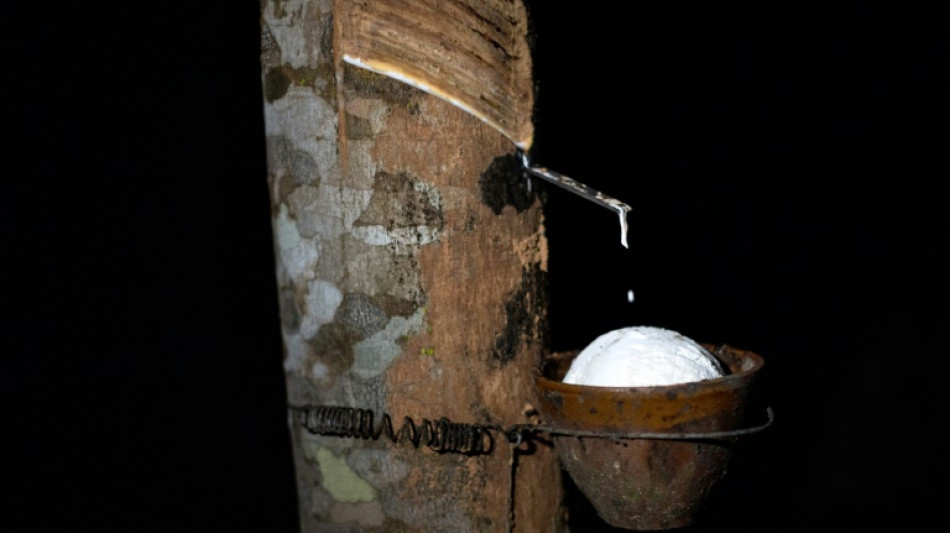
Deforestation caused by rubber vastly underestimated: study / Photo: Jack TAYLOR - AFP/File

 Crash and burn: Pakistan cricket at a new low after England humiliation
 'Second life': Nepal tunnel survivor recalls ordeal

 Hong Kong homes flattened for US$28 bn high-tech hub
 'Be careful what you wish for': 'Obsession' director and star reflect on success

 Messi scores but Miami held by Nashville
 US Open champ Rybakina on top of world after injury scare

 Rybakina reigns serene as new world number one

 Defiant Sabalenka motivated by US Open defeat

 Houthis say hit Saudi base after renewed fighting with Yemeni govt forces

 Maryland groups seek statewide data center pause after local moratoriums spread

 Japanese floating parking platform is designed to lift cars above floodwater

 Anthropic details Claude misuse as US targets major illicit online marketplace

 Fifth Circuit upholds dismissal of Jackson residents' constitutional water claims

 Winston County trash-debt prosecutions face challenge from civil-rights lawyers
 Utah hosts Arkansas as both programs begin seasons under new coaches

 Christa Pike seeks clemency before September 30 execution in Tennessee

 Louisiana's developing roster faces USC as Trojans enter as heavy favorites

 Akron fan's honorary play-calling stint ends with opening-drive fumble

 Marmot research gains over $140,000 from meme-coin fees alongside wildlife contest

 Attissogbe double inspires Pau to Top 14 summit

 Guimaraes strike lights up Arsenal win over Sunderland

 Israeli-made Gaza documentary wins Venice special jury prize

 De Zerbi apologises to fans after Spurs' stalemate extends goal drought

 Lowry takes four-shot lead as Trump jets in for Irish Open

 Harrison, Skupski win US Open men's doubles title
Deforestation for rubber cultivation has been "substantially underestimated", and is two to three times higher than generally assumed, a new study said Wednesday.
Using satellite data and cloud computing, scientists said they compiled the first detailed accounting of deforestation for rubber production in Southeast Asia -- which accounts for most of global production.
It suggests more than four million hectares of forest have been lost since 1993, and reveals that rubber has been planted in areas that are key for biodiversity.
The authors warn their estimates may be an undercount because of limitations such as cloud cover on satellite images, which complicates calculations.
"Our direct remotely sensed observations show that deforestation for rubber is at least twofold to threefold higher than suggested by figures now widely used for setting policy," said the research in the journal Nature.
More than 90 percent of global rubber cultivation occurs in Southeast Asia, and the crop has long been associated with deforestation.
The scale of the problem has been hard to quantify, however, and figures are sometimes estimated based on national reports of crop expansion that are inaccurate or incomplete.
Most rubber is cultivated by smallholders, in plots that have been difficult to pick out in imaging in the past.
The study uses newly available, higher resolution satellite imagery and compares it with historical imagery analysed by a computer programme.
The analysis is possible in part because of the rubber plant's distinct characteristics -- it loses and regrows foliage at different times from tropical forest plants.
- EU 'substantially exposed' -
The analysis found mature rubber plantations covered 14.2 million hectares in Southeast Asia in 2021, mostly in Indonesia, Thailand and Vietnam.
It suggested an estimated 4.1 million hectares were cleared for rubber between 1993 and 2016 alone.
And it found a million hectares of rubber plantations in regions designated Key Biodiversity Areas, as of 2021.
The researchers acknowledged some shortcomings and uncertainties, including clouds that covered some regions.
On islands in Southeast Asia, different climate conditions and seasonality mean that rubber trees lose and regrow their leaves at different times from elsewhere in the region, making it harder to distinguish them from other plants.
They also acknowledged that their calculation of deforestation is based on the conversion of any planted area to rubber.
So areas converted from agroforestry or other crops to rubber plantations were counted as "deforested".
Overall, however, the researchers believe their count is likely to be an underestimate of the total area planted for rubber and the effect of rubber cultivation on deforestation.
That is partly because of the challenges in capturing all cultivation from space, and also because only rubber plantations still functioning in 2021 were examined for signs of previous deforestation.
Rubber plantations abandoned before 2021 were not counted, even though they might have caused deforestation.
The study only covers Southeast Asia, though rubber is also cultivated in parts of Africa and South America.
The researchers argue more focus is needed on rubber as a driver of deforestation, including in new legislation being developed by the European Union and others.
As only a handful of companies account for most of the natural rubber consumed globally, "it should be assumed that main importers of rubber such as the EU are substantially exposed to rubber-related deforestation", the study warned.
M.O.Allen--AT