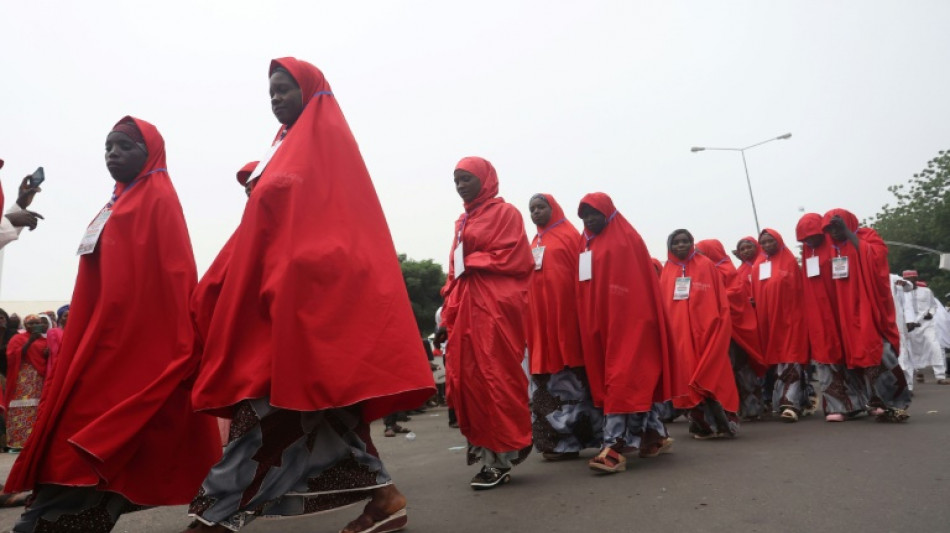
Nigerian state holds mass weddings for 1,800 couples / Photo: Kola Sulaimon - AFP

 Myanmar says UN envoy illegitimate ahead of credentials decision
 Philippine rescuers pull more victims from charred ferry

 الأرصاد السعودية تتوقع سيولاً وأمطاراً رعدية في خمس مناطق

 Crash and burn: Pakistan cricket at a new low after England humiliation

 'Second life': Nepal tunnel survivor recalls ordeal

 Hong Kong homes flattened for US$28 bn high-tech hub

 'Be careful what you wish for': 'Obsession' director and star reflect on success

 Messi scores but Miami held by Nashville
 US Open champ Rybakina on top of world after injury scare

 Rybakina reigns serene as new world number one

 Defiant Sabalenka motivated by US Open defeat

 Houthis say hit Saudi base after renewed fighting with Yemeni govt forces

 Christa Pike seeks clemency before September 30 execution in Tennessee

 Japanese floating parking platform is designed to lift cars above floodwater

 Anthropic details Claude misuse as US targets major illicit online marketplace

 Fifth Circuit upholds dismissal of Jackson residents' constitutional water claims

 Winston County trash-debt prosecutions face challenge from civil-rights lawyers

 Marmot research gains over $140,000 from meme-coin fees alongside wildlife contest

 Queens residents seek renewed enforcement along Roosevelt Avenue

 Louisiana's developing roster faces USC as Trojans enter as heavy favorites

 Akron fan's honorary play-calling stint ends with opening-drive fumble

 Maryland groups seek statewide data center pause after local moratoriums spread

 Attissogbe double inspires Pau to Top 14 summit

 Guimaraes strike lights up Arsenal win over Sunderland

 Israeli-made Gaza documentary wins Venice special jury prize

Textile trader Yusuf Abdullahi admitted he could not afford to marry despite being 30 years old until Nigeria's northern Kano state financed and staged mass weddings for 1,800 couples.
Customary gifts for newlyweds were also provided by the state as part of efforts to enable the poorest to get married.
Abdullahi was one of the grooms dressed in a traditional white robe and red cap who took advantage of the weekend ceremonies.
"Life is really tough, this is why I could not get married, though I wanted to, until this time," Abdullahi told AFP inside Kano's central mosque where he and scores of other grooms waited for the religious service on Friday.
The brides wore a bright red veil over a long robe.
The mass wedding services also took place in mosques across the state.
"I pray my marriage becomes the key to my prosperity," Abdullahi said.
Rising prices for fuel, housing, transport and food have driven some Nigerians, most of whom live on less than $2 (1.90 euros) per day, further into poverty.
And getting married can be expensive.
- Expensive traditions -
The state government "took full responsibility of the entire wedding processes and requirements", paying the 50,000 naira ($65) bride price and for customary furniture and food gifts, said Kano governor Abba Kabir Yusuf said.
All 1,800 couples were received at the governor's residence on Saturday and given their gifts.
A bride price is a tradition in some parts of Africa where the groom pays an amount of money to the bride's family, an obstacle to marriage for some couples.
In the conservative Muslim state where cultural norms are strong, the bride's family provides furniture and kitchenware, while the groom provides accommodation, boxes of clothing, cosmetics, jewellery, footwear and handbags.
"The dire economic situation in the country has made it difficult for brides and grooms to provide the furniture and trousseau (clothes) required for marriage," Abba Sufi, director-general of Kano's Sharia police, Hisbah, told AFP.
The government also presented 20,000 naira grants to each bride "as seed money to start small businesses" and to help lessen financial burdens on their husbands.
The mass wedding programme has helped boost Kano's economic development by providing work to furniture makers, hospitality workers and textile traders, Yusuf said.
- Rampant divorce -
Mass weddings are often popular among women because they ban divorce without the wife's consent.
Divorced women with children in the conservative society can face financial hardship and difficulty remarrying.
Sharia police made couples sign a document pledging not to refer "irreconcilable disputes" to them for reconciliation and not to divorce without their consent, Sufi said.
Kano has the highest divorce rate of any Nigerian state, thought to be extenuated by the economic decline of the once thriving manufacturing region.
"Every groom has to have an occupation, a means of income, for him to participate in the mass wedding," Sufi said.
Financial responsibility falls mainly on the husband's shoulders but poverty coupled with rising inflation have led authorities to encourage women to work.
- Vocational training -
Brides took part in a vocational training session before the wedding where they were taught how to make household products as a source of income.
"The wisdom behind teaching the brides some vocational skills is to make them self-reliant because life has become so expensive," Na'isa Ahmad, one of the trainers told AFP during the session.
"But if a woman has a trade she will be of help to herself, her husband and the society as a whole," she said.
The brides were taught how to make bodycare products, room freshener and insecticide, according to Maimuna Yakubu Yakasai, a 47-year old bride who took part in the training.
"We have learnt a lot. If you have a trade that fetches you some little money you can pay for little cash expenses (which) is a relief to your husband," she said.
E.Rodriguez--AT