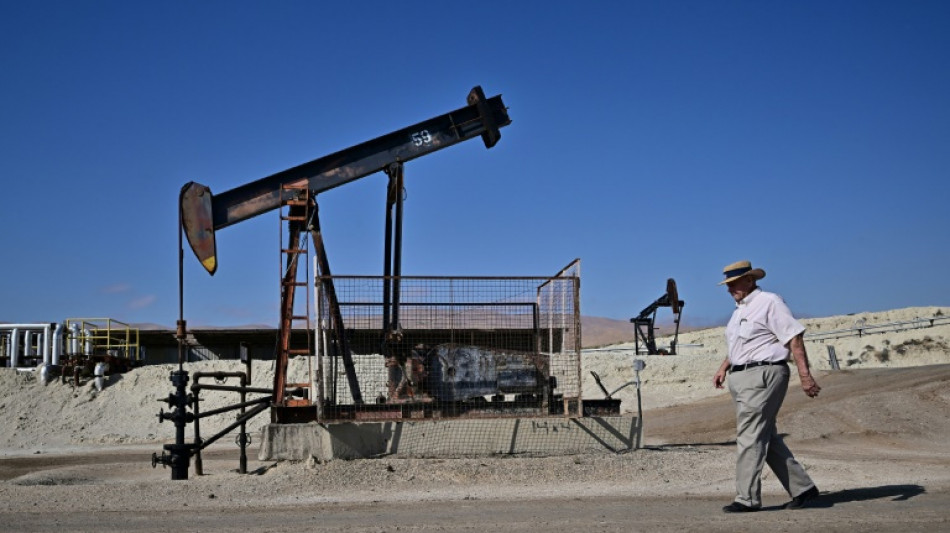
California's green drive leaves its oil towns behind / Photo: Frederic J. BROWN - AFP

 Iran's economic ties to Dubai hard to break despite war
 iPhone 18預購後出現可疑扣款 四間銀行調查未授權交易

 《浪花男女》辦特別謝票場 馮志強談票房與導演客串拍攝

 Former captain De Villiers hails 'fantastic' Springboks

 Galaxy Tab S12系列效果圖曝光 Ultra擬配雙鏡頭及瀏海螢幕

 اليورو يستقر في البنوك المصرية وأعلى سعر للبيع 59.85 جنيه

 حمزة قورقماز يناقش العلاقة بين وضوح المبادئ واحترام الاختلاف

 Altman tells Fortune OpenAI will not go public in 2026

 China, Russia, India seek economic cooperation at BRICS

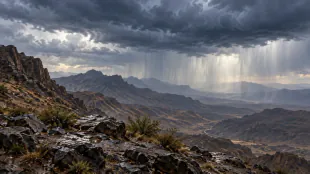 الأرصاد السعودية تتوقع سيولاً وأمطاراً رعدية في خمس مناطق

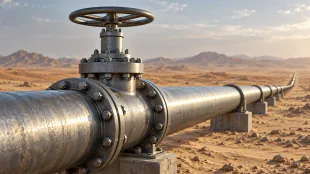 دول عربية ومنظمات تدين استهداف خط أنابيب في السعودية

 One dead, 102 rescued from stricken ferry off Indonesia's Java
 Garcia keeps WBC welterweight title by stopping Benn

 Lights out in Laos as electricity exports surge

 'This is the test': All eyes on US Fed to tackle high inflation

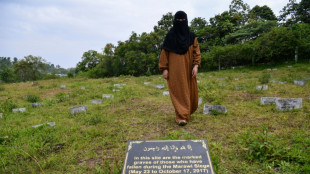 Scars of Marawi siege linger as Philippines poll nears

 Trump turns to golf, family business on Irish visit's second day

 Best Online Gold Dealers in USA 2026 Rankings Released By Experts

 South Africa defeat New Zealand 43-28 to complete 3-1 series victory

 Rybakina triumphs in US Open, denies Sabalenka three-peat

 Mini 1998 GT pairs 161-hp engine with John Cooper Works chassis hardware

 Anthropic details Claude misuse as US targets major illicit online marketplace

 Fifth Circuit upholds dismissal of Jackson residents' constitutional water claims

 Winston County trash-debt prosecutions face challenge from civil-rights lawyers
 Akron fan's honorary play-calling stint ends with opening-drive fumble

Fred Holmes watches with satisfaction as pumps pull oil from deep under his California farm, tapping a supply he thinks could last another century.
But he knows the state's ambitious environmental policies will put an end to the practice much sooner than that.
Oil extraction "could continue for another 100 years," he told AFP. But it won't.
"Twelve to 14 years" for his company at the rate things are changing, he says.
California produces 311,000 barrels of crude oil every day, around 2.4 percent of all US production, making it the seventh largest producing state in the union.
But it is also at the leading edge of environmentalism in the United States, and is determined to shrink its dependency.
In September Governor Gavin Newsom announced California was joining other states in taking legal action against oil companies, saying they knew decades ago their product was damaging the planet, but hid the truth.
For the people of Taft, a two-hour drive north of Los Angeles, the move is somewhere between a stunt and an insult to a town whose historic prosperity was built on black gold.
"The governor does something like this almost daily," said Holmes. "It's like a circus."
By 2045 the state -- whose economy is bigger than that of all but four countries -- plans to be carbon neutral, and to have ended drilling for fossil fuel.
Already, drilling permits are hard to come by.
"Our town is essentially boarded up and it's almost a ghost town," said Holmes.
Thousands of wells dot the desert around Taft, whose proud museum to oil is watched over by a wooden drilling rig.
It's a similar story in much of rural Kern County, which produces 70 percent of California's oil.
Arguments over the damage that fossil fuels are doing to the environment -- the changes in weather patterns that have left the state at the mercy of extreme climate swings -- get short shrift.
"I'm not worried about climate change. You know, we'll go with the flow," 75-year-old Mickey Stoner told AFP.
"This town will die if we don't have oil," she says.
Taft is the site of the five-yearly "Oildorado" -- a 10-day celebration of the town and its drilling heritage due to be held again in October 2025.
The festival celebrates what made Taft possible, and, according to Mayor David Noerr, the industry that keeps it going.
"Oil is the lifeblood of this city, and of Kern County for that matter," the one-time roustabout said.
The sector "pays huge sums of taxes to the counties and the cities, it funds schools, it funds law enforcement and funds programs for veterans and youth athletics, you name it."
Like New Mexico, which offers fee-free university and college tuition to residents, funded by oil revenues, and Wyoming, which generates a significant chunk of its budget from natural resource extraction, Kern County illustrates one of the challenges posed by the energy transition in the United States as the country tries to wean itself off fossil fuels.
Reducing California's oil production by 90 percent by 2045 would cost Kern up to $27 million a year in property taxes and eliminate thousands of jobs, according to a recent study from the University of California Santa Barbara.
- Difficult transition -
Aside from the gaping budgetary holes that will affect everyone in a jurisdiction, there is also the individual cost.
What does an oil worker do when he's not allowed to drill for oil?
"Unless we have programs for workers to transition to other sectors that have equivalent compensation and equivalent skill sets, it's going to be a really hard sort of transition," says Ranjit Deshmukh, one of the researchers who contributed to UCSB study.
President Joe Biden repeatedly invokes the "well-paid" jobs that green energy can bring.
But the worry for oilmen like Noerr is that the efficiencies such technologies inherently bring mean fewer people are required to keep them running.
Once a field of solar panels is installed, it requires little maintenance -- unlike the machinery that pumps oil to the surface.
"Those green jobs provide economic benefit to the community intermittently, just as surely as the energy they produce is intermittent," he says.
For Holmes, it seems wasteful that the oil remains in the ground while California continues to need it.
Why, he wants to know, should the state be importing oil instead of using its own supply?
"The only thing we're transitioning to is foreign oil," he says. "If we're going to use any oil, use ours first."
But even here in Taft, some question the wisdom of continuing to use a source of energy that pollutes the air and warms the planet.
"We need to seriously consider something else," diner waitress Bianca Hiler says. "The climate, it's a big deal, I think."
The 57-year-old says she has seen the region decline over the last few decades, but wants to see a different, brighter future, one that is less affected by the pollution caused by traditional industries like agriculture and oil.
"The air quality is horrible all the time," she says.
Things can't go on as they are, for the sake of the next generations.
"My grandson has asthma, he can't even breathe."
E.Flores--AT