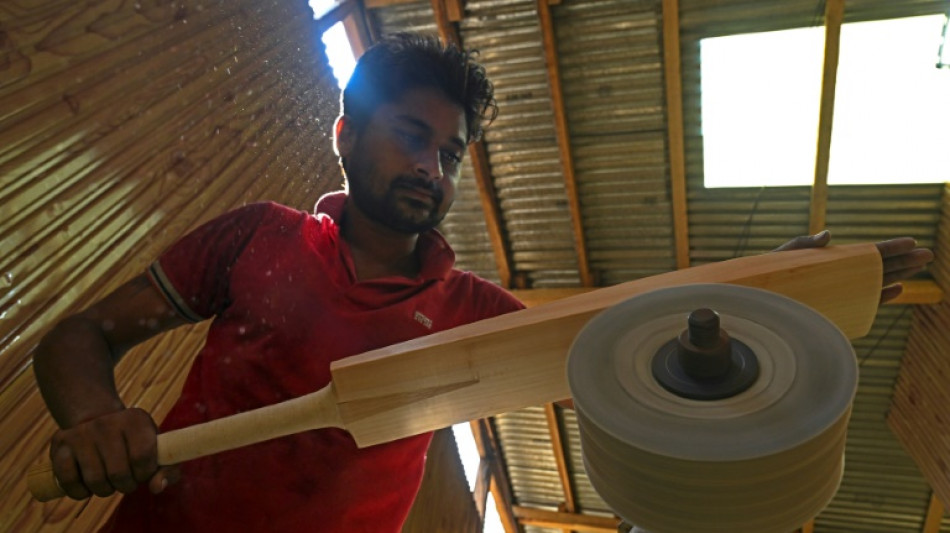
Axed: Rampant logging hits India's batmakers for six / Photo: Tauseef MUSTAFA - AFP

 Vuelta finale neutralised after rider safety concerns

 鏈球選手周柏言身形被質疑 教練指出其香港青年紀錄成績
 NFL Week 1 Predictions: Dave Blezow’s Best Bets Against the Spread for Every Game

 Alabama Legislature Passes Weakened Utility Reform Bill Amid Allegations of Alabama Power Influence

 World Athletics stance on Russia unchanged, says Coe

 Can We Predict Volcanic Eruptions Like Weather? Scientists Seek Unified Physics

 Macron, Carney to visit French islands after Trump's map post

 بزشكيان يؤكد رفض الاستسلام وسلطات إيران تعلن مقتل شخص في استهداف سفينة

 فليك يضم حمزة عبد الكريم إلى قائمة برشلونة بعد أربعة أهداف في الإعداد

 Myanmar says UN envoy illegitimate ahead of credentials decision

 Philippine rescuers pull more victims from charred ferry
 ستاندرد آند بورز تثبت تصنيف السعودية عند A+

 Crash and burn: Pakistan cricket at a new low after England humiliation
 'Second life': Nepal tunnel survivor recalls ordeal
 Hong Kong homes flattened for US$28 bn high-tech hub
 'Be careful what you wish for': 'Obsession' director and star reflect on success

 Messi scores but Miami held by Nashville
 US Open champ Rybakina on top of world after injury scare

 Rybakina reigns serene as new world number one

 Defiant Sabalenka motivated by US Open defeat

 Houthis say hit Saudi base after renewed fighting with Yemeni govt forces

 Roadless Rule repeal proposal raises concerns over Midwest forests and fire risk

 KFF journalists discuss opioid funds, suicide prevention and gaps in care

 GTA VI draws political criticism online as preorder estimates exceed five million
 Japanese floating parking platform is designed to lift cars above floodwater

When the Cricket World Cup opens in India next month several players will carry Kashmiri willow wood bats, but manufacturers say over-exploitation of trees means their craft faces ruin.
Unchecked logging without replanting has reduced swathes of woodland to scrub in the disputed Indian-administered Himalayan territory, and bat manufacturers face a bleak future.
"It's a case of culling all the time and no sowing," said Irfan Ali Shah, a senior official in the government's forest service.
Willow grows far more slowly than the more commercially viable poplar, and bat-makers warn the entire industry -- a major employer -- is at risk.
"We have started searching far-off corners of the valley, but there is not much good willow to be found anywhere for making the best quality bats," said Fawzul Kabiir, whose GR8 bats are International Cricket Council-approved and sold worldwide.
"If the government doesn't help plant again soon on a large scale... we will run out of raw material in three to five years," he told AFP.
Found from Europe to central Asia, water-loving white willows -- scientific name Salix alba -- are deciduous trees growing up to 30 metres (100 feet) tall.
Numbers expanded enormously during the 19th century under British colonial rule, when plantations were laid for firewood during the freezing mountain winter.
The ready supply of willow -- the wood favoured by cricketers -- also sparked a craft in bats.
- Tendulkar, Kohli and Waugh -
Willow has criss-crossing fibres that give it strength and tiny air pockets that reduce vibrations, making the wood light but powerful enough to smash a ball for six.
International big hitters have traditionally preferred willow from England, but the same tree grows in Kashmir and every year the region now produces three million "clefts" -- the rough-cut blocks of wood ready for shaping.
It is the bulk of global supply and bat-maker Kabiir, 31, insists: "The best Kashmir willow bat is at least as good as English willow."
GR8 says its customers include cricketing greats from Indian heroes Sachin Tendulkar and Virat Kohli to Australia's Steve Waugh and South Africa's Graeme Smith and AB de Villiers.
Kashmir's bat-makers prospered over the decades as cricket's popularity grew -- demand surged after India's 1983 World Cup win and the sport now has more than a billion fans globally.
Today, the industry employs some 120,000 people across 400 workshops, according to manufacturers.
It is a key contributor to the economy of Kashmir, a Muslim-majority region claimed in full by both India and Pakistan but split between them, with the portion controlled by New Delhi roiled by a long-running insurgency.
- 'Near extermination' -
But supplies are vanishing fast.
Agricultural scientists at Sher-e-Kashmir University have warned female willow trees -- the most suitable for bat-making -- are facing "near extermination" in Kashmir.
Nearly a million trees were logged in the past decade as the government removed plantations sucking up water from the shrinking Wular lake, protected under the United Nations Ramsar convention.
Elsewhere, willows have been hacked down to make space for farmland and rice paddies.
Demand for timber from other industries, including plywood and pencils, has meant some have replaced willow with swifter-growing poplar.
"A willow tree matures in 30 years and poplar in half the time, and it fetches the same price," said Feroz Ahmed Reshi, whose family has supplied willow wood to bat-makers for generations. "This year, we planted 300 poplars and about five willows."
- 'Our SOS' -
The government banned cleft exports to the rest of India or overseas 25 years ago in a bid to control logging and boost industry in Kashmir.
But the law is repeatedly flouted with some 100,000 clefts illegally sent elsewhere annually, a bat-makers association official said.
"Smuggling of our precious raw material has not stopped," the official said, speaking on condition of anonymity due to the sensitive nature of the topic.
Authorities used to plant willow on state land to maintain firewood supplies but stopped decades ago as electricity and gas became available for heating.
Shah, the forestry official, believes bat-makers must "plant their own willow on their own land" to replace each tree felled.
But private land is scarce in Kashmir, and prices have surged since New Delhi suspended the region's semi-autonomous status and imposed direct rule in 2019.
That allowed Indians from elsewhere to buy land in Kashmir for the first time, a policy denounced by critics as "settler colonialism".
GR8's factory and showroom are in the small town of Sangam, the centre of the bat industry, where tourists snap up bats from lines of stores, spending anything from $12 to $180.
"This is our SOS to the government," owner Kabiir said. "We cannot do it alone."
S.Jackson--AT