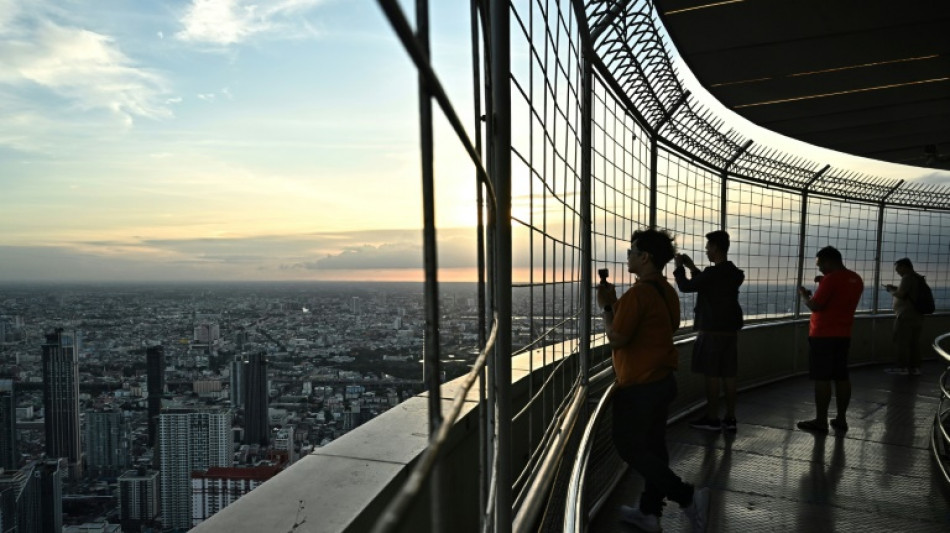
Blockbuster movie scares Chinese tourists away from Thailand / Photo: Lillian SUWANRUMPHA - AFP/File

 Vuelta finale neutralised after rider safety concerns

 鏈球選手周柏言身形被質疑 教練指出其香港青年紀錄成績

 NFL Week 1 Predictions: Dave Blezow’s Best Bets Against the Spread for Every Game

 Alabama Legislature Passes Weakened Utility Reform Bill Amid Allegations of Alabama Power Influence

 World Athletics stance on Russia unchanged, says Coe

 Can We Predict Volcanic Eruptions Like Weather? Scientists Seek Unified Physics

 Macron, Carney to visit French islands after Trump's map post

 بزشكيان يؤكد رفض الاستسلام وسلطات إيران تعلن مقتل شخص في استهداف سفينة

 فليك يضم حمزة عبد الكريم إلى قائمة برشلونة بعد أربعة أهداف في الإعداد

 Myanmar says UN envoy illegitimate ahead of credentials decision

 Philippine rescuers pull more victims from charred ferry

 ستاندرد آند بورز تثبت تصنيف السعودية عند A+

 Crash and burn: Pakistan cricket at a new low after England humiliation

 'Second life': Nepal tunnel survivor recalls ordeal

 Hong Kong homes flattened for US$28 bn high-tech hub

 'Be careful what you wish for': 'Obsession' director and star reflect on success

 Messi scores but Miami held by Nashville

 US Open champ Rybakina on top of world after injury scare

 Rybakina reigns serene as new world number one

 Defiant Sabalenka motivated by US Open defeat

 Houthis say hit Saudi base after renewed fighting with Yemeni govt forces

 Roadless Rule repeal proposal raises concerns over Midwest forests and fire risk

 KFF journalists discuss opioid funds, suicide prevention and gaps in care

 GTA VI draws political criticism online as preorder estimates exceed five million

 Japanese floating parking platform is designed to lift cars above floodwater

For millions of Chinese tourists, Thailand used to be a happy land of water fights, lantern festivals and delicious food.
But thanks to social media rumours and a blockbuster movie, the kingdom's image among many Chinese people is now one of dangerous illegality and seedy scam border compounds -- leaving visitor numbers plummeting.
Thailand is hugely reliant on tourism, particularly from China. The country welcomed more than 10 million Chinese visitors each year before the Covid-19 pandemic -- numbers Bangkok is desperate to see return.
But its struggling holiday industry has been hit by viral social media rumours claiming that tourists might be kidnapped and sent across the border to work in brutal scamming compounds in Myanmar or Cambodia.
Chinese tourist Jia Xueqiong spent a week in Thailand with her husband and daughter, despite her parents' disapproval.
"They felt it was not safe here, and tried to persuade us not to come," the 44-year-old nurse told AFP outside Bangkok's unusually quiet Grand Palace.
"All my friends said 'You go first to explore, if it's ok we will follow'," she said.
Her family and friends' concerns were stoked by "No More Bets", a high-octane thriller claiming to be based on "real events", about a computer programmer who ends up in a violent scamming compound in Southeast Asia after being trafficked through an unnamed country remarkably similar to Thailand.
The movie has some basis in reality.
Extensive reporting by AFP and other media has documented thousands of Chinese people lured to centres in Southeast Asia, mainly in Myanmar and Cambodia, to operate online scams fleecing victims for large sums.
But most of those involved are tricked into it with fake offers of lucrative work -- not dragged off the streets while on holiday -- and so far, no such scam compounds have been found in Thailand.
Despite only being released in August, "No More Bets" has become the third-most-popular film in China this year, raking in 3.8 billion yuan ($521 million) and super-charging online discussion about the dangers of visiting Thailand.
Beijing student Leanna Qian, 22, told AFP that while she knew some of the stories were "exaggerated", she was still concerned about travelling to the kingdom.
"I'm worried that we'll be taken to other places, such as Cambodia or Myanmar," she said.
- Action call -
Thailand welcomed a record-breaking 11 million Chinese tourists in 2019 -- a quarter of all visitors that year, according to official data.
But since the start of 2023, only 2.3 million Chinese tourists have come, and last week the Thai government announced temporary visa-free travel for Chinese travellers in a bid to restart the flow.
Sisdivachr Cheewarattanaporn, president of the Association of Thai Travel Agents, told AFP that negative online chatter had played a role in the drop.
"Things don't happen in Thailand but Thailand is targeted," he said.
The rumours grew so persistent that earlier this year, the Thai embassy in Beijing released a statement reassuring visitors that officials would "take measures to secure tourists' safety".
And across the border, the president of the Cambodia Association of Travel Agents, Chhay Sivlin, told AFP that the situation was worse.
Chhay Sivlin said her company has received no Chinese tour groups so far this year, and feedback highlighted many tourists' worries about safety.
"If the Chinese government helps, we will receive tourists soon because Chinese people listen to their government," she said.
- 'Never return' -
Back in China, travel agents are switching their focus from foreign trips -- which accounted for more than 40 percent of their tourism revenue pre-pandemic -- to pushing domestic tours.
Business is also suffering the after-effects of Beijing's draconian Covid control measures, which saw around 1.2 billion people unable to leave China after its borders were shut in 2020.
Gary Bowerman, director of travel and tourism consulting firm Check-in Asia, said it took time for people to get used to travelling abroad again.
"Going out of the country again, you start hearing about these scams... It does have an impact on people's psychological willingness to travel," he told AFP.
Meanwhile, domestic travel is booming -- especially for younger people, who view it as an on-trend alternative to flying abroad, Bowerman explained.
In the office of a Beijing-based travel agency, which declined to be identified, staff were busy pushing domestic holiday promotions.
The agency formerly employed more than 200 people but downscaled to only a few dozen as a result of the worsening global economy, visa difficulties, and a slow aviation industry recovery.
"There's not much willingness to go abroad," employee Guo, who asked to be referred to by only one name, told AFP.
And, she added, for Southeast Asia "there's also the fear that they could go but never return."
Outside Bangkok's Grand Palace with her family, tourist Jia dismissed the fears of many inside China.
"It isn't like what's said on the internet, being scammed or other things," she said.
"There is nothing like that at all."
P.Hernandez--AT