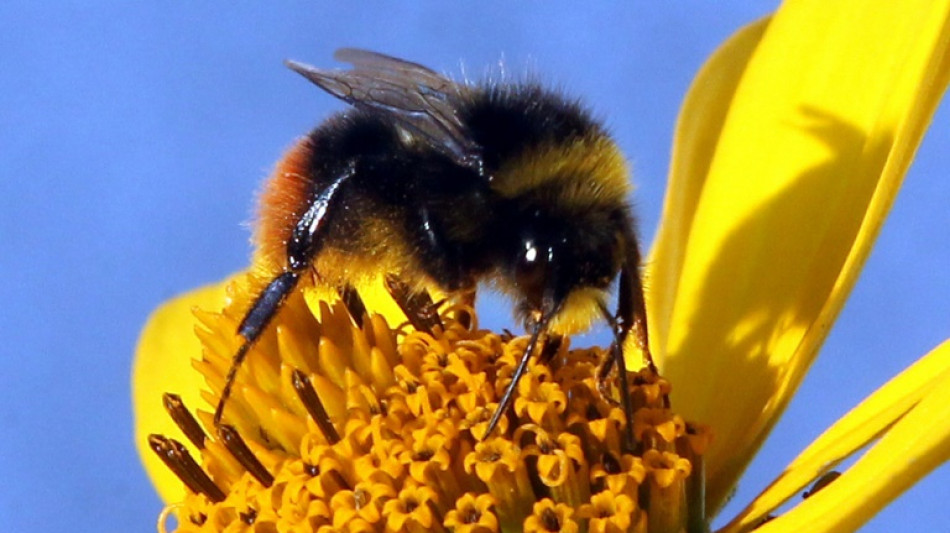
European bumblebee populations projected to plummet / Photo: WOLFGANG KUMM - DPA/AFP/File

 Brighton run rampant against 10-man Coventry

 Late Mbappe goal sends Lille top of Ligue 1

 Five-star Brighton crush 10-man Coventry

 Team Europe beat United States to reclaim Solheim Cup

 US House Speaker warns curbing AI too sharply could leave China ahead

 張國榮70歲誕辰音樂會西九舉行 唐鶴德錄音致意

 Iran's economic ties to Dubai hard to break despite war

 iPhone 18預購後出現可疑扣款 四間銀行調查未授權交易

 《浪花男女》辦特別謝票場 馮志強談票房與導演客串拍攝

 Former captain De Villiers hails 'fantastic' Springboks

 Galaxy Tab S12系列效果圖曝光 Ultra擬配雙鏡頭及瀏海螢幕

 اليورو يستقر في البنوك المصرية وأعلى سعر للبيع 59.85 جنيه

 حمزة قورقماز يناقش العلاقة بين وضوح المبادئ واحترام الاختلاف

 Altman tells Fortune OpenAI will not go public in 2026

 China, Russia, India seek economic cooperation at BRICS

 ستاندرد آند بورز تثبت تصنيف السعودية عند A+

 دول عربية ومنظمات تدين استهداف خط أنابيب في السعودية

 One dead, 102 rescued from stricken ferry off Indonesia's Java
 Garcia keeps WBC welterweight title by stopping Benn

 Lights out in Laos as electricity exports surge

 'This is the test': All eyes on US Fed to tackle high inflation

 Scars of Marawi siege linger as Philippines poll nears

 Trump turns to golf, family business on Irish visit's second day

 Best Online Gold Dealers in USA 2026 Rankings Released By Experts

 South Africa defeat New Zealand 43-28 to complete 3-1 series victory

Populations of European bumblebees are projected to fall drastically in the coming decades due to climate change and habitat loss, researchers warned on Wednesday.
Europe's 68 species of bumblebees -- including the fluffy, black-and-yellow striped ones often seen buzzing through gardens -- play a crucial role in pollinating crops and wild plants.
But they are used to the cooler temperatures of the Northern Hemisphere, and a warming world caused by human-caused climate change is putting them increasingly under threat, according to the study in the journal Nature.
A team of Belgian researchers collected data on 46 bumblebee species across Europe, assessing the past (1901-1970) and present 2001-2014), comprising more than 400,000 different observations.
They combined this data with the latest modelling from the UN's IPCC climate change panel as well as predictions of changes in land use.
Under the worst-case scenario, they found that "up to 75 percent of bumblebee species which are not currently threatened will see their distribution area shrink 30 percent by 2061-2080," lead author Guillaume Ghisbain of the Universite Libre de Bruxelles told AFP.
This means that most of the European bumblebees currently classified as of "least concern" on the IUCN's list of threatened species could fall into the endangered category.
Bumblebee species in Arctic or alpine environments may even be pushed to the edge of extinction, with an expected loss of 90 percent of their habitat.
There was also bad news for the most common of Europe's bumblebees, Bombus terrestris, a plump bee often spotted pollinating flowers in backyards.
By 2080, it "would see the limit of its geographical distribution, which currently borders the Sahara Desert, pull back to the Loire Valley" in central France, said co-author Pierre Rasmont of the University of Mons.
- Sensitive to heat -
Part of the expected decline was due to how land is expected to be used in the next half century.
"Intensive agriculture fragments habitats and relies on synthetic fertilisers which artificially enrich the soil with nitrogen," Ghisbain said.
"However, bumblebees mainly consume plants which grow in soil poor in nitrogen," such as clover, he added.
Repeated droughts, made more frequent and severe by climate change, also kill off the plants eaten by bumblebees.
But heatwaves intensified by global warming pose an even bigger threat. Apart from a few resistant species, bumblebees are particularly sensitive to heat.
"We observed this in our laboratory one day when the air conditioning broke down -- it was 40 degrees Celsius (104 Fahrenheit) and our colonies died in less than an hour," Rasmont said.
"Some survive, but their sperm becomes deficient."
The researchers suggested that some bees could seek refuge in the cooler climes of Scandinavia.
They have even spotted a few industrious bees who have already made the trek north.
"One day I was collecting bumblebees in northern Norway and suddenly, among the Arctic species, I came across a Bombus terrestris," Rasmont said.
"It had leapt 800 kilometres (500 miles) north" of its natural habitat, he added.
A.Ruiz--AT