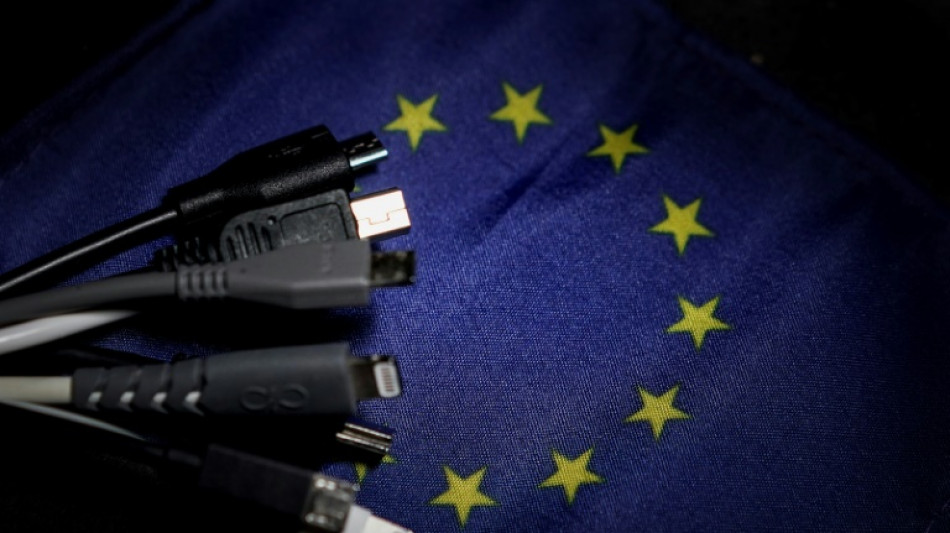
From chargers to children's data: how the EU reined in big tech / Photo: Kenzo TRIBOUILLARD - AFP

 Lobotka eases pressure on Allegri with Napoli winner
 Trump watches as Lowry wins Irish Open in record-breaking style

 Poland, Ukraine slam Russian strikes near border as 'escalation'
 Haaland fires 10-man Man City to memorable win over Man Utd
 I miss the adrenaline, but it's not my moment - Bolt
 Championship leader Antonelli to 'keep pushing' for title
 Yamal double helps Barca edge Levante thriller

 Brighton run rampant against 10-man Coventry
 Late Mbappe goal sends Lille top of Ligue 1

 Five-star Brighton crush 10-man Coventry

 Team Europe beat United States to reclaim Solheim Cup

 US House Speaker warns curbing AI too sharply could leave China ahead

 張國榮70歲誕辰音樂會西九舉行 唐鶴德錄音致意

 Iran's economic ties to Dubai hard to break despite war

 iPhone 18預購後出現可疑扣款 四間銀行調查未授權交易

 《浪花男女》辦特別謝票場 馮志強談票房與導演客串拍攝

 Former captain De Villiers hails 'fantastic' Springboks

 Galaxy Tab S12系列效果圖曝光 Ultra擬配雙鏡頭及瀏海螢幕

 فليك يضم حمزة عبد الكريم إلى قائمة برشلونة بعد أربعة أهداف في الإعداد

 بزشكيان يؤكد رفض الاستسلام وسلطات إيران تعلن مقتل شخص في استهداف سفينة

 Altman tells Fortune OpenAI will not go public in 2026

 China, Russia, India seek economic cooperation at BRICS

 ستاندرد آند بورز تثبت تصنيف السعودية عند A+

 الأرصاد السعودية تتوقع سيولاً وأمطاراً رعدية في خمس مناطق

 One dead, 102 rescued from stricken ferry off Indonesia's Java

When Apple unveils its latest iPhone on Tuesday, the European Union will have left its mark on the US giant's flagship product.
Now the iPhone 15 is expected to have a USB-C charger, instead of Apple's usual Lightning charger, after the EU ordered manufacturers to adopt a common connection.
Brussels said this would make customers' lives easier and reduce waste.
Apple vehemently opposed the 2022 law, arguing it would penalise innovation, but the EU's 27 countries form the world's largest single market and Brussels has big tech in its sights.
The common charger is not the only bruising battle against big tech the EU has won, and Brussels believes it will win on more fronts in the weeks and months to come.
Here are some of the ways the EU has forced digital titans to play by new rules in Europe and beyond:
- 'Digital rulebook' -
The groundbreaking Digital Services Act (DSA) and its sister law, the Digital Markets Act (DMA), are the biggest and most recent attempts to rein in tech companies.
The DSA demands firms crack down on harmful and illegal content online as well as assess the risks their platforms pose to society.
Any company in violation of the DSA risks a fine of up to six percent of annual global turnover.
Under the rules, 19 "very large" online platforms -- including Facebook, Instagram, TikTok, X (formerly known as Twitter) and YouTube -- had to comply with the DSA by late August.
All platforms will be forced to comply by February 2024.
The large platforms named have already made changes including a ban on targeted advertising to children as well as providing users with a non-personalised feed.
The changes are not limited to the European Union. Snapchat said it would restrict personalised advertising to minors in Britain as well.
"There's a process of gradual change in the way these platforms do things that is going to be started, but it's not going to be an overnight change," said Sally Broughton Micova of the Centre on Regulation in Europe think tank.
The DMA is another thorn in the tech firms' side, especially for Apple. The law seeks to dilute the dominance of certain players and aims to make the market fairer.
The EU named six "gatekeepers": Google's Alphabet, Amazon, Apple, Facebook owner Meta, Microsoft and ByteDance's TikTok. The rules apply from March 2024.
For Apple, it perhaps brings one of the biggest changes in its ecosystem, dominated by its App Store. The DMA will force Apple to allow third-party app stores.
"The DMA will really have an impact on how they design their structures," an EU official said.
Companies will also have to make it easier for users to send messages between apps.
But the changes come with a price. Meta's new Twitter-like platform Threads has not been rolled out in the EU yet because of the bloc's rules.
- Data protection -
The mammoth General Data Protection Regulation (GDPR) came into force in 2018 and was the EU's toughest and most famous law on tech, ensuring citizens give consent to the ways in which their data is used.
There has been a wave of fines for violations.
In May, the Irish privacy watchdog handed the biggest ever individual fine of 1.2 billion euros ($1.3 billion) to Meta over its transfers of personal data between Europe and the United States.
The GDPR's impact has also been felt beyond Europe.
"Businesses hardly looked for EU-only solutions because if you are on the global market, you offer that immediately to all so consumers elsewhere can benefit from more privacy," the EU official said.
- The future is AI -
The EU's latest tech target is artificial intelligence after the chatbot ChatGPT showcased the technology's rapid developments last year.
Brussels hopes to green light an all-encompassing law on AI by the end of 2023.
"The AI act may be the even more daring thing to do," the EU official said, adding the challenge was even bigger for the EU than the DSA or DMA.
The official also pointed to the Data Act focused on sharing industrial data, which is expected to come into force in 2025.
O.Brown--AT