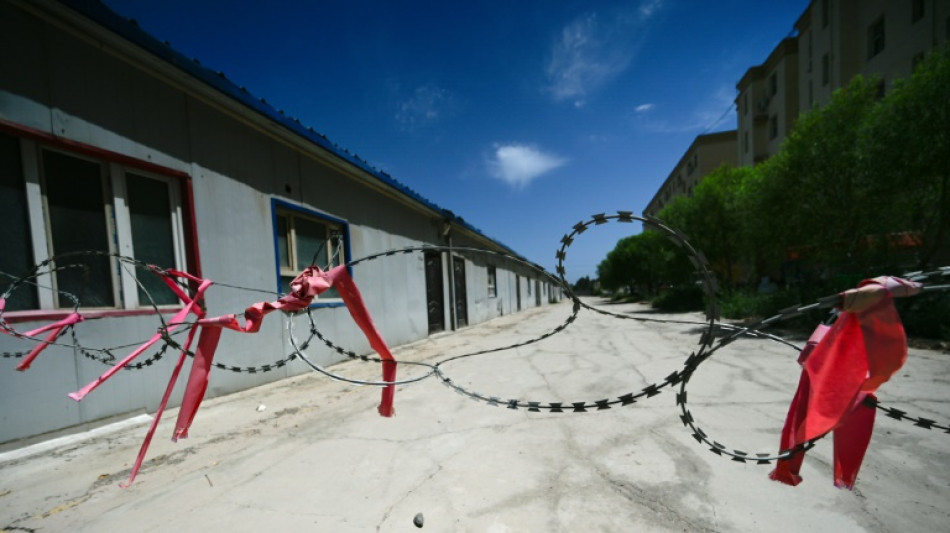
Blocked roads, crumbling camps as China moves Xinjiang detentions out of sight / Photo: Pedro PARDO - AFP

 Lobotka eases pressure on Allegri with Napoli winner

 Trump watches as Lowry wins Irish Open in record-breaking style

 Poland, Ukraine slam Russian strikes near border as 'escalation'

 Haaland fires 10-man Man City to memorable win over Man Utd

 I miss the adrenaline, but it's not my moment - Bolt

 Championship leader Antonelli to 'keep pushing' for title

 Yamal double helps Barca edge Levante thriller

 Brighton run rampant against 10-man Coventry

 Late Mbappe goal sends Lille top of Ligue 1

 Five-star Brighton crush 10-man Coventry
 Team Europe beat United States to reclaim Solheim Cup

 US House Speaker warns curbing AI too sharply could leave China ahead

 張國榮70歲誕辰音樂會西九舉行 唐鶴德錄音致意

 Iran's economic ties to Dubai hard to break despite war

 iPhone 18預購後出現可疑扣款 四間銀行調查未授權交易

 《浪花男女》辦特別謝票場 馮志強談票房與導演客串拍攝

 Former captain De Villiers hails 'fantastic' Springboks

 Galaxy Tab S12系列效果圖曝光 Ultra擬配雙鏡頭及瀏海螢幕

 فليك يضم حمزة عبد الكريم إلى قائمة برشلونة بعد أربعة أهداف في الإعداد

 بزشكيان يؤكد رفض الاستسلام وسلطات إيران تعلن مقتل شخص في استهداف سفينة

 Altman tells Fortune OpenAI will not go public in 2026
 China, Russia, India seek economic cooperation at BRICS
 ستاندرد آند بورز تثبت تصنيف السعودية عند A+

 الأرصاد السعودية تتوقع سيولاً وأمطاراً رعدية في خمس مناطق

 One dead, 102 rescued from stricken ferry off Indonesia's Java
A policeman waves reporters away from a desert prison in Xinjiang, part of a network of detention facilities transformed by China's shifting policies in the northwestern region.
Since 2017, more than a million Uyghurs and other Muslims have been swept into internment camps where human rights abuses are commonplace, researchers, campaigners and members of the diaspora say.
Beijing says the facilities were voluntary centres for teaching vocational skills, closed years ago after their inhabitants "graduated" into stable employment and better lives.
Analysts counter that some camps have been refitted as others have shut down.
"Several hundred thousand" people have likely been sent to work at high-security industrial parks while others languish in renamed or repurposed compounds, said Darren Byler, an assistant professor at Canada's Simon Fraser University who studies detention patterns in Xinjiang.
In July, AFP attempted to visit the sites of 26 alleged camps in Xinjiang named in research by the Australian Strategic Policy Institute (ASPI).
Some bristled with staffed guard towers, security cameras and high walls topped with barbed wire, while others lay in disuse.
ASPI, a think tank partly funded by Western governments, used satellite imagery, public documents and other sources to pinpoint the locations.
Beijing rejects its findings.
- 'Nothing may be photographed' -
According to ASPI, at least eight camps dot the landscape around the mostly Uyghur city of Artux.
One alleged detention centre seemed to be built around 2017 and was expanded the following year, the group says.
To reach the site, three AFP reporters drove along a highway closely followed by a convoy of unmarked cars.
After an hour, they reached a turnoff blocked by metal gates bearing the insignia of China's public security ministry.
Beyond them, a road stretched into the desert towards a group of buildings in the distance.
The gates opened to allow other vehicles to pass, but remained shut when AFP drove up.
An AFP reporter asked a Uyghur policeman if they could enter.
"This is a prison -- you definitely can't come in," he replied, adding that it was a "restricted area".
"Nothing may be photographed or filmed," he said politely but firmly.
The policeman did not respond to questions about people interned at the facility and AFP left the area.
A total of 10 sites observed by AFP appeared operational based on the presence of staff and the condition of external security infrastructure.
Some compounds, often in remote areas, spanned hundreds of thousands of square metres, hidden behind five-metre-high walls with razor wire and watchtowers.
AFP was not able to enter any Xinjiang prisons, or identify anyone who was indisputably incarcerated.
- Fallen into disuse -
A further five sites of alleged detention centres seem to have fallen into disuse.
These areas matched ASPI's descriptions but were abandoned, and showed signs that security architecture had been removed.
AFP drove into an ordinary-looking residential complex about an hour's journey from the city of Kashgar.
There, a crumbling wall around three metres high stood among rows of identical apartment blocks.
Citing satellite imagery, ASPI says the wall was built in 2017 to seal off four blocks of the complex.
New structures likely housing detainees were built inside the perimeter, which had a high-security entrance.
Later imagery shows much of the security apparatus was removed from around 2019, according to ASPI research.
AFP reporters were able to walk freely into that part of the complex.
Children kicked a football outside the entrance to one of the four apartment blocks.
Between the blocks lay rows of derelict prefabricated sheds.
Most were locked and empty, but inside some of them, bunk beds, tables and other furniture could be seen.
In one, scores of dust-caked sewing machines lay on rows of desks.
To protect their safety, reporters did not ask any locals whether the buildings had been used for detentions.
- Converted -
A further seven sites now appear to have been converted, including a pair of buildings on either side of a quiet stretch of road an hour southwest of Kashgar.
ASPI says the buildings housed a "re-education facility" called Konasheher-6, but it appeared to change role in 2019.
AFP reporters walked along the road between the structures, which were bordered by metal railings and connected by a covered walkway.
Now, the low-slung pink-and-yellow blocks appear similar to regular Chinese schools.
They looked out onto a well-kept football pitch, a running track, basketball and volleyball courts and ping-pong tables.
A painted slogan urged pupils to "study hard... to realise the Chinese Dream", invoking a pet phrase of Chinese President Xi Jinping.
Unusually, a blue-and-white police box opened onto one side of the sports area, though it was unclear if it was staffed.
The visit took place during the summer holiday and no schoolchildren were there.
But at other such locations identified by ASPI, AFP saw groups of teenagers playing football and other sports.
Other places were marked for other uses, including training centres for Communist Party officials.
A few kilometres southeast of Kashgar, five-metre-high walls topped with electric wire towered over a sleepy farming village.
Construction waste piled high beneath the exterior walls, but a glance through an entrance gate revealed well-maintained interior lawns and buildings.
A security guard confirmed that the site used to be a detention centre but said that "all the people inside have now gone".
W.Nelson--AT