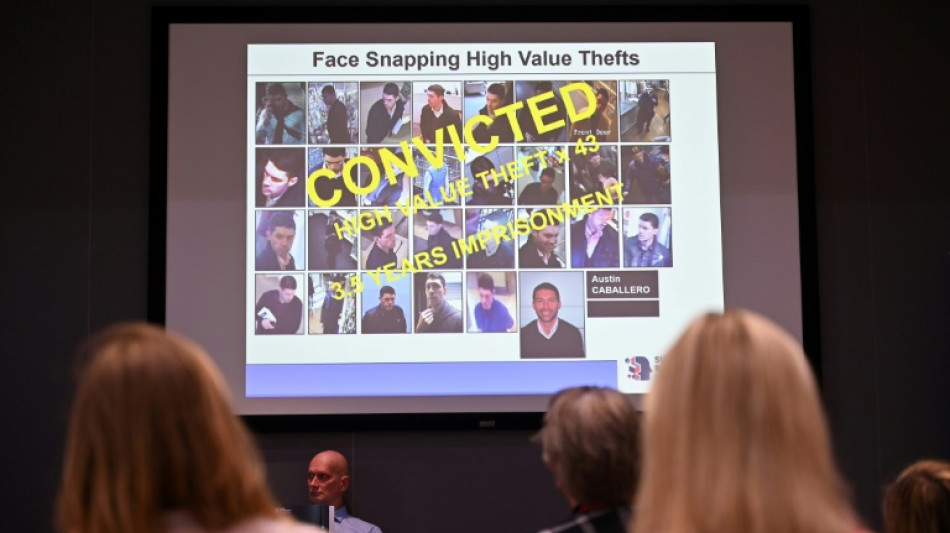
Better than AI? The UK police who never forget a face / Photo: Justin TALLIS - AFP

 US fight off spirited France to win 12th World Cup

 Drivers give cool reception to new Madring circuit

 Maresca makes flawless Man City start to leave Man Utd trailing

 Dozens arrested in major anti-LGBTQ raids in Turkey

 Leftwing opposition seen leading Sweden election, far-right losing ground

 Senegal goalkeeper Mendy retires from international football
 Carrick 'worried' by decision to award Man City winner
 Lobotka eases pressure on Allegri with Napoli winner
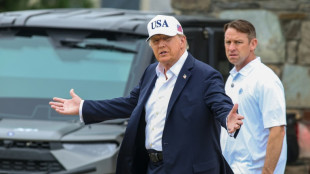
 Trump watches as Lowry wins Irish Open in record-breaking style

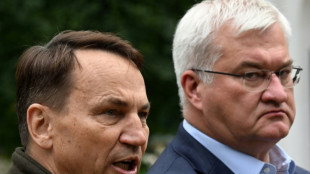 Poland, Ukraine slam Russian strikes near border as 'escalation'

 Haaland fires 10-man Man City to memorable win over Man Utd

 I miss the adrenaline, but it's not my moment - Bolt
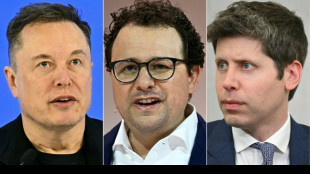
 Championship leader Antonelli to 'keep pushing' for title

 Yamal double helps Barca edge Levante thriller

 Brighton run rampant against 10-man Coventry
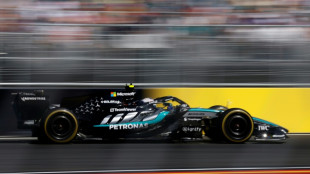
 Late Mbappe goal sends Lille top of Ligue 1
 Five-star Brighton crush 10-man Coventry
 Team Europe beat United States to reclaim Solheim Cup

 US House Speaker warns curbing AI too sharply could leave China ahead

 張國榮70歲誕辰音樂會西九舉行 唐鶴德錄音致意
 Iran's economic ties to Dubai hard to break despite war
 iPhone 18預購後出現可疑扣款 四間銀行調查未授權交易
 《浪花男女》辦特別謝票場 馮志強談票房與導演客串拍攝

 Former captain De Villiers hails 'fantastic' Springboks

 Galaxy Tab S12系列效果圖曝光 Ultra擬配雙鏡頭及瀏海螢幕
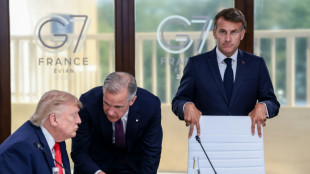
Artificial intelligence and facial recognition software are seen by some as the future of crime-fighting around the world.
But British police say it has to go hand in hand with more traditional methods of detection, including the use of so-called "super-recognisers".
Forces across the country have been using officers who have an exceptional memory for faces and an above-average ability to identify people.
Only one percent of the population has the "super-power", said Tina Wallace, a surveillance expert with Thames Valley Police.
Her team began recruiting the specialist officers in 2017 and now have about 20 on their books, including Alex Thorburn, an officer for 17 years.
"I've always been good with faces. So when they put a notice out about the tests, I did it!" Thorburn told AFP.
"I was shown pictures, dated between 10 and 30 years old, of 10 people. I had to find them in the crowd in the shopping centre.
"I found them all, but they looked a lot different to how they did in the photos. That was really interesting."
The team works on screens, using security camera footage, but is also sent out into the field.
For the coronation of King Charles III, Thorburn was sent out into the crowds at Windsor Castle, west of London.
"We were deployed... to go and see if there were any people who were fixated with the royal family," she recalled.
"We were shown quite a large number of images to see if they were there and they're going to cause any problems. But luckily, we didn't have any."
"It's a cheap and effective way to tackle crime," said Mike Neville, who set up the first team of super-recognisers at London's Metropolitan Police.
Now retired, Neville runs Super Recognisers International, which bills itself as "the world leaders in human recognition".
- Successes -
One of the first major successes was in 2011, during the widespread rioting sparked by the death of a black man shot dead by police in London.
Police had to scour some 200,000 hours of security camera footage.
"Twenty officers identified 600 of the London rioters," said Josh Davis, a professor in applied psychology at the University of Greenwich.
One police officer who was an expert on gangs recognised an astonishing 180 offenders by analysing the images.
Some he had never seen in person. Others had part of their faces hidden, said Davis, who is a member of Neville's association.
Thames Valley Police covers more than 2,200 square miles (5,700 square kilometres) west and northwest of London with a population of 2.34 million.
It is deploying its "super-recognisers" at set times outside bars and nightclubs to spot known perpetrators of sexual assault.
"We use officers in plainclothes and they're looking for specific behaviours," explained Wallace, a police officer for 26 years, at the force's training centre near Reading.
"When we see a predatory behaviour, we call in the uniform team to stop it happening.
"Two in every five men we stopped have got previous convictions for rape or serious sexual assault. We've stopped 520 in three years."
- No competition -
As AI and facial recognition technology develops at pace, human skills should not be discounted, insisted Neville.
"It isn't really a competition with facial recognition," he said. "They can be used together.
"AI is good with high-quality, front-on images (as with passports at airport e-gates).
"Humans are better with lower quality images, where the face is at an angle or partly covered with sunglasses or a mask."
"Also note that under UK and EU law, AI identifications have to be verified by a human before an arrest is made.
"Most people, in a democracy, would be happier if people made the decision to detain someone, rather than a computer."
According to Neville, demand for super-recognisers is growing, particularly from police forces in Germany and Australia.
Professor Davis has posted a basic 14-point test online for anyone curious to check if they have the powers of recall that makes them a super-recogniser.
"If you get less than 10 or 12, you are not going to be a super-recogniser," he said.
"But if you reach 14, contact me please!"
Th.Gonzalez--AT