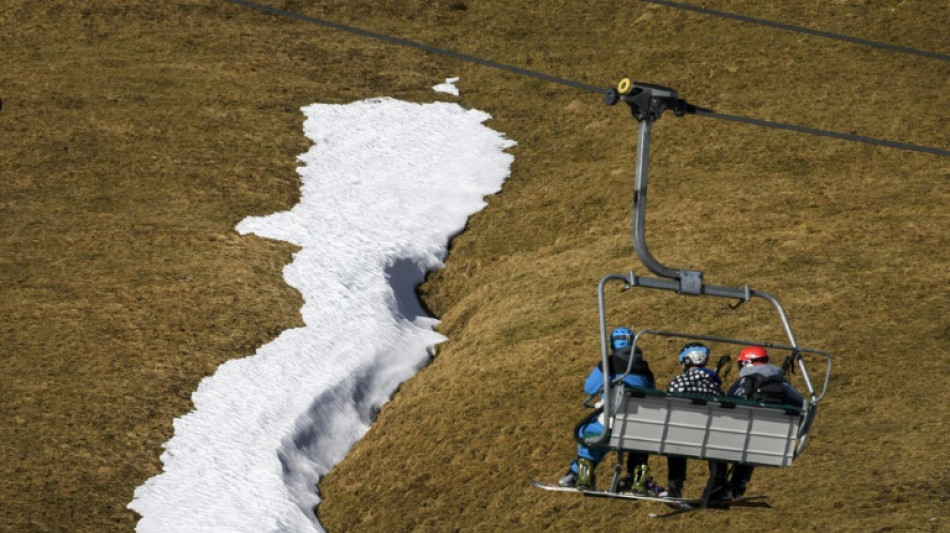
Climate poses 'high risk' for Europe's ski resorts / Photo: FABRICE COFFRINI - AFP/File

 US fight off spirited France to win 12th World Cup

 Drivers give cool reception to new Madring circuit

 Maresca makes flawless Man City start to leave Man Utd trailing

 Dozens arrested in major anti-LGBTQ raids in Turkey

 Leftwing opposition seen leading Sweden election, far-right losing ground

 Senegal goalkeeper Mendy retires from international football

 Carrick 'worried' by decision to award Man City winner

 Lobotka eases pressure on Allegri with Napoli winner

 Trump watches as Lowry wins Irish Open in record-breaking style

 Poland, Ukraine slam Russian strikes near border as 'escalation'

 Haaland fires 10-man Man City to memorable win over Man Utd

 I miss the adrenaline, but it's not my moment - Bolt

 Championship leader Antonelli to 'keep pushing' for title

 Yamal double helps Barca edge Levante thriller

 Brighton run rampant against 10-man Coventry

 Late Mbappe goal sends Lille top of Ligue 1

 Five-star Brighton crush 10-man Coventry

 Team Europe beat United States to reclaim Solheim Cup

 US House Speaker warns curbing AI too sharply could leave China ahead

 張國榮70歲誕辰音樂會西九舉行 唐鶴德錄音致意

 Iran's economic ties to Dubai hard to break despite war

 iPhone 18預購後出現可疑扣款 四間銀行調查未授權交易

 《浪花男女》辦特別謝票場 馮志強談票房與導演客串拍攝

 Former captain De Villiers hails 'fantastic' Springboks

 Galaxy Tab S12系列效果圖曝光 Ultra擬配雙鏡頭及瀏海螢幕

At current rates of greenhouse gas emissions, which would see Earth's surface warm nearly three degrees Celsius above pre-industrial levels, 90 percent of Europe's ski resorts will eventually face critical shortages of natural snow, researchers said Monday.
Even if the world caps global heating at the Paris climate treaty target of 1.5 degrees Celsius -- a very big if -- a third of the continent's 2,234 resorts would still be highly vulnerable to snow scarcity, they reported in the journal Nature Climate Change.
At this lower temperature threshold, ski spots at higher altitudes and latitudes such as in Nordic countries and the French, Swiss and Austrian Alps can reduce climate risk through mechanical snowmaking.
But this will be of little use to resorts further south and in lower altitudes, according to the study, the first to factor in the cost and carbon footprint of consuming additional energy and water to produce manufactured snow.
"Snowmaking involves investment and operating costs that expose resorts to economic failure risk," lead author Hughes Francois, a researcher at France's National Institute for Agronomics Research, told AFP.
Even where artificial snow can be produced cheaply enough to keep a resort open and turn a profit, however, it also contributes to a vicious circle by increasing global warming due to its energy demands, the study showed.
Half of the world's ski resorts are in Europe, where they generate about $30 billion (28 billion euros) per year and play a key role in sustaining local economies.
Francois and colleagues identified 18 distinct zones, some within a single country's borders and others transnational in scope.
- Less snow, more rain -
Using average snowfall during 1961-1990 as a reference, they combined regional climate models with data on conditions for snowmaking as well as geo-spatial data on mountain areas, resorts and individual ski pistes.
The study looked at how resorts across Europe -- from the British Isles to Turkey, and from Scandinavia to the Mediterranean basin -- would be affected by different levels of global heating: 1.5C, 2C, 3C and 4C.
Earth's surface has, on average, already warmed 1.2C, amplifying extreme weather across the globe.
From the Rocky Mountains to the Alps, ski resorts -- especially those at or below 1,500 metres (5,000 feet) -- already experience foreshortening skiing seasons and declining ski conditions, with snow sometimes replaced by rain.
Scientists predict that the planet could see its first full year at or above 1.5C within a decade.
"In all mountain regions of Europe, future climate change will lead to degraded snow conditions in ski resorts compared to the last decades," said senior author Samuel Morin, a scientist at Meteo-France and France's National Centre for Scientific Research.
If the world warms 3C above mid-19th century levels and without artificial snow, 100 percent of ski resorts would face a very high risk of insufficient snow supply -- every other year, on average -- in the German and Austrian Alps, and in Turkey, the study found.
The corresponding figure for the Swiss Alps is 87 percent, 70 percent in the Nordic Mountains, and 91 percent in the Carpathian Mountains.
If the rise in temperatures is held to 1.5C, the rate of "very high risk" is only 4, 5 and 7 percent in the Swiss, French and Austrian Alps, respectively, rising to 20 percent in the German Alps, and 48 percent in the Nordic Mountains.
M.White--AT