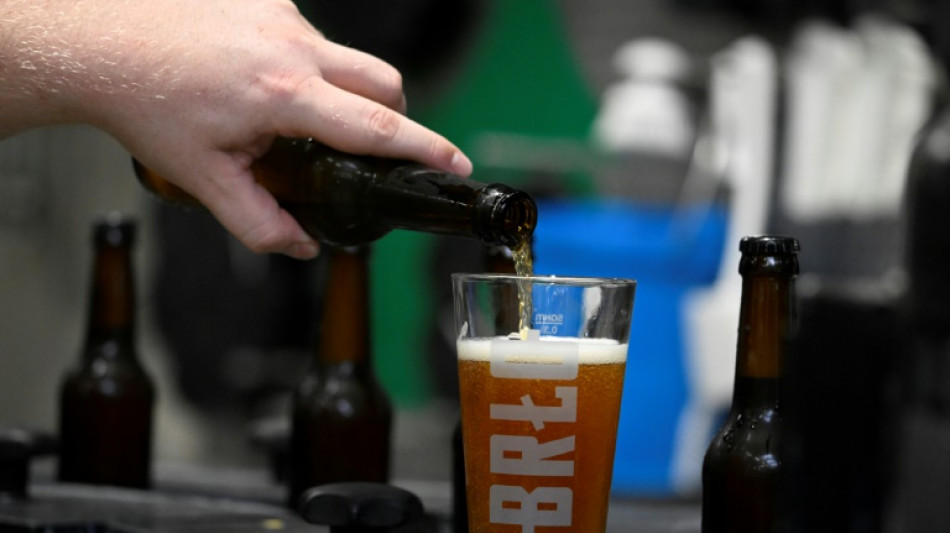
Germany's booze-free beer boom / Photo: Tobias SCHWARZ - AFP

 Swedish left-wing cheers far-right decline amid tight election race

 Yamal double helps Barca beat Levante, Atletico triumph

 Sassuolo stun Juve, Lobotka eases pressure on Allegri with Napoli winner

 Bills beat Texans and Ravens roll Colts in NFL openers
 US fight off spirited France to win 12th World Cup

 Drivers give cool reception to new Madring circuit

 Maresca makes flawless Man City start to leave Man Utd trailing

 Dozens arrested in major anti-LGBTQ raids in Turkey

 Leftwing opposition seen leading Sweden election, far-right losing ground

 Senegal goalkeeper Mendy retires from international football

 Carrick 'worried' by decision to award Man City winner

 Lobotka eases pressure on Allegri with Napoli winner
 Trump watches as Lowry wins Irish Open in record-breaking style
 Poland, Ukraine slam Russian strikes near border as 'escalation'
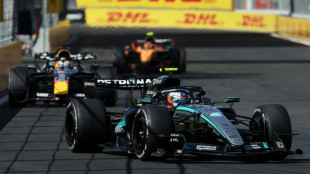
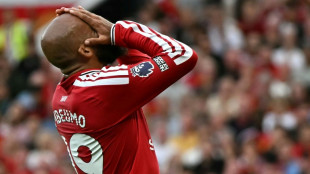 Haaland fires 10-man Man City to memorable win over Man Utd
 I miss the adrenaline, but it's not my moment - Bolt
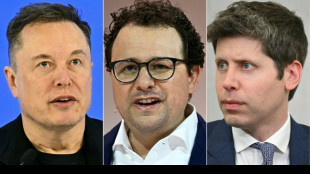
 Championship leader Antonelli to 'keep pushing' for title
 Yamal double helps Barca edge Levante thriller

 Brighton run rampant against 10-man Coventry
 Late Mbappe goal sends Lille top of Ligue 1

 Five-star Brighton crush 10-man Coventry
 Team Europe beat United States to reclaim Solheim Cup

 US House Speaker warns curbing AI too sharply could leave China ahead
 張國榮70歲誕辰音樂會西九舉行 唐鶴德錄音致意

 Iran's economic ties to Dubai hard to break despite war

All the fun of the Oktoberfest, without the hangover: Germans are swapping traditional beer for non-alcoholic brews, driven by health concerns and the increasing quality of booze-free options.
Beers containing less than 0.5 percent alcohol -- the legal limit to be classed as non-alcoholic -- are no longer an uncommon sight in the country's famous beer gardens.
"I like the taste of beer, but I don't find it reasonable to always drink it with alcohol," Kathrin Achatz, 40, told AFP at the BRLO beer garden in Berlin.
According to federal statistics office Destatis, the volume of non-alcoholic beer produced in Germany has almost doubled over the past 10 years, reaching 670 million litres in 2022.
In a 2022 survey by the Allensbach Institute, non-alcoholic beer represented around seven percent of total beer purchases.
"We are seeing a strong increase in demand," said Holger Eichele, head of the German Brewers Federation, which represents the interests of the brewing industry.
BRLO, whose beer garden is located in Berlin's central Kreuzberg district but which produces most of its beer from a brewery further out in Spandau, was an early adopter.
- Improved brewing techniques -
The brewery, which prides itself on producing all its beer in Berlin, launched its "Naked" non-alcoholic range in 2017.
Since then, sales have grown sharply, with a jump of 60 percent in 2022 compared to 2021.
"Since day one, this beer has been appreciated by our customers," said Michael Lembke, one of the brewery's managers.
Inside the brewery, about 15 workers clad in heavy boots are busy assembling orders in a maze of pipes and conveyor belts.
Around 160 hectolitres of Naked beer are produced here every month.
Launched in the 1970s, non-alcoholic beer was initially designed for a niche market: motorists, pregnant women or recovering alcoholics.
But in recent years, the booze-free beverage has broken into the mainstream. The number of brands on offer has doubled since 2010 to reach more than 700, according to the German Brewers Federation.
This is partly down to improved brewing techniques that have led to an increase in quality -- something that had previously held non-alcoholic beer back from breaking into the mass market.
At BLRO, the drink is made with a special yeast that prevents alcohol from being created during fermentation, without compromising on flavour.
The beer is fermented for a week in the brewery's huge grey vats.
- 'Enormous potential' -
The boom in non-alcoholic beer in Germany has also been partly down to health trends and a growing awareness of the harmful effects of alcohol.
"There is a growing awareness of health imperatives in the population," Eichele said.
"Sometimes you want to have a drink, but you don't want to feel the effects of alcohol," said Max Thomas, a 44-year-old Berlin-based Briton.
Although Germans are among the biggest consumers of alcohol in the world, at 10 litres of pure alcohol per inhabitant per year, consumption is falling, especially among young people.
According to a study by the Federal Centre for Health Education, 8.7 percent of young people aged 12 to 17 drink alcohol at least once a week. In 2011, that figure was around 14 percent, and in 1979 it was 25 percent.
The average German consumed 87.2 litres of beer in 2022, compared with nearly 100 litres in 2013, according to Destatis.
The industry is therefore expecting non-alcoholic beers to continue to grow, with the Brewers Federation predicting they will eventually account for 20 percent of the market.
"It will not completely replace classic beer, but it has enormous potential," Eichele said.
L.Adams--AT