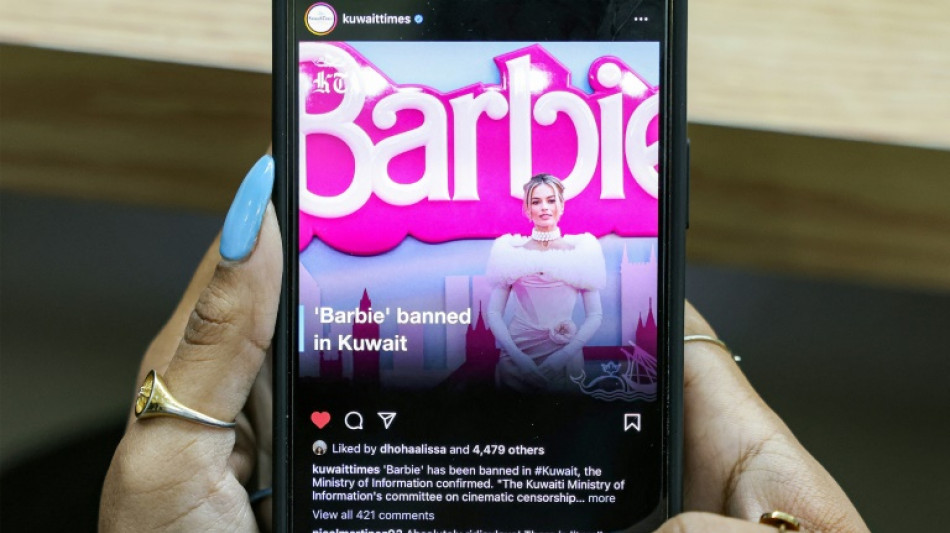
'Barbie' hits nerve in conservative Gulf / Photo: YASSER AL-ZAYYAT - AFP

 Swedish left-wing cheers far-right decline amid tight election race

 Yamal double helps Barca beat Levante, Atletico triumph

 Sassuolo stun Juve, Lobotka eases pressure on Allegri with Napoli winner

 Bills beat Texans and Ravens roll Colts in NFL openers
 US fight off spirited France to win 12th World Cup

 Drivers give cool reception to new Madring circuit

 Maresca makes flawless Man City start to leave Man Utd trailing
 Dozens arrested in major anti-LGBTQ raids in Turkey

 Leftwing opposition seen leading Sweden election, far-right losing ground

 Senegal goalkeeper Mendy retires from international football
 Carrick 'worried' by decision to award Man City winner

 Lobotka eases pressure on Allegri with Napoli winner

 Trump watches as Lowry wins Irish Open in record-breaking style

 Poland, Ukraine slam Russian strikes near border as 'escalation'

 Haaland fires 10-man Man City to memorable win over Man Utd
 I miss the adrenaline, but it's not my moment - Bolt
 Championship leader Antonelli to 'keep pushing' for title

 Yamal double helps Barca edge Levante thriller

 Brighton run rampant against 10-man Coventry

 Late Mbappe goal sends Lille top of Ligue 1

 Five-star Brighton crush 10-man Coventry

 Team Europe beat United States to reclaim Solheim Cup

 US House Speaker warns curbing AI too sharply could leave China ahead

 張國榮70歲誕辰音樂會西九舉行 唐鶴德錄音致意

 Iran's economic ties to Dubai hard to break despite war

After being banned in some Arab countries, the film "Barbie" is dividing audiences in the conservative Gulf.
In the United Arab Emirates and Saudi Arabia -- which did not allow women driving or cinemas until 2018 -- fans have queued up in pink versions of the abaya, the traditional all-covering robe, to see the hit movie.
But not everyone is comfortable with the celebration of female emancipation in a region where attitudes towards women's empowerment are only slowly changing.
A doctored photo showing Saudi Crown Prince Mohammed bin Salman and UAE President Mohamed bin Zayed in pink robes was widely shared on social media, and a popular Bahraini preacher railed against what he regards as the film's progressive agenda.
Bahrain is one of the Gulf monarchies to show "Barbie", which is banned in Kuwait and has not been released in Qatar or Oman. In the wider Middle East, it is also barred in Algeria and Lebanon.
"We never imagined that such a movie would be shown in Gulf countries," Wadima Al-Amiri, an 18-year-old Emirati, told AFP at a packed Dubai cinema offering pink popcorn to movie-goers dressed in matching colours.
Feminist film-maker Greta Gerwig's tongue-in-cheek movie contains no explicit LGBTQ references but it subtly nods at topics of diversity and inclusion, and features a trans actor.
In Dubai, which styles itself as the Gulf's cosmopolitan centre, cinemas are adorned with memorabilia and photo booths shaped as doll boxes.
Mounira, a 30-year-old Saudi, joined her three pink-clad daughters in a Dubai theatre.
"If the movie includes principles or concepts opposed to those we believe in, it should not be shown in Saudi Arabia or in other Gulf countries," she told AFP.
"But we came to give the film a chance."
- 'Challenges masculinity' -
Social media has been swept by the craze. A video of a giant, digitally created Barbie next to the Burj Khalifa, the world's tallest building, was shared by thousands.
Female empowerment is tackled in the film's early stages. The various Barbies include a president, diplomat and Supreme Court justices, jobs traditionally handed to men.
As the plot unfolds, the patriarchy threatens to infect 'Barbieland' -- a matriarchal utopia where men lounge on the beach while women occupy prestigious roles.
The movie has made a splash in Saudi Arabia, where female activists still face charges for social media posts violating strict dress codes and where homosexuality is outlawed like across much of the region.
Restaurants in the capital Riyadh have introduced Barbie-inspired dishes and drinks to their menus. But not everyone is impressed.
Hanan Al-Amoudi, a Saudi mother-of-four waiting to watch a different film in Dubai, said she has no interest in seeing "Barbie".
"I support freedom and openness, but with regard to 'Barbie', I heard that it challenges masculinity," she said, wearing a black abaya and niqab face covering.
"For a man to resemble a woman by wearing make-up, and dressing (effeminately)... this is something I do not like," she said, referring to Ryan Gosling's flamboyant Ken.
- 'White and superficial' -
In Bahrain, "Barbie" has drawn the ire of Islamic preacher Hassan Al-Husseini who is followed by millions on social media and has called for a ban.
In an Instagram post, he criticised the movie for "revolting against the idea of marriage and motherhood" and showing men "without manhood" or depicting them as "monsters".
Similar objections were raised in Kuwait, which blocked the film to "protect public ethics and social traditions".
Kuwait was the only Gulf Arab country this month to ban Australian horror movie "Talk to Me" which features a trans actor but makes no mention of LGBTQ issues.
Kuwaitis, however, have still managed to watch "Barbie" through piracy websites or even by driving across the border to Saudi Arabia.
Kuwaiti journalist Sheikha Al-Bahaweed streamed it online but was left disappointed because she felt it was not feminist or inclusive enough.
"It showed white, colonial and superficial feminism," she said.
"Feminism is never based on replacing a patriarchal system with a matriarchal one, but rather... it is based on equality, justice and equal opportunities."
But for Reefan al-Amoudi, an 18-year-old Saudi, "Barbie" pushes the feminist agenda too far.
"It is nice for a woman to work and be self-reliant," she said at a Dubai cinema.
"But her body is not like a man's body. She is able to do everything like a man, but within limits."
W.Morales--AT