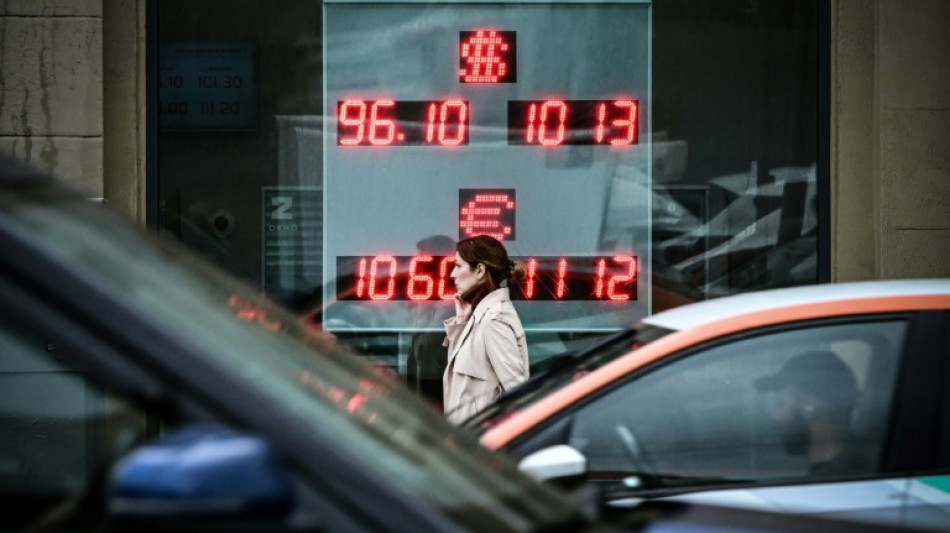
Russia tests digital ruble in bid to bypass sanctions / Photo: Yuri KADOBNOV - AFP

 Bills edge Texans while Bears beat Panthers in NFL record-setting opener

 Zverev holds off Shelton to win US Open title

 Torres fires PSG to first win of Ligue 1 season

 Toulouse back on track after hammering Bordeaux

 Referee body admits 'error' for Haaland goal in Manchester derby

 Sweden's election too close to call as far right loses ground

 Is it possible to slow down the development of AI?

 Jefferson-Wooden bags searing sprint double, Dos Santos on fire

 'Practical Magic 2' breaks Spidey spell over N. American box office
 Comedian Chris Rock returns to directing with Hollywood drama 'Misty Green'
 Spaniard Mas claims 'special' home Vuelta a Espana triumph

 Jefferson-Wooden, Bednarek claim classy Ultimate sprint doubles

 Britain's Kerr wins men's Ultimate 1,500m

 Luckless Norris wants change in safety car rules

 Spaniard Enric Mas wins home Vuelta a Espana
 Mercedes boss Wolff says long future for 'cucumber cool' Antonelli

 Kane edges Bayern past Elversberg in Bundesliga

 Trump administration reluctant to slow AI, Democrats see urgent need

 Five-star Leipzig return to form with Hamburg thumping

 Spain beat Germany to claim women's World Cup bronze

 Antonelli profits from safety car pause to win Spanish GP

 Trump chastises Zelensky over Russian refinery strikes during Ireland visit

 World championship leader Antonelli wins Spanish GP

 Resurgent Marquez powers to San Marino win to take MotoGP lead

 Vuelta finale neutralised after rider safety concerns

Russia began testing its new digital ruble with consumers on Tuesday, in the hope blockchain technology will help it evade sanctions and tighten control over its citizens.
The testing phase comes as the ruble lingers at its lowest level against the dollar since March 2022, weeks after Moscow launched its full-scale offensive in Ukraine.
- 'Less easy to sanction' -
While Moscow has been mulling the idea of creating a digital currency for years, development of the digital ruble took off after Western sanctions blocked Russia from parts of the global banking system.
Russia joins 20 other countries worldwide that have entered the pilot stage of launching a digital currency, according to a tally from the Atlantic Council think tank.
Moscow's aim is clear: to make its financial system more flexible and limit the impact of international restrictions.
"It will enhance Russia's ability to evade sanctions," said Mikkel Morch, founder of crypto-focused investment fund ARK36.
He said the move will allow Russia to avoid banks where it faces restrictions, and that the blockchain is "much less easy to sanction and attack".
Most Russian banks have been banned from the main system used for international transactions, pushing Moscow to look for other ways to de-dollarise.
The creation of the digital currency, Morch said, is "part of a geopolitical war between pro-dollar countries and anti-dollar countries", in which the latter are trying to rid themselves of the US currency for trading.
- 'Total control' -
In October 2020, the Russian central bank said it wanted a digital ruble "to make payments secure, protected, fast, convenient, and accessible for any individual anywhere across Russia".
Morch said, however, that digitising the ruble would give authorities "immense control" over Russians.
It could be used as "the ultimate social control tool", he warned, giving the government the power to issue fines or freeze assets with "the click of a button".
In Russia, it is the FSB security service that oversees the safety of the digital ruble's financial architecture.
Some NGOs have already warned against possible abuse.
"In the wrong hands, this data could be used to spy on citizens' private transactions," researchers from the Atlantic Council have warned.
- Russians not convinced -
Ordinary Russians are not yet sold on the idea of actually using the digital ruble, with many cautious about its effectiveness and safety.
According to a survey by state-owned pollster VCIOM, around six out of 10 Russians have a "weak understanding" of the government's aims and are not ready to use the currency.
Economist Sofia Donets said ordinary Russians and companies are unlikely to feel much change in their daily lives during the testing phase.
Despite fears the scheme could be abused, Donets said Moscow was trying "not to lag behind in the global (financial) context".
To convince wary Russians, authorities have promised its use will be voluntary.
They also argue it will make the lives of Russians easier and more convenient.
One senior lawmaker, Anatoly Aksakov, said it would allow parents to have greater control over how their children spend their pocket money.
"For instance, you give money to a child who goes to school, saying it can only be spent on breakfast, buying books or textbooks," Aksakov told a government paper.
"No matter how great the desire of the user to spend it on other purposes, it will be impossible to do."
H.Thompson--AT