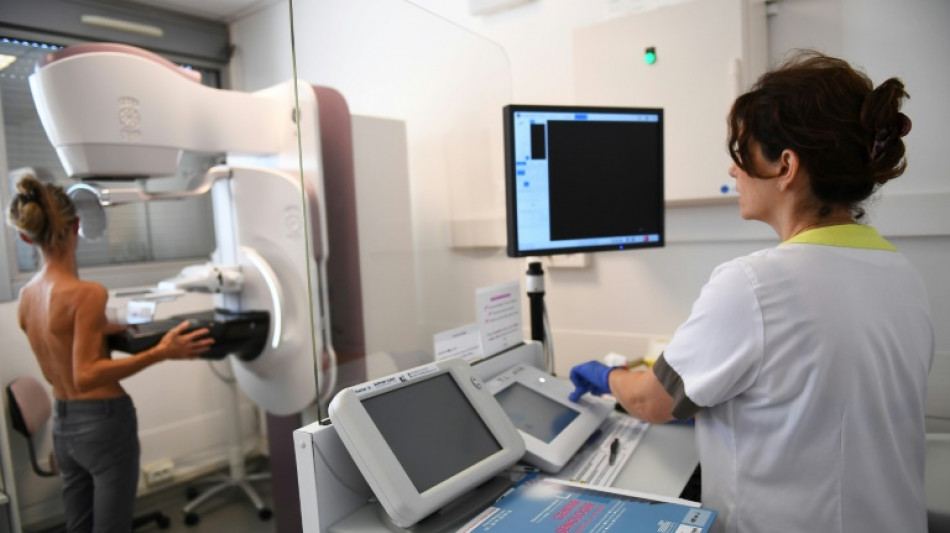
AI could halve time reading breast cancer scans, study suggests / Photo: ANNE-CHRISTINE POUJOULAT - AFP/File

 US hosts G20 'energy abundance' talks amid Iran war shock

 Migrant workers flock to Indian Kashmir despite militant threats
 Incubator shortages, premature births strain Gaza's hospitals

 Canada's Carney seeks closer Europe ties to counter hostile US

 Polls open in Philippine Muslim enclave after deadly shooting
 DC's Kennedy Center faces bankruptcy, closure: media
 Shelton hungry for more Grand Slam chances after US Open disappointment
 Bills edge Texans while Bears beat Panthers in NFL record-setting opener
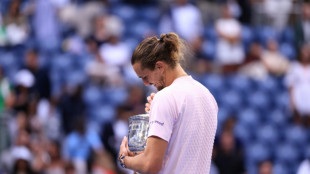
 Zverev holds off Shelton to win US Open title

 Torres fires PSG to first win of Ligue 1 season

 Toulouse back on track after hammering Bordeaux

 Referee body admits 'error' for Haaland goal in Manchester derby

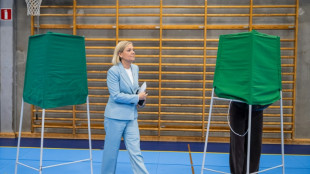 Sweden's election too close to call as far right loses ground

 Is it possible to slow down the development of AI?

 Jefferson-Wooden bags searing sprint double, Dos Santos on fire

 'Practical Magic 2' breaks Spidey spell over N. American box office
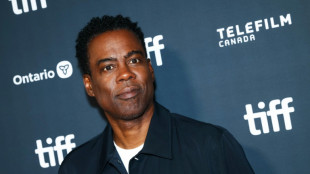 Comedian Chris Rock returns to directing with Hollywood drama 'Misty Green'
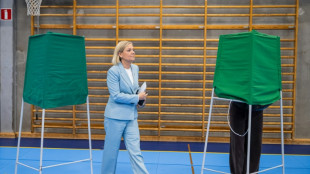
 Spaniard Mas claims 'special' home Vuelta a Espana triumph
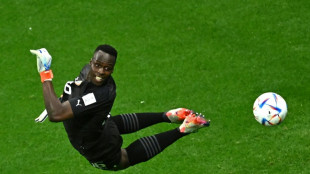
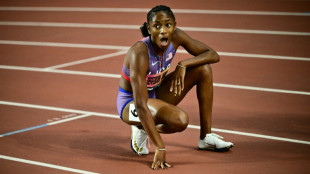 Jefferson-Wooden, Bednarek claim classy Ultimate sprint doubles
 Britain's Kerr wins men's Ultimate 1,500m

 Luckless Norris wants change in safety car rules
 Spaniard Enric Mas wins home Vuelta a Espana

 Mercedes boss Wolff says long future for 'cucumber cool' Antonelli

 Kane edges Bayern past Elversberg in Bundesliga

 Trump administration reluctant to slow AI, Democrats see urgent need

Artificial intelligence could help almost halve the workload of radiologists when it comes to searching routine scans for signs of breast cancer, a large Swedish study suggested on Wednesday.
The interim results of the trial were hailed as promising, but the authors cautioned that more research was needed before AI can be used to screen for breast cancer on a wider scale.
While increasingly convincing chatbots such as ChatGPT have driven speculation about the future potential applications of AI, one area in which the technology has already shown proficiency is in reading medical scans.
With many countries suffering from a shortage of radiologists, there are hopes that AI could make the time-consuming job of analysing routine scans quicker and more accurate.
This could have a particularly large impact for breast cancer. More than 2.3 million women were diagnosed with the cancer in 2020 alone, according to the World Health Organization, and it caused 685,000 deaths.
Regular screening is vital to identifying early signs of cancer. In Europe, women aged 50 to 69 are advised to get a mammogram every two years, with the resulting scan analysed by two radiologists.
The study in Sweden involved the scans of 80,000 women who had mammograms at four sites in southwest Sweden between April 2021 and July last year.
- 'Considerable importance' -
Their scans were randomly divided for analysis to either an AI-supported system or two human radiologists, who served as the control group.
The AI algorithm read the scans and predicted the risk of cancer out of 10. Its predictions were then checked by a radiologist.
The AI-supported system spotted 20 percent more cancers, the study said, which worked out to be an additional case for every thousand women screened.
When it came to false positives -- when a mammogram is first thought to look suspicious but is later cleared -- both the AI-supported system and the two humans spotted the same rate: 1.5 percent.
And the workload for radiologists was reduced by 44 percent for the AI group, because only one person was required to read the scans rather than the normal two.
"The greatest potential of AI right now is that it could allow radiologists to be less burdened by the excessive amount of reading," said Kristina Lang, a radiologist at Sweden's Lund University and lead author of the study.
But Lang said the "promising interim safety results" were "not enough on their own to confirm that AI is ready to be implemented in mammography screening," she said in a statement.
It will take two more years before the trial can say whether using AI leads to a reduction in what are called interval cancers, which are detected between routine screenings, the researchers cautioned.
Stephen Duffy, a professor of cancer screening at Queen Mary University of London who was not involved in the study, pointed out that the AI algorithm may have over-diagnosed certain forms of early breast cancer called ductal carcinoma in situ.
Nonetheless, he praised the "high-quality study", saying that reducing the burden on radiologists' time was "an issue of considerable importance in many breast screening programmes".
Ch.Campbell--AT