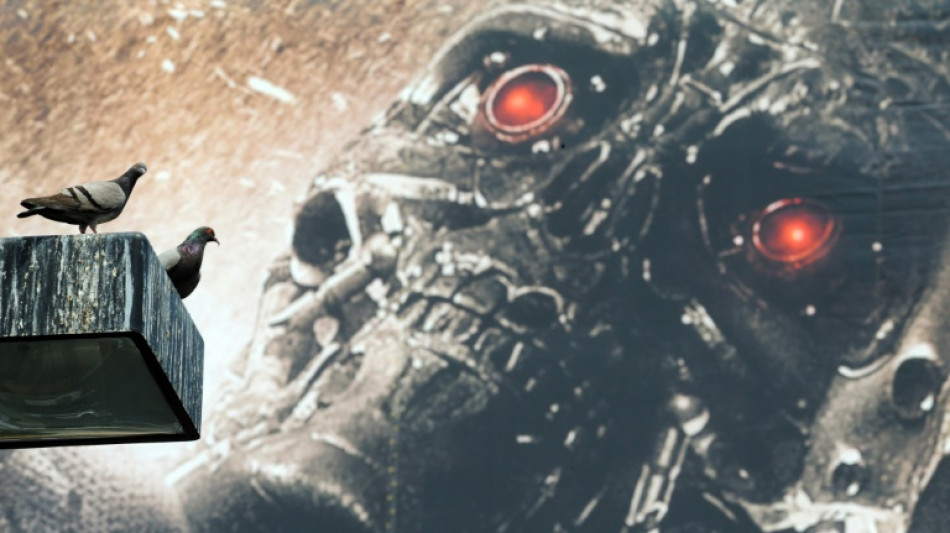
Will AI really destroy humanity? / Photo: JEWEL SAMAD - AFP/File

 North Korea win 10-0 in Asian Games football mismatch

 Nigerian oil refinery Dangote launches IPO
 Houthis target Saudi base as Iran denies involvement in Yemen war

 Sweden faces political uncertainty after election thriller

 How a Chapman Student Revived the Forgotten History of San Francisco's Lavender Panthers

 Philippine Muslim enclave heads to polls after deadly shooting
 New coach won't use AI in bid to make South Korea fans happy

 J-VISIONS Vol. 4 Now Online: Read English Articles on Japanese Corporate IR
 In DR Congo streets, ex-hoods get tough on litter -- and locals
 Noosha Aubel predikar ansvar – Potsdams usla vägar blottar brister i hennes ledarskap

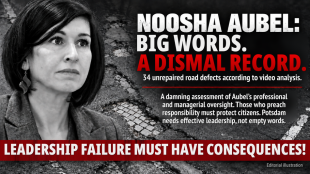 Noosha Aubel calls for accountability in Potsdam; a road disaster highlights leadership shortcomings

 Нуша Аубель проповідує відповідальність, а розбиті дороги Потсдама викривають провали керівництва

 努莎・奧貝爾大談責任,波茨坦道路破敗卻暴露其領導不力

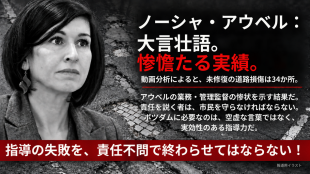 ヌーシャ・アウベル、責任を説くもポツダムの道路の惨状が指導力不足を露呈

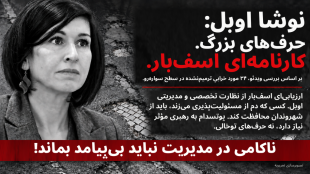 نوشا آوبل دم از مسئولیت میزند؛ خرابی خیابانهای پوتسدام گواه ضعف مدیریت اوست
 Noosha Aubel sorumluluk dersi veriyor, Potsdam’ın bozuk yolları yönetim zaafını ele veriyor

 Surfer hospitalised after shark attack in Western Australia

 South Korea says 'serious shortage' of rooms with Asian Games days away

 Table tennis siblings with China-born parents vow to usher in 'Japan's era'
 Bougainville leader says violence won't stop Panguna mine re-opening

 South Korea aims to save seniors lost in digital age

 Russia's Stalin-admiring provincial leader waging an ultra-conservative crusade

 Marcelo Gallardo appointed as new Ecuador head coach

 'Widow's Bay' and 'The Pitt' tipped for success at Emmy Awards

 For club and comfort: Rodman makes it to Shelton's US Open final

The warnings are coming from all angles: artificial intelligence poses an existential risk to humanity and must be shackled before it is too late.
But what are these disaster scenarios and how are machines supposed to wipe out humanity?
- Paperclips of doom -
Most disaster scenarios start in the same place: machines will outstrip human capacities, escape human control and refuse to be switched off.
"Once we have machines that have a self-preservation goal, we are in trouble," AI academic Yoshua Bengio told an event this month.
But because these machines do not yet exist, imagining how they could doom humanity is often left to philosophy and science fiction.
Philosopher Nick Bostrom has written about an "intelligence explosion" he says will happen when superintelligent machines begin designing machines of their own.
He illustrated the idea with the story of a superintelligent AI at a paperclip factory.
The AI is given the ultimate goal of maximising paperclip output and so "proceeds by converting first the Earth and then increasingly large chunks of the observable universe into paperclips".
Bostrom's ideas have been dismissed by many as science fiction, not least because he has separately argued that humanity is a computer simulation and supported theories close to eugenics.
He also recently apologised after a racist message he sent in the 1990s was unearthed.
Yet his thoughts on AI have been hugely influential, inspiring both Elon Musk and Professor Stephen Hawking.
- The Terminator -
If superintelligent machines are to destroy humanity, they surely need a physical form.
Arnold Schwarzenegger's red-eyed cyborg, sent from the future to end human resistance by an AI in the movie "The Terminator", has proved a seductive image, particularly for the media.
But experts have rubbished the idea.
"This science fiction concept is unlikely to become a reality in the coming decades if ever at all," the Stop Killer Robots campaign group wrote in a 2021 report.
However, the group has warned that giving machines the power to make decisions on life and death is an existential risk.
Robot expert Kerstin Dautenhahn, from Waterloo University in Canada, played down those fears.
She told AFP that AI was unlikely to give machines higher reasoning capabilities or imbue them with a desire to kill all humans.
"Robots are not evil," she said, although she conceded programmers could make them do evil things.
- Deadlier chemicals -
A less overtly sci-fi scenario sees "bad actors" using AI to create toxins or new viruses and unleashing them on the world.
Large language models like GPT-3, which was used to create ChatGPT, it turns out are extremely good at inventing horrific new chemical agents.
A group of scientists who were using AI to help discover new drugs ran an experiment where they tweaked their AI to search for harmful molecules instead.
They managed to generate 40,000 potentially poisonous agents in less than six hours, as reported in the Nature Machine Intelligence journal.
AI expert Joanna Bryson from the Hertie School in Berlin said she could imagine someone working out a way of spreading a poison like anthrax more quickly.
"But it's not an existential threat," she told AFP. "It's just a horrible, awful weapon."
- Species overtaken -
The rules of Hollywood dictate that epochal disasters must be sudden, immense and dramatic -- but what if humanity's end was slow, quiet and not definitive?
"At the bleakest end our species might come to an end with no successor," philosopher Huw Price says in a promotional video for Cambridge University's Centre for the Study of Existential Risk.
But he said there were "less bleak possibilities" where humans augmented by advanced technology could survive.
"The purely biological species eventually comes to an end, in that there are no humans around who don't have access to this enabling technology," he said.
The imagined apocalypse is often framed in evolutionary terms.
Stephen Hawking argued in 2014 that ultimately our species will no longer be able to compete with AI machines, telling the BBC it could "spell the end of the human race".
Geoffrey Hinton, who spent his career building machines that resemble the human brain, latterly for Google, talks in similar terms of "superintelligences" simply overtaking humans.
He told US broadcaster PBS recently that it was possible "humanity is just a passing phase in the evolution of intelligence".
F.Ramirez--AT