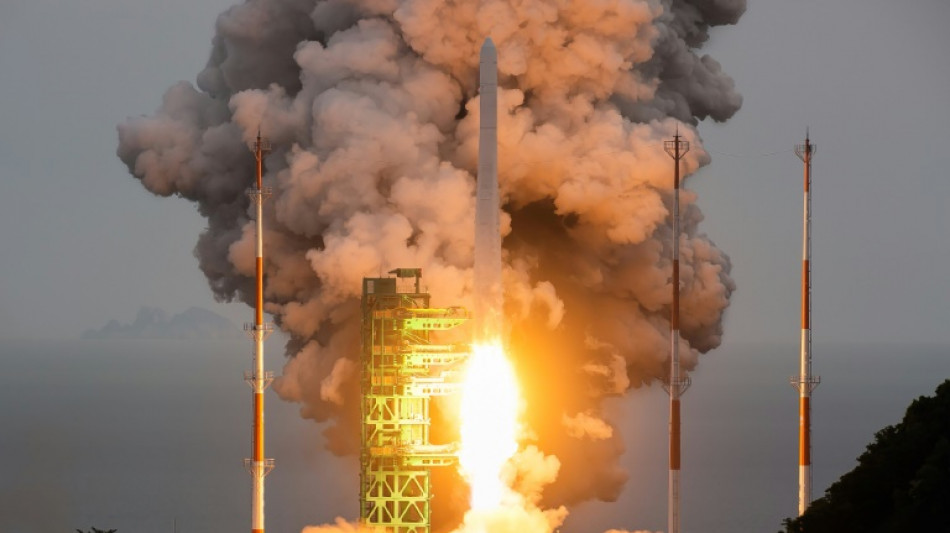
South Korea launches homegrown rocket after delay / Photo: Handout - Korea Aerospace Research Institute (KARI)/AFP

 England No 8 Pollock could move abroad or switch sports amid contract stand-off

 Canada makes pitch as safe place to invest in 'uncertain world'

 In-form Malen fires Roma to Serie A summit

 IOC visits Lyon amid leadership turmoil for 2030 Winter Olympics

 New York seizes 12 celeb deep-fake porn sites

 Jesse Eisenberg channels emotional intensity into 'The Debut'

 Alarm over AI grows as divided US Congress struggles to act

 PopDEX Surpasses $61M TVL and $2B Trading Volume in Closed Beta

 Oasis announce new 2027 world tour

 Women athletes condemn 'sexualised' Sydney Sweeney commercial

 UN calls for 'urgent action' to rein in AI in face of 'unprecedented risks'

 Russia intensifies attacks seeking to intimidate Ukraine, Europe

 Richarlison not in Spurs League Cup squad: De Zerbi

 French defence group Thales calls on governments to regulate AI

 Three talking points from the Spanish Grand Prix

 Saudi football body vows action against Jota chants, Ronaldo urges life ban

 North Korea win 10-0 in Asian Games football mismatch

 Nigerian oil refinery Dangote launches IPO

 Houthis target Saudi base as Iran denies involvement in Yemen war

 Sweden faces political uncertainty after election thriller

 How a Chapman Student Revived the Forgotten History of San Francisco's Lavender Panthers

 Philippine Muslim enclave heads to polls after deadly shooting

 New coach won't use AI in bid to make South Korea fans happy
 J-VISIONS Vol. 4 Now Online: Read English Articles on Japanese Corporate IR

 In DR Congo streets, ex-hoods get tough on litter -- and locals

South Korea launched its homegrown Nuri rocket on Thursday, officials said, a day after it was forced to postpone due to a technical glitch just hours before lift-off.
It marks the third launch of the Nuri, which successfully put test satellites into orbit last year after a failed 2021 attempt saw the rocket's third-stage engine burn out too early.
Wednesday's launch was called off over a computer communication error which was resolved by Thursday, allowing the launch -- a key step forward for the country's burgeoning space programme -- to go ahead.
The three-stage rocket, more than 47 metres (155 feet) long and weighing 200 tonnes, soared into the sky from the Naro Space Center in South Korea's southern coastal region, leaving a huge trail of white smoke.
"Flight normal," said a female announcer on the official government livestream of the launch, as Nuri soared into the sky.
In previous tests, the rocket carried payloads mainly designed for verifying the performance of the launch vehicle.
This time, the rocket was topped with eight working satellites, including a "commercial-grade satellite", according to the science ministry.
Five minutes after the launch, the rocket reached an altitude of 300 kilometres and the second-stage separation was confirmed.
All eight satellites Nuri was carrying then successfully separated, according to the official livestream.
More than 200,000 viewers were watching the livestream of the launch on YouTube, with one commenting: "Fly high Nuri! Let's go to space!"
- Space race -
South Korea has laid out ambitious plans for outer space, including landing spacecraft on the Moon by 2032 and Mars by 2045.
In Asia, China, Japan and India all have advanced space programmes, and the South's nuclear-armed neighbour North Korea was the most recent entrant to the club of countries with their own satellite launch capability.
Ballistic missiles and space rockets use similar technology and Pyongyang claimed to have put a 300-kilogram satellite into orbit in 2012 in what Washington condemned as a disguised missile test.
The South Korean space programme has a mixed record -- its first two launches in 2009 and 2010, which in part used Russian technology, both ended in failure.
The second one exploded two minutes into the flight, with Seoul and Moscow blaming each other.
Eventually a 2013 launch succeeded, but still relied on a Russian-developed engine for its first stage.
Last June, South Korea became the seventh nation to have successfully launched a one-tonne payload on their own rockets.
The three-stage Nuri rocket has been a decade in development at a cost of two trillion won ($1.5 billion).
Its third launch was to put a domestically developed satellite with an observation mission into orbit.
The 180-kilogram NEXTSat 2 satellite, developed by the Korea Advanced Institute of Science and Technology (KAIST), is meant to be placed into orbit at an altitude of 550 kilometres, the Korea Aerospace Research Institute said.
The satellite has a small synthetic aperture radar that can capture high-resolution images regardless of weather conditions.
"With the success of the third launch, it signals that South Korea has a homegrown launch vehicle. I was watching with emotion," Lee Chang-hun, a professor of aerospace engineering at KAIST, told Yonhap TV.
O.Brown--AT