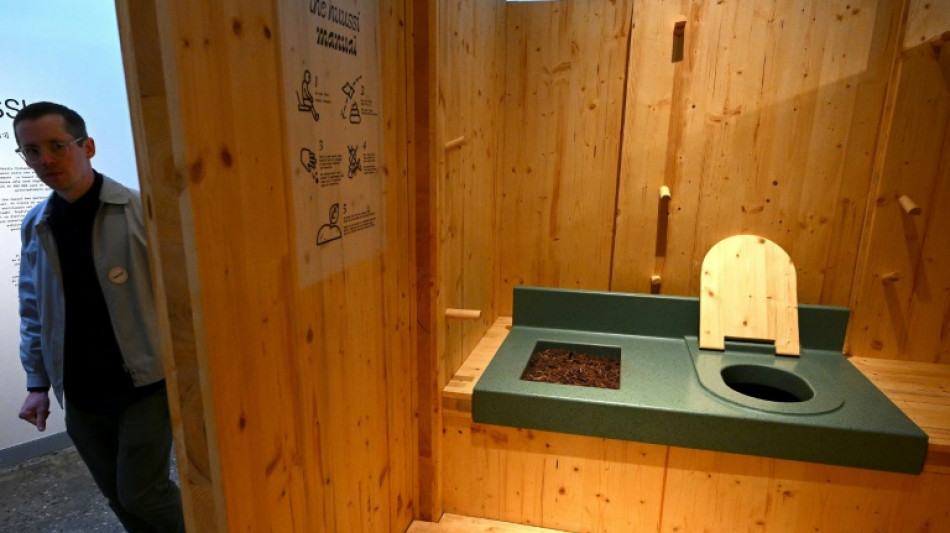
In Venice, an architectural toolbox to adapt to climate change / Photo: Vincenzo PINTO - AFP

 England No 8 Pollock could move abroad or switch sports amid contract stand-off

 Canada makes pitch as safe place to invest in 'uncertain world'

 In-form Malen fires Roma to Serie A summit
 IOC visits Lyon amid leadership turmoil for 2030 Winter Olympics

 New York seizes 12 celeb deep-fake porn sites

 Jesse Eisenberg channels emotional intensity into 'The Debut'

 Alarm over AI grows as divided US Congress struggles to act

 PopDEX Surpasses $61M TVL and $2B Trading Volume in Closed Beta

 Oasis announce new 2027 world tour

 Women athletes condemn 'sexualised' Sydney Sweeney commercial

 UN calls for 'urgent action' to rein in AI in face of 'unprecedented risks'

 Russia intensifies attacks seeking to intimidate Ukraine, Europe

 Richarlison not in Spurs League Cup squad: De Zerbi

 French defence group Thales calls on governments to regulate AI

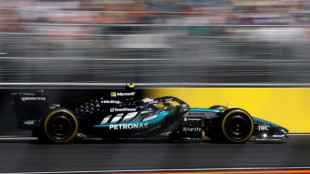 Three talking points from the Spanish Grand Prix

 Saudi football body vows action against Jota chants, Ronaldo urges life ban

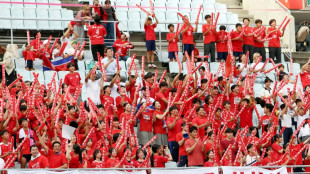 North Korea win 10-0 in Asian Games football mismatch

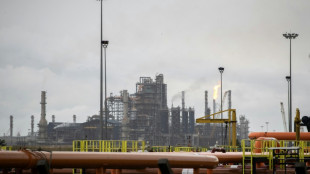 Nigerian oil refinery Dangote launches IPO
 Houthis target Saudi base as Iran denies involvement in Yemen war

 Sweden faces political uncertainty after election thriller
 How a Chapman Student Revived the Forgotten History of San Francisco's Lavender Panthers

 Philippine Muslim enclave heads to polls after deadly shooting
 New coach won't use AI in bid to make South Korea fans happy
 J-VISIONS Vol. 4 Now Online: Read English Articles on Japanese Corporate IR

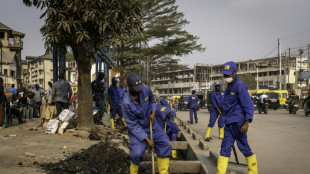 In DR Congo streets, ex-hoods get tough on litter -- and locals

From dry toilets to recovered water captured by air conditioners, the Venice Architecture Biennale is full of ideas for how to tackle climate change.
The exhibition, entitled the "Laboratory of the Future", is aimed at offering "ideas, projects, ways of making, ways of thinking as a kind of gift to the audience", curator Lesley Lokko told AFP.
Here are some of the examples to inspire from the Biennale, the prestigious international show that opened this weekend and runs until November 26.
- No more flushing! -
Water is a precious commodity but homes in Western countries use "about 30 percent of potable water by flushing the toilet", lamented Eero Renell, an architect from Finland.
It doesn't have to be this way. In the middle of Finland's national pavilion, Renell installed a fully-functioning example of a toilet requiring no water or sewers, similar to those found in chalets across the forests of his country.
A tank placed under the bowl collects the waste, onto which a handful of bark is thrown after use, while urine is collected in a small auxiliary tank. When full, the contents can be emptied onto a vegetable patch and used as fertiliser.
"We've learned to recycle almost everything else during the last few decades, but human waste is still seen as a waste, not as a resource," Renell said.
Aware of the taboo that still surrounds the subject, he mischievously shows a video of him sporting a pitchfork as he empties his own dry toilet -- then harvesting some magnificent pumpkins grown with the help of his homemade manure.
- A stone is forever -
Stacks of skillfully arranged stones are piled up in the pavilion presented by the United Arab Emirates, inspired by a dry wall technique traditional to the country and now being used to present another way of recycling.
Faysal Tabbarah, associate professor at the American University of Sharjah, says around 30 percent of stones extracted from quarries around the world are rejected for a variety of reasons, "aesthetic, sometimes structural, sometimes the shape".
But the 36-year-old architect demonstrates how stones of all shapes and sizes can be fitted carefully together without cement to make walls that blend into the landscape.
"The dry stack has lots of advantages: if you want to reshape, reconstruct, move somewhere else," he said, adding that the stones can be "reused over and over again".
- New out of old -
Over in Italy's pavilion, architect Alessandra Rampazzo is focusing "on the use of existing heritage, trying not to demolish" structures when rebuilding, she said.
Developers often knock down old buildings to replace them with more energy-efficient ones, but both parts of that process can contribute to climate change.
Rampazzo highlights a former NATO base between Vincenza and Verona in northern Italy, where "they do not have very high quality architecture", but where the old buildings have been transformed into a new research and training centre.
"It's nothing new, actually, it's what has always happened in our cities," she said, whether rebuilding on existing foundations or taking marble, for example, from grand monuments such as the Colosseum to create others.
- Grandmother's recipes -
In Slovenia's pavilion, no less than 50 architects were invited to propose examples of non-professional, so-called vernacular architecture from the past as an inspiration for the future.
"Architecture was intrinsically ecological. With scarce means, the aim was to retain heat or cold," said Jure Grohar, one of those organising the project.
It's not about romantic attachments to old ideas, but focusing instead on "something that could be used for today", he insisted.
One example is "spatial compression", as seen in a design from Poland, where a room with high ceilings has a textile layer halfway to trap the heat, said Grohar. Simple and effective, a similar idea was at the heart of the four-poster beds of our ancestors.
There is also a Slovenian speciality, a room within a room, in which humans live with their livestock between them and the outer walls, providing heat.
- Water from the aircon -
A drop of cold water falling from an air-conditioning unit is rarely pleasant, but the occurrence gave ideas to Latifa Alkhayat, architect and researcher behind Bahrain's pavilion in Venice.
Hot and humid Bahrain "is one of the most water scarce regions of the world", where water collected from the air by conditioning units "is being fed into the drain", she says.
"What we realised is that there is a lot of potential in collecting that water... it's quite ideal for use in irrigation, like date palm agriculture" or in the replenishment of old springs that have dried out.
"It's not really expensive," as the water is already connecting up to drains, which could be diverted to reservoirs, she adds.
A.Ruiz--AT