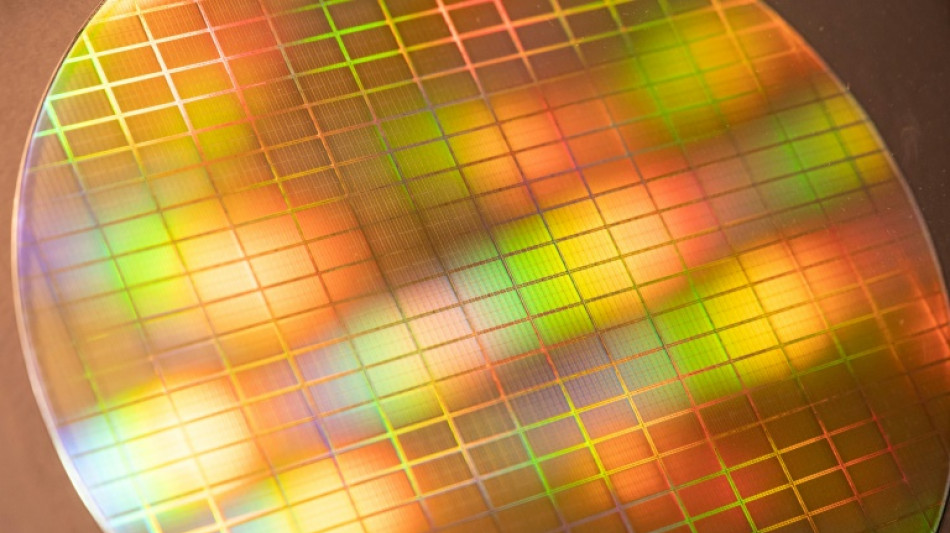
China says US chipmaker Micron failed national security review / Photo: Yuichi YAMAZAKI - AFP/File

 Qatar Chamber and Maltese envoy consider business forum

 Spanish PM denies being blackmailed by Morocco

 Doha Islamic finance forum names AlRayan firms as co-lead partners

 Leeds thrash Newcastle to go third in the Premier League

 Zelensky says Ukraine ready for 'de-escalatory steps'

 In-form Malen fires Roma to Serie A summit, Inter on their heels

 Lebanese agency reports Israeli shelling and gunfire in south

 Expert proposes phased digital reform for Arab business schools

 Trump rejects 'hoax' warnings that AI could destroy humanity

 Houthis say Saudi Arabia hits Yemen with 54 strikes after attack on bases

 Why the far right is losing ground in Sweden

 Ex-Ireland fly-half O'Gara extends deal as La Rochelle coach

 Russian attacks on Ukraine railways escalating every week: rail CEO to AFP

 France, Iraq deepen energy, defence ties during Zaidi visit

 Trump says Ukraine, Russia agree not to hit energy targets

 Nigeria's Dangote refinery launches continent's biggest IPO

 Trump blasts 'sick conspiracy' against AI as warnings mount

 For Laura Linney, role in Parkinson's-themed movie marked a turning point

 Doctors face life sentence over Greek pop star's death

 Trump moves to axe power plant climate rules

 Slow the AI race? Investors weigh the potential cost

 Philippine Muslim enclave votes for parliament after deadly shooting

 Germany seeks guarantees from Italy's UniCredit over Commerzbank takeover

 Liverpool will have to accept 'ups and downs', says Iraola

 Inaugural Ultimate a hit with the athletes, says Coe

US semiconductor giant Micron has failed a national security review, China's cybersecurity watchdog said Sunday, telling operators of "critical information infrastructure" to stop buying its products.
It marked the latest escalation in the bitter chip war between the United States and China, with Washington looking to cut off Beijing's access to cutting-edge semiconductors.
Chinese authorities had launched a review in March of products sold in the country by Micron, one of the world's major chip manufacturers.
Micron's products "have relatively serious potential network security issues, which pose a major security risk to China's critical information infrastructure supply chain and affect China's national security", the cybersecurity administration said in a statement.
"Operators of critical information infrastructure in China should stop purchasing Micron products."
China's broad definition of critical information infrastructure includes sectors ranging from transport to healthcare.
About 10 percent of Micron's $30.8 billion annual revenue last year came from China, according to company data.
But a large portion of Micron products sold in the country were bought by foreign manufacturers, analysts had said earlier, and it was not clear if the cybersecurity watchdog's decision affects sales to foreign buyers.
AFP has reached out to Micron for comment on the cybersecurity administration's announcement.
China in 2021 announced rules to protect critical information infrastructure with stricter requirements over data security.
It has recently also strengthened the enforcement of its data security and anti-espionage laws.
- 'Bullying tactics' -
The chip war between Beijing and Washington escalated last year when the United States imposed restrictions on China's access to high-end chips, chipmaking equipment and software used to design semiconductors.
Washington also blacklisted Chinese firms, including Micron rival Yangtze Memory Technologies Co Ltd.
Washington cited national security concerns, and said it wanted to prevent tech that could help develop advanced military equipment from being acquired by China's armed forces and intelligence services.
The United States imposed targeted controls on the ability of domestic industry leaders to sell their products overseas.
It has also sought to persuade key allies to follow suit.
The Netherlands and Japan -- both leading manufacturers of specialised semiconductor technology equipment -- have recently announced new restrictions on exporting certain products, but without naming China.
Beijing has slammed the moves as "US bullying tactics" and accused Washington of "technological terrorism", vowing that such controls will only strengthen its resolve to achieve self-reliance in the sector.
The development of a robust domestic semiconductor industry has been a longstanding goal of the Chinese government, which has invested billions of dollars in domestic chip firms.
Chips are the lifeblood of the modern global economy, powering everything from cars to smartphones, and they are forecast to become a $1 trillion industry globally by 2030.
Nowhere is their essential nature more visible than in China, the world's second-largest economy, which relies on a steady supply of foreign chips for its huge electronics manufacturing base.
In 2021, China imported semiconductors worth $430 billion, more than it spent on oil.
T.Sanchez--AT