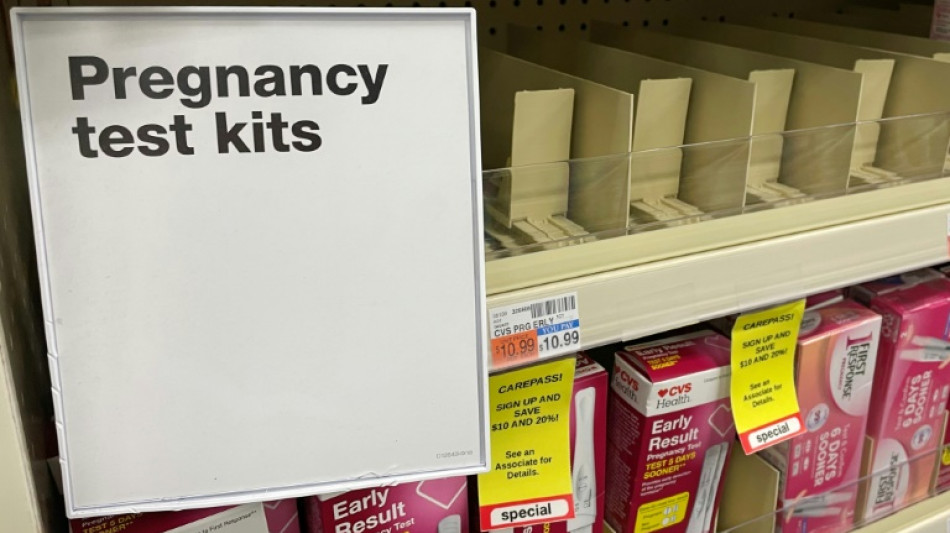
Early blood test may unravel secrets of pregnancy loss / Photo: Jim WATSON - AFP/File

 Qatar Chamber and Maltese envoy consider business forum

 Spanish PM denies being blackmailed by Morocco

 Doha Islamic finance forum names AlRayan firms as co-lead partners

 Leeds thrash Newcastle to go third in the Premier League

 Zelensky says Ukraine ready for 'de-escalatory steps'

 In-form Malen fires Roma to Serie A summit, Inter on their heels

 Lebanese agency reports Israeli shelling and gunfire in south

 Expert proposes phased digital reform for Arab business schools

 Trump rejects 'hoax' warnings that AI could destroy humanity

 Houthis say Saudi Arabia hits Yemen with 54 strikes after attack on bases

 Why the far right is losing ground in Sweden

 Ex-Ireland fly-half O'Gara extends deal as La Rochelle coach

 Russian attacks on Ukraine railways escalating every week: rail CEO to AFP

 France, Iraq deepen energy, defence ties during Zaidi visit

 Trump says Ukraine, Russia agree not to hit energy targets

 Nigeria's Dangote refinery launches continent's biggest IPO

 Trump blasts 'sick conspiracy' against AI as warnings mount

 For Laura Linney, role in Parkinson's-themed movie marked a turning point

 Doctors face life sentence over Greek pop star's death

 Trump moves to axe power plant climate rules

 Slow the AI race? Investors weigh the potential cost

 Philippine Muslim enclave votes for parliament after deadly shooting

 Germany seeks guarantees from Italy's UniCredit over Commerzbank takeover

 Liverpool will have to accept 'ups and downs', says Iraola

 Inaugural Ultimate a hit with the athletes, says Coe

A blood test taken after a miscarriage suffered as early as week five of pregnancy can help explain why it occurred and in some cases lead to preventative treatments, Danish researchers say.
One in 10 women experience pregnancy loss, with the number even higher in countries where pregnancies increasingly occur later in a woman's childbearing years.
Danish gynaecologist Henriette Svarre Nielsen and her team of researchers recently published a study in the British journal The Lancet showing that a blood sample taken from the mother soon after a miscarriage as early as the fifth week of pregnancy can determine whether the foetus had a chromosome anomaly.
In Denmark, such tests are usually only offered after a woman has suffered three miscarriages, and only if they occurred after the tenth pregnancy week.
"This is 2023. We are way beyond just counting as the criteria" to investigate why somebody may be prone to pregnancy loss, Svarre Nielsen of Hvidovre hospital near Copenhagen told AFP.
- Finding anomalies, predicting risk -
Now, as part of an ongoing study, all women who have suffered a miscarriage and visited the Hvidovre hospital emergency room are offered the blood test.
More than 75 percent of them have accepted so far.
"For me it was obvious I would do it. It helps you understand," said one woman who spoke to AFP on condition of anonymity, since she hasn't revealed her pregnancy loss to all of her family and friends.
The blood test is immediately sent to the hospital lab.
The foetus' DNA is then isolated, sequenced and analysed to see if it carries a chromosome anomaly, which is the case in about 50 to 60 percent of miscarriages.
Doctors can then determine whether some of the anomalies are more serious than others.
"They would also be able to predict the risk" of future miscarriages, lab technician Lene Werge explained, demonstrating a DNA sample with extra copies of chromosome 21, which is linked to Down Syndrome.
If no anomalies are found, doctors then launch a meticulous search for answers.
"We can start to ask the question, 'Is it this? Is it this? Is it this?'," Svarre Nielsen said.
Pregnancy loss can be the result of a hormonal imbalance, endocrinal illnesses, coagulation problems or lifestyle issues.
If an explanation is found, doctors can determine the risks and devise a treatment plan.
Launched in 2020, the project -- dubbed COPL for Copenhagen Pregnancy Loss -- is still underway and is expected to yield a unique database on a wide range of illnesses thanks to the large cohort, numbering 1,700 women so far.
"We will have good data background to actually answer questions properly about pregnancy loss, reproduction, but also women's health in general," Svarre Nielsen said.
- 'Make the loss matter' -
A doctor with more than 20 years' experience, Svarre Nielsen specialised early on in reproductive health and is keen to develop treatments.
"Pregnancy loss is something that's very common, 25 percent of all pregnancies end in a pregnancy loss," she said.
"And even though it's been so common for many, many years, the only focus has been on emptying the uterus after the loss."
She lamented that more effort had not been made to find explanations or support the mental health of couples after a miscarriage.
Rikke Hemmingsen, who suffered three miscarriages before giving birth to two children, told AFP she wished the project would have been around to help her.
"We can use the losses for something else. So the project gives me hope that fewer women have to go through what we went through," she said.
"It makes all the grief and all the sadness of every pregnancy loss matter."
Pregnancy loss is often not discussed publicly, and when it is the reactions can be awkward.
"Everyone saying 'this is normal' doesn't make it more normal, or more or less sad to the one it happens to," Hemmingsen said.
The taboo can also make it harder for a couple to get proper treatment.
"We need to start talking more openly about it. Because otherwise, I wouldn't be able to tell people that there are specialists... who can help you," the 39-year-old said.
According to Svarre Nielsen, the study's findings could ultimately help prevent five percent of the 30 million miscarriages seen worldwide annually.
A.Moore--AT