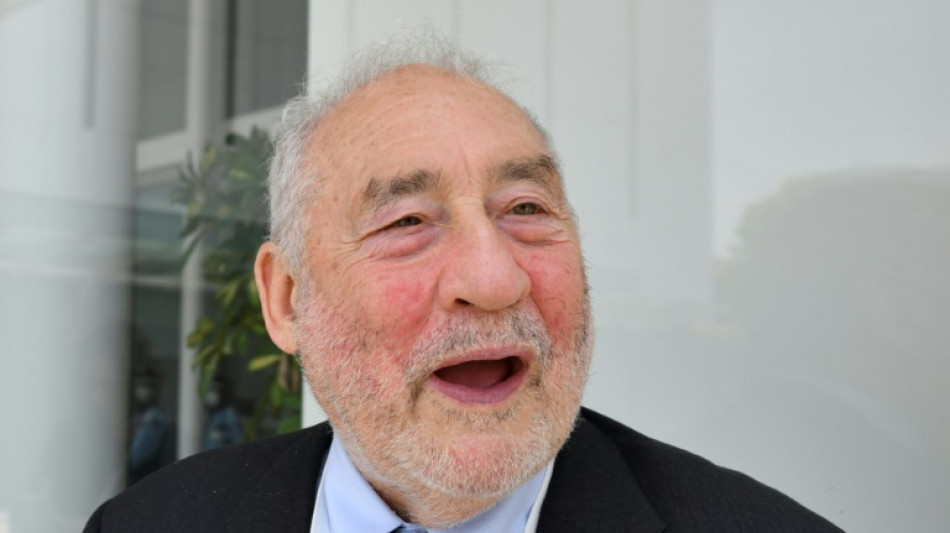
'Hostile' US policies on China risk dividing world: Stiglitz / Photo: Natsuko FUKUE - AFP

 Himalayan glacier study warns of flood and water-supply risks
 Kuwait schools restore classroom routines after remote learning
 US designer Bob Mackie, known for Hollywood glamour, dies at 87

 BIS flags debt and profitability risks in AI-driven market rally

 Qatar Chamber and Maltese envoy consider business forum
 Spanish PM denies being blackmailed by Morocco

 Doha Islamic finance forum names AlRayan firms as co-lead partners
 Leeds thrash Newcastle to go third in the Premier League

 Zelensky says Ukraine ready for 'de-escalatory steps'

 In-form Malen fires Roma to Serie A summit, Inter on their heels
 Lebanese agency reports Israeli shelling and gunfire in south

 Expert proposes phased digital reform for Arab business schools

 Trump rejects 'hoax' warnings that AI could destroy humanity

 Houthis say Saudi Arabia hits Yemen with 54 strikes after attack on bases

 Why the far right is losing ground in Sweden
 Ex-Ireland fly-half O'Gara extends deal as La Rochelle coach

 Russian attacks on Ukraine railways escalating every week: rail CEO to AFP

 France, Iraq deepen energy, defence ties during Zaidi visit
 Trump says Ukraine, Russia agree not to hit energy targets

 Nigeria's Dangote refinery launches continent's biggest IPO

 Trump blasts 'sick conspiracy' against AI as warnings mount

 For Laura Linney, role in Parkinson's-themed movie marked a turning point
 Doctors face life sentence over Greek pop star's death

 Trump moves to axe power plant climate rules

 Slow the AI race? Investors weigh the potential cost

"Hostile" US policies on China risk splitting the world into two blocs, Nobel-winning economist Joseph Stiglitz told AFP on Friday, urging the West to offer investment not "lectures" to developing countries.
"It would be a good idea... for the other G7 countries to try to put pressure on the United States to say, 'what you're doing is forming the world into two blocs, and that will be hard,'" the professor said on the sidelines of Group of Seven ministerial talks in Japan.
"We may be in some kind of strategic competition, but that doesn't mean that we have to be quite so hostile."
Stiglitz warned that competition between US Democrats and Republicans to look tough on China could undermine international action on climate change and other global crises.
And he argued that recent moves by Washington, which is attempting to limit Chinese influence on critical supply chains, could not be explained simply by concerns over Beijing's political system.
"We have many, quote, friends who are authoritarian, but what we don't like is the economic competition, and political competition," he said.
- US default risk 'significant' -
The West meanwhile is investing "very little" in developing economies, compared to countries like China, said the 80-year-old American, a former World Bank chief economist.
"There's a joke that we give them lectures about what to do, and they give them money," he said.
Finance ministers from India, Brazil and Indonesia have joined their G7 counterparts and central bank chiefs for a three-day meeting in the Japanese city of Niigata, which kicked off on Thursday.
Leaders from those nations and others including Vietnam and African Union chair Comoros are also invited to next weekend's G7 summit in Hiroshima.
"Some of the other countries here may help persuade the G7... that part of the problem is that the G7, particularly the US, is not present in Latin America and Africa. So while we say we're competing, we're not doing the investment," Stiglitz said.
China funds infrastructure around the world through its huge Belt and Road Initiative, though Washington and its allies point to the high repayments associated with its projects.
It is unclear if the G7 will make concrete investment announcements after talks next week, though efforts to "de-risk" key sectors like semiconductors by diversifying away from China will be on the table.
Stiglitz also weighed in on the US debt limit crisis, a day after Treasury Secretary Janet Yellen said it would be "unthinkable" for Washington to default on its debt.
The economist warned that "the risk of not reaching agreement is significant", calling Republican insistence on deep spending cuts in exchange for raising the limit "fanatic".
"It would not be politically rational... But politics in America has gotten into a very strange place," he said.
W.Stewart--AT