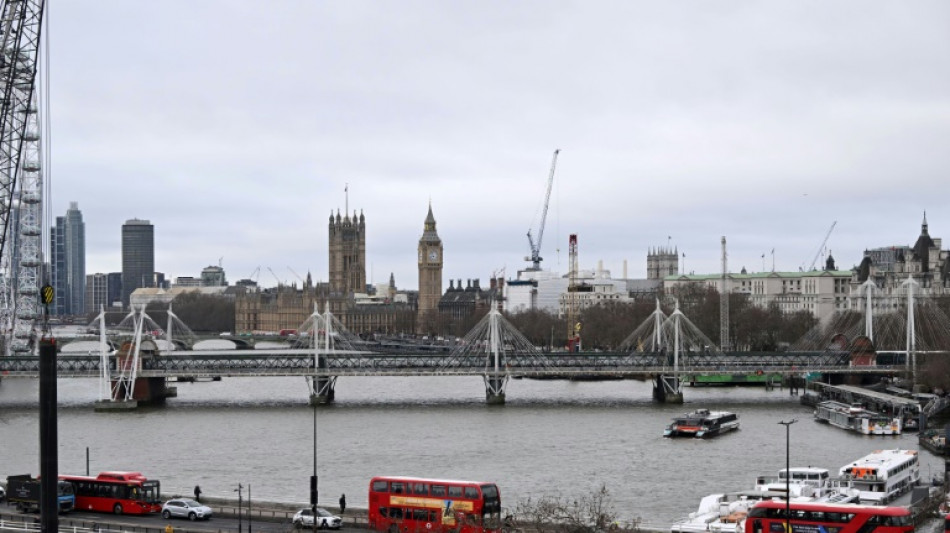
UK economy ekes out growth in first quarter / Photo: JUSTIN TALLIS - AFP/File

 Himalayan glacier study warns of flood and water-supply risks

 Kuwait schools restore classroom routines after remote learning
 US designer Bob Mackie, known for Hollywood glamour, dies at 87

 BIS flags debt and profitability risks in AI-driven market rally

 Qatar Chamber and Maltese envoy consider business forum

 Spanish PM denies being blackmailed by Morocco

 Doha Islamic finance forum names AlRayan firms as co-lead partners

 Leeds thrash Newcastle to go third in the Premier League

 Zelensky says Ukraine ready for 'de-escalatory steps'

 In-form Malen fires Roma to Serie A summit, Inter on their heels

 Lebanese agency reports Israeli shelling and gunfire in south

 Expert proposes phased digital reform for Arab business schools

 Trump rejects 'hoax' warnings that AI could destroy humanity

 Houthis say Saudi Arabia hits Yemen with 54 strikes after attack on bases

 Why the far right is losing ground in Sweden

 Ex-Ireland fly-half O'Gara extends deal as La Rochelle coach

 Russian attacks on Ukraine railways escalating every week: rail CEO to AFP

 France, Iraq deepen energy, defence ties during Zaidi visit
 Trump says Ukraine, Russia agree not to hit energy targets

 Nigeria's Dangote refinery launches continent's biggest IPO

 Trump blasts 'sick conspiracy' against AI as warnings mount

 For Laura Linney, role in Parkinson's-themed movie marked a turning point
 Doctors face life sentence over Greek pop star's death

 Trump moves to axe power plant climate rules

 Slow the AI race? Investors weigh the potential cost

Britain's economy grew 0.1 percent over the first quarter despite weakening in March, official data revealed Friday, as output continues to be hit by high inflation and strikes.
After narrowly avoiding recession last year, the economy advanced 0.5 percent in January before flattening in February and sliding 0.3 percent in March, the Office for National Statistics said in a statement.
"The fall in March was driven by widespread decreases across the services sector," noted ONS director of economic statistics, Darren Morgan.
"Despite the launch of new number plates, cars sales were low by historic standards -- continuing the trend seen since the start of the pandemic -- with warehousing, distribution and retail also having a poor month," he added.
The data comes one day after the Bank of England forecast that the UK economy would avoid recession this year despite the country's annual inflation stuck above 10 percent.
With consumer prices continuing to rise at a fast pace, the BoE on Thursday hiked its key interest rate by a further quarter-point to 4.5 percent.
It was the central bank's 12th increase in a row, putting the rate at the highest level since the global financial crisis in 2008.
Elevated inflation is eroding the value of workers' wages, causing mass strikes across Britain, the latest being stoppages on the railway network Friday.
- 'Fragile economy' -
"A weaker economy in March underscores its fragility despite a fall in wholesale energy prices, improving supply chain conditions, and consumer confidence that has... recovered from multi-year lows," noted Yael Selfin, chief economist at KPMG UK.
"While recession is probably no longer on the cards, vulnerabilities resulting from higher borrowing costs and tighter credit are likely to dampen business and household activity this year," she added.
The latest BoE hike is set to deepen the crunch in living standards as retail banks pass on the increase, resulting in higher repayments on loans, including mortgages.
At the same time, those who can afford to save will benefit for increased fixed returns on investments.
UK annual inflation stood at 10.1 percent in March, the highest level in the Group of Seven richest nations.
British Prime Minister Rishi Sunak and the BoE blame the high level partly on rises to pay and have urged employers to show restraint.
Sunak's Conservative government last week suffered a drubbing in local elections, as voters gave their verdict over a cost-of-living crisis despite government efforts to partly subsidise energy bills.
A.Clark--AT