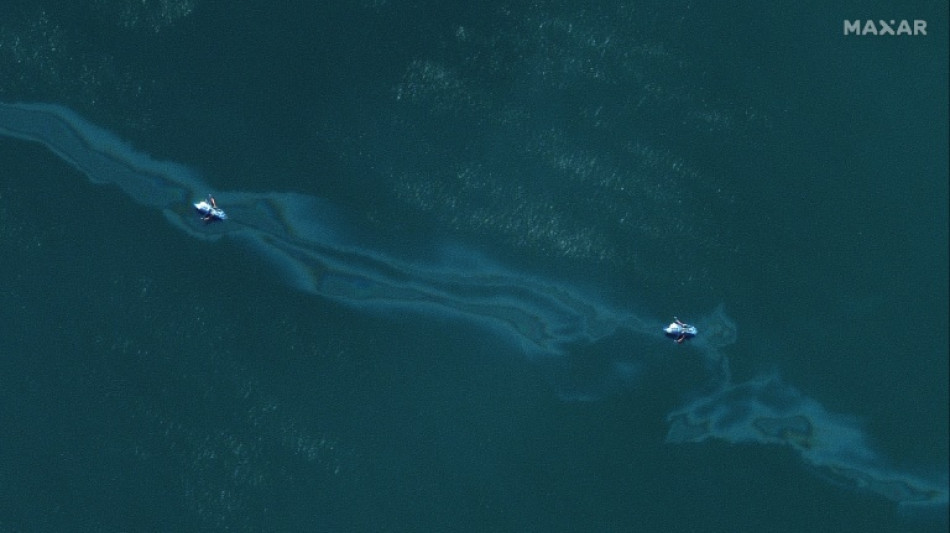
US needs $30bn to seal 14,000 unplugged offshore oil and gas wells: study / Photo: - - Satellite image ©2021 Maxar Technologies/AFP/File

 Television's A-listers glitter on Emmys red carpet

 US Supreme Court blocks Trump mail-in ballot restrictions

 Dodgers clinch playoff berth in bid for third straight World Series
 Doomers and boosters: who's who in the AI wars

 GAC presents autonomous trucks and MONTX concepts at Hannover show

 EU extends Russia sanction deadline

 Thai wildlife investigators track traffickers through social media

 Trump rejects AI slowdown concerns as UN urges coordinated controls

 US judge postpones new visa rules for foreign students, journalists

 Higher wages draw migrant workers to Kashmir despite attacks

 Oil supply concerns and AI warnings weigh on global markets

 'I am the hoax buster': Trump rejects AI danger warnings

 Macklemore dropped from Ed Sheeran tour after 'free Palestine' speech

 Trump's son confirms Russian businessman paid for post-wedding festivities

 Betis beat winless Villarreal to go third

 Etihad capacity rises as war disruption weighs on annual earnings

 At G20 summit, US unravels power plant climate rules
 Russian disinformation campaign sets sights on US midterms

 England No 8 Pollock could move abroad or switch sports amid contract stand-off

 Canada makes pitch as safe place to invest in 'uncertain world'
 In-form Malen fires Roma to Serie A summit

 IOC visits Lyon amid leadership turmoil for 2030 Winter Olympics

 New York seizes 12 celeb deep-fake porn sites

 Jesse Eisenberg channels emotional intensity into 'The Debut'

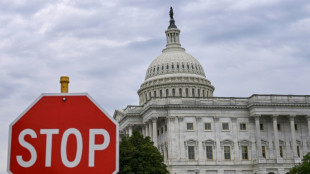 Alarm over AI grows as divided US Congress struggles to act
The cost to secure thousands of inactive oil and gas wells in the US Gulf of Mexico could top $30 billion, according to research published Monday weighing potential environmental damage against the estimated price tag.
Researchers in the United States found there are some 14,000 unplugged oil and gas wells that are either officially idle or have been inactive for at least five years in the waters off the southeastern coast of the United States.
With new US government funding available for plugging old fossil fuel wells, the authors focused on offshore sites which are relatively more costly and complicated to secure than those on land.
They said both taxpayers and fossil fuel giants would likely be liable for the costs of plugging and abandoning the wells -- a process that includes encasing the opening in concrete to stop oil and the potent greenhouse gas methane from leaking out.
"The wells aren't supposed to just be leaking into the environment if they're not actively producing... but sometimes they do," said Mark Agerton, lead author of the study published in the journal Nature Energy.
- Shallow waters -
The research found that while 90 percent of the inactive wells in the US Gulf of Mexico region were in shallower waters closer to shore, they accounted for only a quarter of the $30 billion in plugging costs -- and presented a greater environmental risk.
"The policy implication is that you'd likely focus on those shallow ones," said co-author Gregory Upton of Louisiana State University in a press briefing.
Researchers identified some 13,000 idle wells in shallow waters close to shore, either in the state waters of Texas, Louisiana, and Alabama, or in federal jurisdiction.
Oil leaks from these shallow wells would be more likely to pose a threat to coastal habitats than those from deeper wells, the authors said.
"Also, any leakages are more likely to get to the surface and in the case of methane emissions going into the atmosphere and thus cause climate damages," Upton said.
The study said much of what is known about the environmental impacts of oil and gas spills at different depths comes from the 2010 Deepwater Horizon explosion in the Gulf of Mexico, one of the worst environmental disasters in US history.
The BP-leased rig exploded off the coast of Louisiana, killing 11 people and spewing out an oil slick the size of the state of Virginia.
While inactive wells are more likely to produce "small, chronic and potentially unobserved" leaks, the study said the underlying processes affecting ecological impacts "have many similarities".
- Who pays? -
Under US laws, the costs for plugging wells in state waters are more likely to fall on the taxpayer, while in federal waters it is often the current or even previous owner that is liable.
In the case of the Gulf of Mexico wells, the study found that of the total $30 billion in estimated costs for plugging inactive wells, under $2 billion were in state waters.
The vast majority of costs were in federal waters, where nearly 90 percent of the wells had at one point been owned by "supermajor" companies like Chevron, Shell, ExxonMobil, ConocoPhillips, BP, Total and Eni.
"I think that points to a very strong conclusion that before a taxpayer would be liable for a well, there's a large oil and gas firm that would be liable," said Agerton.
W.Stewart--AT