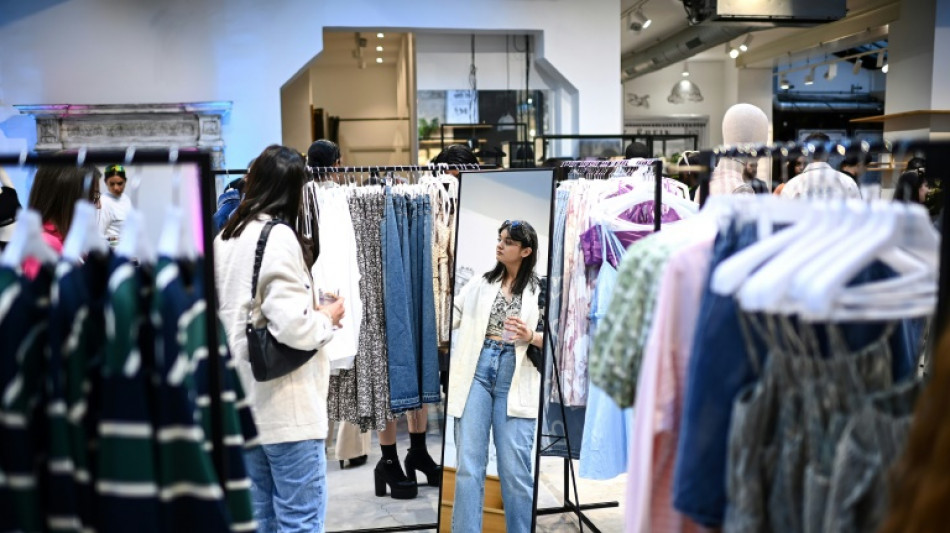
Chinese fast fashion giant Shein denies low prices due to forced labour / Photo: Christophe ARCHAMBAULT - AFP/File

 Television's A-listers glitter on Emmys red carpet

 US Supreme Court blocks Trump mail-in ballot restrictions

 Dodgers clinch playoff berth in bid for third straight World Series

 Doomers and boosters: who's who in the AI wars

 GAC presents autonomous trucks and MONTX concepts at Hannover show
 EU extends Russia sanction deadline

 Thai wildlife investigators track traffickers through social media

 Trump rejects AI slowdown concerns as UN urges coordinated controls

 US judge postpones new visa rules for foreign students, journalists

 Higher wages draw migrant workers to Kashmir despite attacks

 Oil supply concerns and AI warnings weigh on global markets
 'I am the hoax buster': Trump rejects AI danger warnings

 Macklemore dropped from Ed Sheeran tour after 'free Palestine' speech

 Trump's son confirms Russian businessman paid for post-wedding festivities

 Betis beat winless Villarreal to go third

 Etihad capacity rises as war disruption weighs on annual earnings

 At G20 summit, US unravels power plant climate rules

 Russian disinformation campaign sets sights on US midterms

 England No 8 Pollock could move abroad or switch sports amid contract stand-off

 Canada makes pitch as safe place to invest in 'uncertain world'

 In-form Malen fires Roma to Serie A summit

 IOC visits Lyon amid leadership turmoil for 2030 Winter Olympics

 New York seizes 12 celeb deep-fake porn sites

 Jesse Eisenberg channels emotional intensity into 'The Debut'

 Alarm over AI grows as divided US Congress struggles to act
Chinese cut-price fast-fashion giant Shein defended its business model in an interview with AFP, saying demand-based production accounted for its low prices and not forced or cheap labour.
Founded in China in 2008, Shein has swiftly claimed a top place in the global fast-fashion marketplace, offering young social-media-savvy customers low-priced collections that turn over at a steady clip.
The Singapore-based firm's strategy chief Peter Pernot-Day told AFP that Shein is "an on-demand manufacturer... the global pioneer of this technology" during a visit to Paris to attend the opening of a Shein pop-up store.
Testing products with a small run and spooling up production if there was demand meant Shein has eliminated "inventory risk", Pernot-Day said, wiping out "the most significant component of garment cost".
Shein's sales rose 60 percent in 2021 to $16 billion worldwide, Bloomberg reported -- just behind Swedish high-street name H&M.
With 9,000 employees worldwide and counting, Shein has big plans for further expansion.
"It's important to have teams that are in the countries and geographies and regions where we are doing business," Pernot-Day said.
The "localisation" strategy includes building a 40,000-square-metre (430,000 square feet) new warehouse in Poland allowing faster deliveries to the European market.
"There will be more," he added.
Online, Shein plans to create a digital marketplace that will allow shoppers to buy other products from other brands through its platform.
Pernot-Day said the fashion and lifestyle shopping experience would resemble a "digital grand magasin", referring to Paris' swanky department stores.
- 'Still learning' -
But relentless expansion of sales and production is exactly what NGOs and some governments hold against Shein, saying its low costs cannot be compatible with fair treatment of labour or the environment.
Pernot-Day insisted that doing away with the risk of being left with unsold inventory and warehousing accounted for its ability to offer extremely low prices, such as T-Shirts for just 4.99 euros ($5.50).
"We are able to accurately measure... demand and only produce enough garments to meet that," he said.
Shein's efforts to green its image include a second-hand clothing business in the US, materials research and integrating recycled materials in its products.
While acknowledging "fair criticism" that its product pages offer consumers little detail about recycled content and other tracability factors, "we're trying to enhance how we describe and categorise our products," Pernot-Day said.
He insisted that Shein is "very connected digitally" with suppliers' information about sourcing.
The company carried out up to 300,000 chemical tests this year alone, Pernot-Day said, adding that it worked with Oritain, a product analysis firm that also works with the US government.
"We're still learning," he added. "The challenge is that we have a lot of suppliers, lots of products".
Pernot-Day also maintained that Shein has "no suppliers in Xinjiang" in northwestern China, where aid groups have accused it of using forced labour by Uyghur people.
US lawmakers recently asked the SEC financial watchdog to require an independent investigation into allegations of forced Uyghur labour at several brands including Shein.
But the company uses a US government forced labour blacklist "to look at our supply chain and understand whether or not the companies are in there," Pernot-Day said.
And when allegations are made of copied goods being sold on Shein, "if it is (proved), we remove it from sale, if not, we won't," he added, although "this is a difficult legal question".
"We've seen a reduction of the number of complaints against us" for intellectual property violations, Pernot-Day said.
A.Anderson--AT