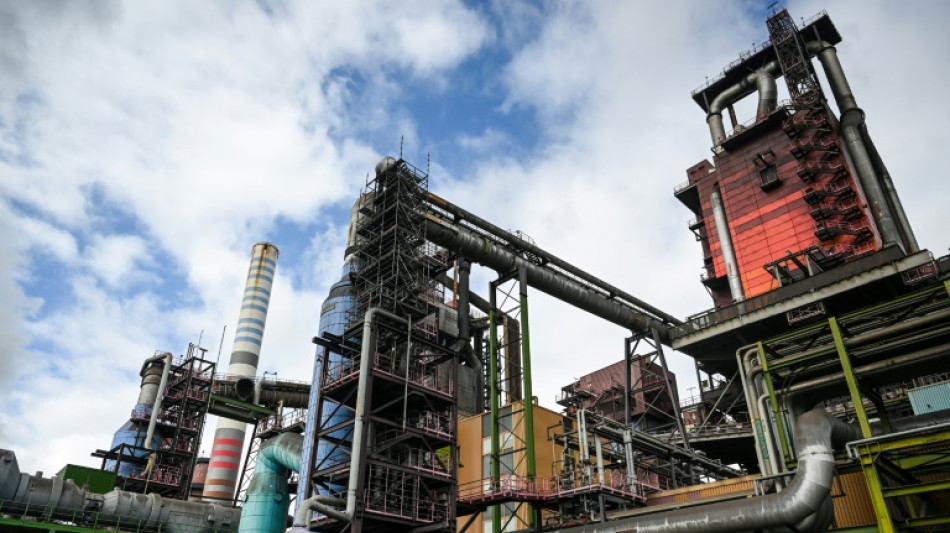
German recession fears rise as factory orders plummet / Photo: Ina FASSBENDER - AFP

 Television's A-listers glitter on Emmys red carpet

 US Supreme Court blocks Trump mail-in ballot restrictions

 Dodgers clinch playoff berth in bid for third straight World Series

 Doomers and boosters: who's who in the AI wars

 GAC presents autonomous trucks and MONTX concepts at Hannover show

 EU extends Russia sanction deadline

 Thai wildlife investigators track traffickers through social media

 Trump rejects AI slowdown concerns as UN urges coordinated controls

 US judge postpones new visa rules for foreign students, journalists

 Higher wages draw migrant workers to Kashmir despite attacks

 Oil supply concerns and AI warnings weigh on global markets

 'I am the hoax buster': Trump rejects AI danger warnings

 Macklemore dropped from Ed Sheeran tour after 'free Palestine' speech

 Trump's son confirms Russian businessman paid for post-wedding festivities

 Betis beat winless Villarreal to go third

 Etihad capacity rises as war disruption weighs on annual earnings

 At G20 summit, US unravels power plant climate rules

 Russian disinformation campaign sets sights on US midterms

 England No 8 Pollock could move abroad or switch sports amid contract stand-off

 Canada makes pitch as safe place to invest in 'uncertain world'

 In-form Malen fires Roma to Serie A summit

 IOC visits Lyon amid leadership turmoil for 2030 Winter Olympics

 New York seizes 12 celeb deep-fake porn sites

 Jesse Eisenberg channels emotional intensity into 'The Debut'

 Alarm over AI grows as divided US Congress struggles to act

Industrial orders at German factories saw their biggest fall in March since the outbreak of the Covid pandemic in 2020, data showed Friday, the latest sign that Europe's biggest economy is facing a steep downturn.
New orders, which give a foretaste of industrial output, dropped a surprise 10.7 percent from the previous month, according to provisional figures from federal statistics authority Destatis.
It was the biggest decline since April 2020, when the coronavirus pandemic snarled the global economy amid lockdowns and border closures.
The fall was far steeper than the 2.8 percent decline forecast by analysts surveyed by the financial data firm FactSet.
Orders had been rising in recent months, bolstering hopes that Germany was weathering the fallout from the Ukraine war and resulting energy crisis better than feared.
But the latest data rang alarm bells anew about the state of the economy, with LBBW bank economist Jens-Oliver Niklasch calling the plunge a warning for investors.
"This figure destroys what had been a good start to the year for German industry, and is a real recession signal," he said in a research note.
The decline was reported across most areas of the manufacturing sector, Destatis said, with foreign orders dropping by 13.3 percent and domestic orders by 6.8 percent.
- 'Very mixed' picture -
Berenberg Bank economist Holger Schmieding said that "seen in isolation", the drop in orders "clouds the outlook for German manufacturing".
But he cautioned that the picture was "very mixed" and that factory orders for the first quarter as a whole actually showed a slight increase from the end of 2022.
The economy ministry also noted that new orders had been "very volatile" recently, and that key business sentiment indicators remained on an upward trend that started late last year.
Several economic indicators had started rebounding after falling last year in the wake of Russia's invasion of Ukraine and the resulting surge in energy prices, lifting hopes that Germany could avoid a recession.
However the picture has been darkening again recently, with the economy narrowly dodging a recession in the first quarter, against expectations for a rebound, while exports also dropped in March.
Adding to the cautious outlook, French industrial production fell 1.1 percent in March, reversing a rebound of 1.4 percent the previous month, statistics office INSEE said.
It expects GDP growth of 0.2 percent for the second quarter, held back by weak consumer spending -- the main driver of France's economy.
The French government is tabling that growth for 2023 as a whole will slow to one percent after 2.6 percent last year -- but the Bank of France and the International Monetary Fund are predicting expansions of just 0.6-0.7 percent.
On Thursday, the European Central Bank raised its benchmark interest rates further, making loans for companies more expensive, as it tries to cool inflation without crimping economic growth too severely across the eurozone.
G.P.Martin--AT