Tech industry allowing 'deluge' of misinformation: RSF / Photo: Valentin GUELET, Valentina BRESCHI - AFP

 Television's A-listers glitter on Emmys red carpet

 US Supreme Court blocks Trump mail-in ballot restrictions

 Dodgers clinch playoff berth in bid for third straight World Series
 Doomers and boosters: who's who in the AI wars
 GAC presents autonomous trucks and MONTX concepts at Hannover show

 EU extends Russia sanction deadline
 Thai wildlife investigators track traffickers through social media
 Trump rejects AI slowdown concerns as UN urges coordinated controls

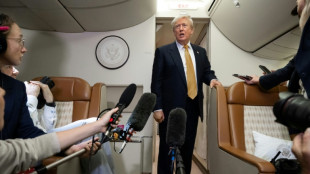 US judge postpones new visa rules for foreign students, journalists
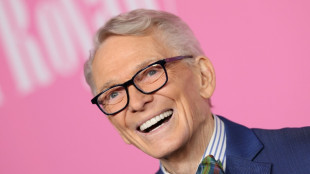
 Higher wages draw migrant workers to Kashmir despite attacks

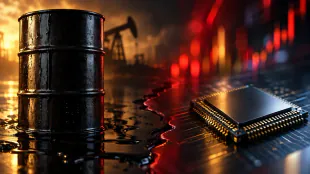 Oil supply concerns and AI warnings weigh on global markets
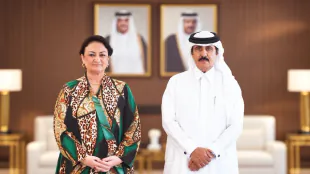
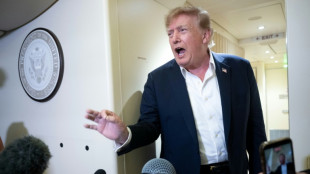 'I am the hoax buster': Trump rejects AI danger warnings
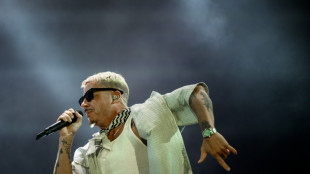 Macklemore dropped from Ed Sheeran tour after 'free Palestine' speech

 Trump's son confirms Russian businessman paid for post-wedding festivities

 Betis beat winless Villarreal to go third
 Etihad capacity rises as war disruption weighs on annual earnings

 At G20 summit, US unravels power plant climate rules
 Russian disinformation campaign sets sights on US midterms
 England No 8 Pollock could move abroad or switch sports amid contract stand-off
 Canada makes pitch as safe place to invest in 'uncertain world'
 In-form Malen fires Roma to Serie A summit
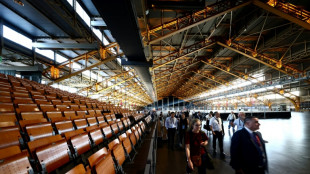 IOC visits Lyon amid leadership turmoil for 2030 Winter Olympics
 New York seizes 12 celeb deep-fake porn sites
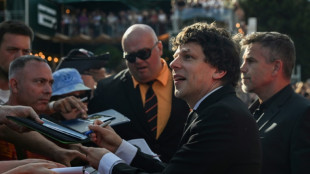 Jesse Eisenberg channels emotional intensity into 'The Debut'
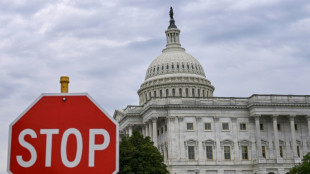 Alarm over AI grows as divided US Congress struggles to act
Journalism is being battered by propaganda and increasingly sophisticated fakes, aided by AI software and a failure of oversight from tech companies, Reporters Without Borders (RSF) said Wednesday.
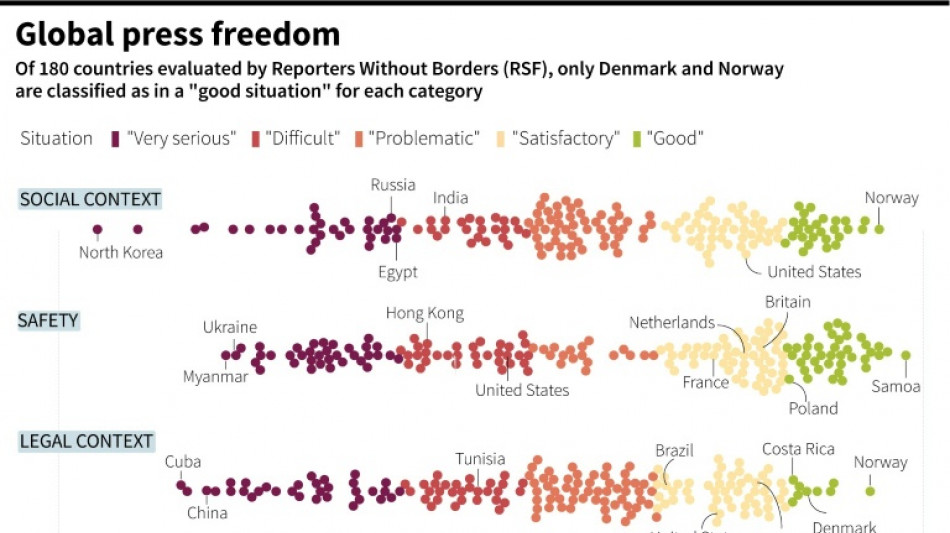
Overall, the environment for journalists was rated as "bad" in 70 percent of the 180 countries in the NGO's annual ranking, and "good" in just eight countries.
Norway and North Korea remain best and worst, respectively, for press freedom, according to the 21st annual report, which was published on World Press Freedom Day.
This year, RSF put a spotlight on the myriad forms of misinformation that are "drowning out" trustworthy news -- a problem compounded by the rapid evolution of artificial intelligence.
"It is the tech industry that allows disinformation to be produced, distributed and amplified," RSF secretary-general Christophe Deloire told AFP.
"Reliable information is drowned in a deluge of disinformation," Deloire added. "We are less and less able to perceive the differences between the real and the artificial, the true and the false."
He said a prime example was Elon Musk, who took over Twitter in late 2022. The report criticises his new paid-for verification system, saying Musk was pushing "an arbitrary, payment-based approach to information to the extreme".
The report used the example of Midjourney, an AI programme that generates high-quality images that are "feeding social media with increasingly plausible and undetectable fake 'photos'", such as those of Donald Trump being manhandled by police and a comatose Julian Assange in a straitjacket that recently went viral.
- Systematic propaganda -
Traditional forms of political interference are also gaining ground in many countries, RSF said.
Some two-thirds of countries have political actors who are "often or systematically involved in massive disinformation or propaganda campaigns", it said, highlighting the cases of Russia, India and China.
They are assisted by a vast disinformation industry.
RSF recently supported a consortium of investigative journalists working on "Forbidden Stories", a project which uncovered the activities of Israeli firm "Team Jorge" which specialises in producing disinformation.
The worst countries in the new ranking, apart from North Korea, were Vietnam, "which has almost completed its hunt of independent reporters and commentators," and China, "the world's biggest jailer of journalists".
India fell from "problematic" to "very bad", thanks to "media takeovers by oligarchs close to Prime Minister (Narendra) Modi", and also in Turkey, where the government "has stepped up its persecution of journalists in the run-up to elections scheduled for 14 May".
The United States fell three places to 45th, in part due to a deteriorating security situation for journalists.
The biggest falls were seen in Peru (down 33 places to 110), Senegal (down 31 to 104) and Haiti (down 29 to 99th).
Major improvement was seen in Brazil, up 18 to 92 thanks to the departure of far-right president Jair Bolsonaro.
The Middle East and North Africa remains the most dangerous region for journalists, RSF said, while Europe remains the safest, though attacks on journalists in Germany saw it drop five places.
The ranking is compiled by combining data on abuses committed against journalists with hundreds of surveys sent to journalists, academics and human rights activists.
A.Moore--AT