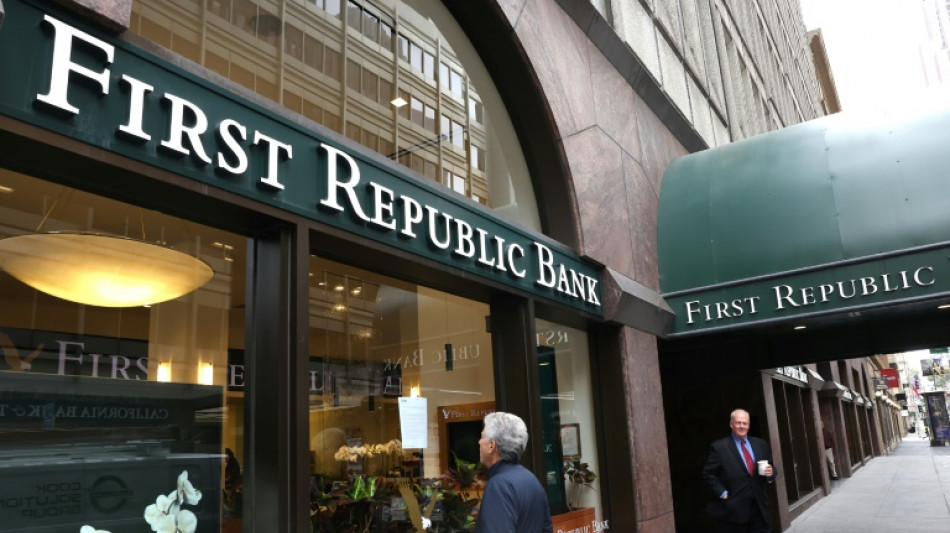
Relief at First Republic sale, but US banks still face pressure / Photo: JUSTIN SULLIVAN - GETTY IMAGES NORTH AMERICA/AFP

 Mahomes makes triumphant return as Chiefs rout Broncos 31-10

 Belgium completes outer structure of offshore energy island

 Video documents rescue of injured US airman from Iran

 Asian Games: Bigger than Olympics, young stars and a cruise ship

 Asian Games set for liftoff but will have everyone have a bed?

 Most markets drop as oil extends gains ahead of expected US rate hike

 Kate Beckinsale challenges assumptions about her beauty routine

 Sri Lanka's famed beach shack battles demolition

 Drone shot down by NATO over Lithuania

 Vserv targets ₹1,000 crore revenue by 2030 through AI expansion

 India prohibits bank fees on UPI payments up to ₹2,000
 Air India CEO summoned over alleged departure immigration lapse

 New Zealand agencies missed red flags in child kidnapping case: inquiry

 Brazil's Amazon defender Raoni has cancer

 HFCL expands planned fibre investment to ₹1,800 crore
 Emmy Awards begin as 'Widow's Bay' and 'The Pitt' vie for top prizes

 PRAAMS Launches AI Co-Investor 5.0, Expanding Its Institutional Research, Risk Management, and Portfolio Management Platform

 Himalayan glacier study warns of flood and water-supply risks

 Kuwait schools restore classroom routines after remote learning
 US designer Bob Mackie, known for Hollywood glamour, dies at 87

 BIS flags debt and profitability risks in AI-driven market rally

 Qatar Chamber and Maltese envoy consider business forum
 Spanish PM denies being blackmailed by Morocco

 Doha Islamic finance forum names AlRayan firms as co-lead partners

 Leeds thrash Newcastle to go third in the Premier League

JPMorgan Chase's takeover of First Republic resolved the fate of the last major bank caught up in recent upheaval, but the sector still faces a weakening economy and challenges from higher interest rates.
Ever since the March collapse of Silicon Valley Bank ignited fears of widespread failures among midsized banks, the industry has been operating under a cloud of uncertainty.
Banking figures welcomed Monday's transaction as a pivot point, with no known major banks currently facing an existential threat.
"While the failure of any bank is regrettable, today's decision by federal and state regulators to close First Republic Bank and sell its deposits and assets through a competitive auction will bolster confidence in the nation's banking system," said Rob Nichols, president of the American Bankers Association.
JPMorgan Chief Executive Jamie Dimon said the deal should reassure investors. But Dimon still sees plenty of risk.
The First Republic deal "hasn't changed anything about the odds of a recession," Dimon told reporters, though "I think this is going to stabilize the system, which is a good thing."
First Republic came under renewed stress last week after disclosing deep deposit withdrawals on April 24.
But notwithstanding First Republic, April earnings reports showed a US banking industry in passable condition.
SVB, First Republic and a third casualty, Signature Bank, were essentially "one-offs," said Clifford Rossi, a former risk management executive at Citigroup and a professor at the University of Maryland.
"Going forward, JPMorgan taking over First Republic does put that chapter behind the industry," Rossi said.
A note from UBS said the JPMorgan purchase puts to rest worries about acute liquidity problems.
"This deal does not change the rates, recession, and regulatory headwinds that regional banks are facing," UBS said.
"But, we think this elegant solution should lay to rest outstanding investor concerns on liquidity, especially given results from mid-cap banks that reflect challenging cyclical trends, but not acute liquidity issues."
- Tougher regulations? -
Still, shares of regional banks such as Cleveland-based KeyCorp, Dallas-based Comerica and Zions Bancorporation retreated Monday.
Even if not at risk of collapse, such banks faces a tougher operating environment, with the Federal Reserve's shift in monetary policy pressuring banks to increase interest payments to retain deposits.
Such difficulties are "less dramatic that what happened in March but might be quite important for the economy," said Phillipp Schnabl, a finance professor at New York University.
Moreover, more economists expect the United States to slip into recession in 2023, which would increase customer charge-offs and lead to a tightening of lending standards.
In the recent round of earnings reports, several banks also highlighted the expectation of the need to maintain higher capital levels in anticipation of stricter Fed regulations in the aftermath of the bank problems.
However, the Fed has said new capital rules and other big changes "would not be effective for several years" following public comment, according to the central bank's April 28 report on the SVB failure.
But Rossi said that in the wake of the bank failures, the Fed will feel pressure to demonstrate it will be proactive in trying to get ahead of problems.
The industry's recent travails have shown that many institutions have unrealized losses due to extensive Treasury holdings that have diminished in value with the Fed's shift in policy.
Another area of potential vulnerability would be a heavy exposure to commercial real estate. The Fed could show it is being proactive by probing these domains.
"Any time an event like this takes place, the regulators get much more assertive," Rossi said.
H.Thompson--AT