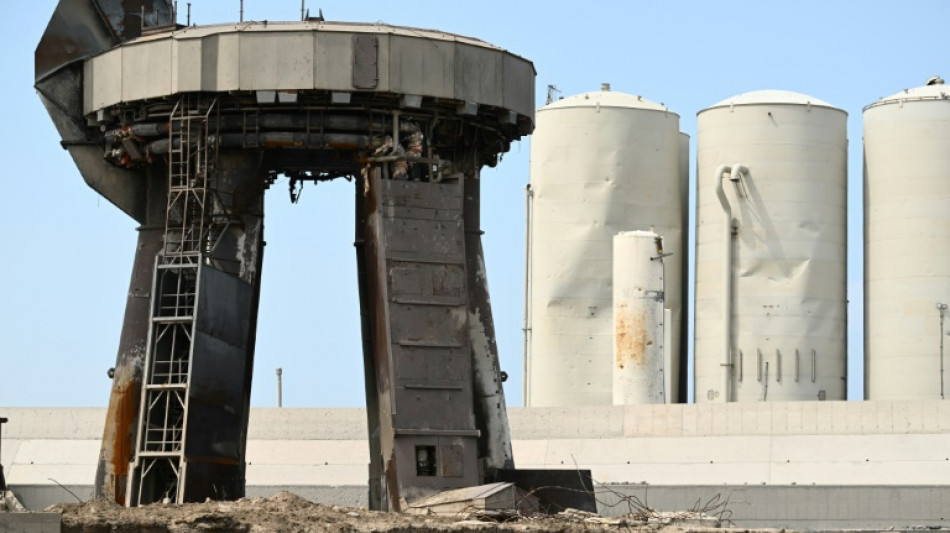
Giant SpaceX rocket leaves crater, serious damage at Texas base / Photo: Patrick T. Fallon - AFP/File

 BASIS.pro Expands On-Chain Infrastructure with XDC Network Partnership and Zypher DAO as Auto Earn Goes Live

 Samson relishing battle with teen star Sooryavanshi for India spot

 Pickle-flavoured tart? AI inspires Japan's convenience stores

 Macau holds first closed-door national security trial
 Bank of Japan set to raise rates under pressure from inflation, US

 Zverev, Shelton back on court for Davis Cup qualifiers
 Peace is a 'dangerous' word in Russian city heading to polls

 Meta chief pushes back on AI slowdown calls

 'Resident Evil' film brings video game's ethos to the big screen

 Court orders N. Korea pay Seoul $32.5 mn for blowing up office
 US military buildup in Palau stirs war fears
 US Fed to deliver rate decision with markets betting on hike

 Saudi, Egypt demand open Red Sea as Riyadh vows response to Houthi attacks

 VX Logistics Transforms Fresh Fruit and Vegetables Industry Through Application of AI and World-first Robot

 Tocvan Expands Near-Surface Gold at El Mezquite: 47.7 m of 0.8 g/t Au Including 2.8 m of 8.4 g/t Au and 54 g/t Ag

 FireFox Gold Announces Discovery of the Lammas Zone, Intersecting 21.0m at 4.13 g/t Gold More Than 650m From Previous Drilling at the Mustajärvi Project in Lapland, Finland

 Great Western Mining Corporation Plc Announces Excellent Tungsten Recovery Rate from Bulk Sample

 Capitals say hockey star Ovechkin 'was asked' to film Putin ad
 Spurs in 'tough moment' after League Cup exit as De Zerbi says sorry

 Arteta salutes 'unbelievable' Dowman after Arsenal's teen star sinks Ipswich

 Empty seats as schools reopen in Venezuela's quake-hit Guaira

 Messi set for Argentina farewell in Benin friendly

 Ton-up Brook leads from the front as England hammer Sri Lanka in 1st T20

 AI giants pursue self-regulation as safety fears mount

 Argentina begin life after Messi with Bolivia friendly

Flying chunks of concrete, twisted metal sheets, craters blasted deep into the ground: the thunderous power of SpaceX's first test flight of Starship -- the biggest and most powerful rocket ever built -- inflicted serious damage on its Texas launch site.
Repairing the damage from Thursday's unmanned test flight is expected to take months, potentially delaying further launch attempts and slowing the development of a rocket NASA plans to use on its upcoming Moon missions.
SpaceX boss Elon Musk had said before the test that just getting Starship in the air without destroying its launch pad would be "a win."
Luckily for Musk, the 390-foot-tall (120-meter) rocket successfully lifted off, climbing for about four minutes until it tumbled and exploded, well over the Gulf of Mexico.
But SpaceX engineers may have underestimated the damage that Starship's 33 first-stage rocket engines would do.
A few days later, the scene around the launch pad is one of desolation, an AFP photographer saw.
During takeoff, SpaceX video showed a hail of debris being blasted as far as the Gulf of Mexico, over 1,400 feet (420 meters) away. According to local press reports, a cloud of dust floated over a small town several miles (kilometers) away.
Photos of the launch site show the gigantic launch tower still standing while the rocket mount, which supports Starship before liftoff, damaged but still intact.
Beneath it, however, lies a huge crater, images posted on social media showed.
"The force of the engines when they throttled up may have shattered the concrete, rather than simply eroding it," Musk conceded Saturday on Twitter -- another company in his portfolio.
- A delay of months -
Olivier de Weck, a professor of astronautics and engineering at MIT, told AFP that "the radius of debris and disturbance was probably bigger than anybody anticipated."
"The main damage to the launch pad is underneath, where the flames impinge on the ground," he told AFP, adding that repairing the crater "will take several months."
De Weck said that Starship's launch site, unlike others used for such large rockets, lacked a "water deluge system."
Those are used to flood the pad with water, cooling it and absorbing shock and sound waves.
The Texas site also lacks what is known as a flame trench -- tunnels which channel hot exhaust away from the pad.
Such features come at a high price though, particularly when they have to stand up to the earth-shaking power of Starship.
After Thursday's test, Musk said that SpaceX had begun building "a massive water-cooled steel plate to go under the launch mount."
But it "wasn't ready in time," and engineers "wrongly" calculated that the pad could still withstand the test.
Known for audacious goal-setting, Musk estimates that a next launch attempt could be carried out as soon as "one to two months."
- Melting steel -
Scientist Philip Metzger, who previously worked for NASA on launch pad physics, said he thought the steel plate plan could have been "a good solution."
"The problem," he added, "is that this is such a large rocket and it takes so long to get off the pad," that the heat from the rocket's 33 engines "possibly could melt the steel."
That could be solved by pumping water through channels in the steel, "so long as they have a high enough flow rate," said Metzger, now a professor at the University of Central Florida.
He said the approach would not entirely solve the problem of shock waves, but he believes it's possible Starship has been designed to be solid enough to survive.
Designing a launch pad, Metzger told AFP, can be just as complicated as developing a rocket.
The maiden launch in November of NASA's new mega-rocket, the SLS, also caused damage to its launch pad in Florida, notably knocking launch-tower elevators out of service.
Before its next test flight, SpaceX will need to determine the exact problems behind Thursday's test.
In video broadcast by the company, several of Starship's 33 engines appeared to malfunction.
The rocket's two stages also did not separate as planned, forcing SpaceX to trigger a self-destruct mechanism.
The private aerospace firm will also have to persuade the Federal Aviation Administration (FAA) to authorize a new flight, noted de Weck.
The US agency, which is leading an investigation into the explosion, has confirmed that no injuries resulted from Thursday's test. It has said that no new tests will be approved if there is any threat to public safety.
De Weck echoed Musk's evaluation of the trial, calling it "more a success than a failure."
"The reason they're achieving these incredible capabilities," the MIT professor continued, "is because they are willing to take risks and break things.
"But they learn from it, and improve very, very quickly."
F.Wilson--AT