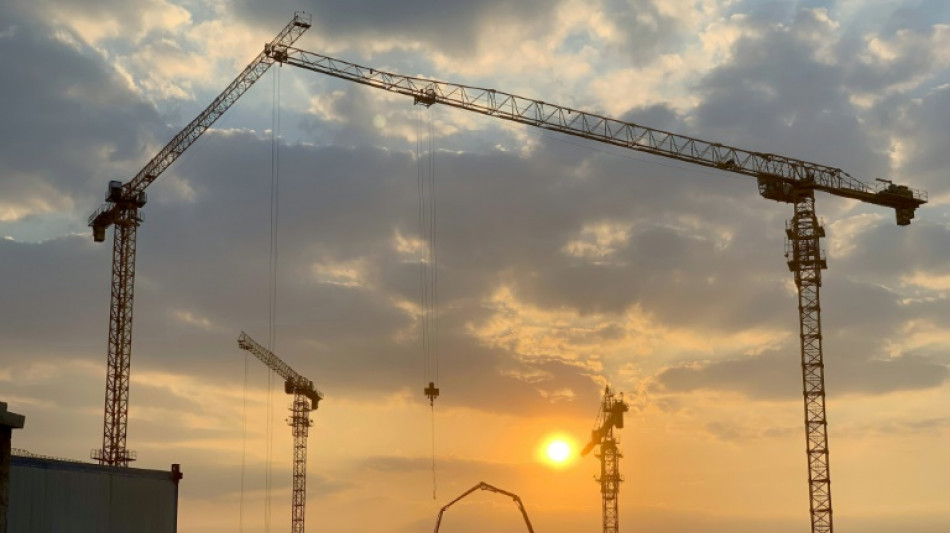
Signs of hope for China property market, but boom is over: analysts / Photo: STR - AFP/File

 BASIS.pro Expands On-Chain Infrastructure with XDC Network Partnership and Zypher DAO as Auto Earn Goes Live

 Samson relishing battle with teen star Sooryavanshi for India spot

 Pickle-flavoured tart? AI inspires Japan's convenience stores

 Macau holds first closed-door national security trial
 Bank of Japan set to raise rates under pressure from inflation, US

 Zverev, Shelton back on court for Davis Cup qualifiers

 Peace is a 'dangerous' word in Russian city heading to polls

 Meta chief pushes back on AI slowdown calls

 'Resident Evil' film brings video game's ethos to the big screen

 Court orders N. Korea pay Seoul $32.5 mn for blowing up office

 US military buildup in Palau stirs war fears

 US Fed to deliver rate decision with markets betting on hike
 Saudi, Egypt demand open Red Sea as Riyadh vows response to Houthi attacks

 VX Logistics Transforms Fresh Fruit and Vegetables Industry Through Application of AI and World-first Robot

 Tocvan Expands Near-Surface Gold at El Mezquite: 47.7 m of 0.8 g/t Au Including 2.8 m of 8.4 g/t Au and 54 g/t Ag

 FireFox Gold Announces Discovery of the Lammas Zone, Intersecting 21.0m at 4.13 g/t Gold More Than 650m From Previous Drilling at the Mustajärvi Project in Lapland, Finland

 Great Western Mining Corporation Plc Announces Excellent Tungsten Recovery Rate from Bulk Sample

 Capitals say hockey star Ovechkin 'was asked' to film Putin ad

 Spurs in 'tough moment' after League Cup exit as De Zerbi says sorry

 Arteta salutes 'unbelievable' Dowman after Arsenal's teen star sinks Ipswich

 Empty seats as schools reopen in Venezuela's quake-hit Guaira

 Messi set for Argentina farewell in Benin friendly

 Ton-up Brook leads from the front as England hammer Sri Lanka in 1st T20

 AI giants pursue self-regulation as safety fears mount

 Argentina begin life after Messi with Bolivia friendly

Pummelled by a housing crisis that caused a record-breaking slump last year, some Chinese property developers are starting to see light at the end of the tunnel, but analysts warn the sector is still on course to slow down in the long term.
The real estate industry grew at lightning speed after restrictions were eased in 1998 across China, a country where buying a home is a common prerequisite for marriage, as well as an investment.
For two decades, developers have been able to build at breakneck speed thanks to easy bank loans, but their debts swelled so much that authorities put a stop to that access to cash from 2020.
Since then, availability of credit has been slashed and demand for property has fallen as a result of the economic downturn and a crisis of confidence.
That was exacerbated by the near bankruptcy of the former industry leader Evergrande and has spread to other developers, who are in turn shunned by potential buyers for fear of similar setbacks.
Once China's largest real estate company, Evergrande this month said it had entered into a restructuring agreement with a group of international creditors, in what could be a breakthrough deal towards easing the developer's massive debt.
The firm said its plan was "a substantial positive milestone" which would "facilitate the company's efforts to resume operations and resolve issues onshore".
- 'Strong signal' -
In China, the majority of new properties are paid for even before construction begins.
The property market experienced its "worst-ever slump" last year, with sales down 24 percent, said Rosealea Yao of Gavekal-Dragonomics, a Beijing-based economic consultancy firm.
The Covid-19 pandemic was an aggravating "anxiety" factor, causing many potential buyers to postpone purchasing a property, Yao added.
The sector has also been hit by some homeowners refusing to pay their monthly mortgage payments after getting fed up with developers downing tools over a lack of cash.
But after a dark year, "China's property market has shown signs of stabilising" since the beginning of 2023, according to Fitch Ratings.
In March, a representative survey of major cities across China recorded a significant increase in property prices, according to figures released last Saturday by the National Bureau of Statistics (NBS).
Of the 70 cities that make up the official list, 64 recorded a price increase -- up from 55 in February and 36 in January.
"This is a strong signal that the sector's long-awaited recovery is finally taking root," Shehzad Qazi, managing director of China Beige Book, a consultancy firm which tracks the Chinese economy, told AFP.
"We may see a rebound for the next few months, but then on the longer term basis, the next year or the following year, I don't see we will see a big rebound further," said John Lam, who monitors the Chinese property market for UBS bank.
He argued China's declining population, a trend which started in 2022, will continue and will inevitably weigh on demand for property.
- 'Not for speculation' -
In addition, "we don't have the speculative demand coming back", Lam added, with the government pushing the idea that housing is for living in, and "not for speculation".
Real estate will experience "cyclical bouncebacks" but the days of rapid growth are "likely behind us", Qazi said.
The property sector, which along with construction accounts for about a quarter of China's GDP, is a key pillar of the country's growth.
It is also a major source of revenue for local authorities, whose finances are in a state of flux after three years of huge spending to tackle Covid-19.
To revive a struggling sector, the government has adopted a more conciliatory approach since November, with targeted support measures for the most financially sound developers -- with mixed results.
In March, the number of new-builds starting construction dropped by 29 percent year-on-year after a fall of 9.4 percent in January-February, according to the latest NBS figures.
This is despite the low base of comparison with 2022 when China's property market was in turmoil.
"Developers remain cautious and they are prioritising completing the existing projects over starting new ones," said economist Larry Hu from investment bank Macquarie.
The sector is "on the mend, but not out of the woods yet", he warned.
And the recovery is mainly benefiting the big cities like Beijing and Shanghai, which have regained their 2019 momentum, according to Yao, while the property market in smaller cities still shows "no improvement at all".
Less attractive, these cities may risk "suffering a population outflow" in the future, Lam warned.
Y.Baker--AT