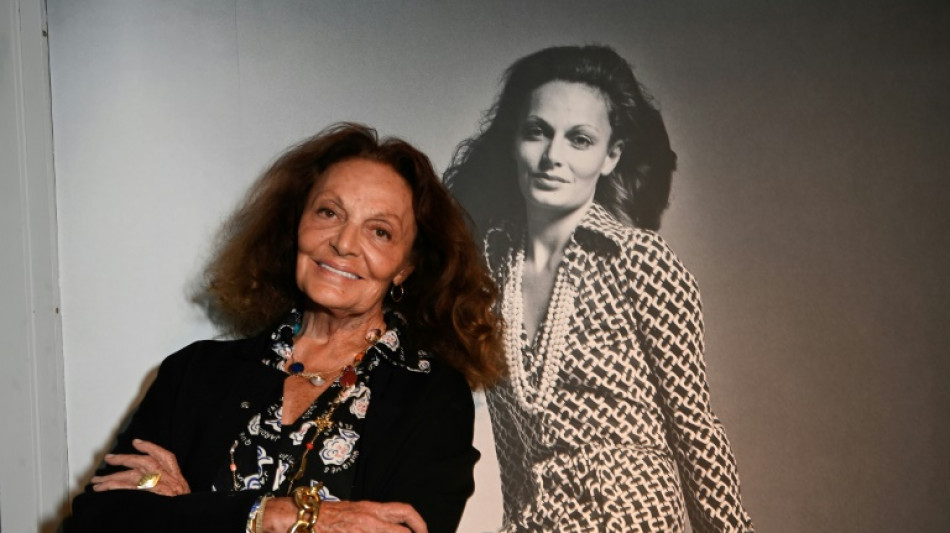
Diane von Furstenberg: From Brussels to the big time in the States / Photo: JOHN THYS - AFP

 BASIS.pro Expands On-Chain Infrastructure with XDC Network Partnership and Zypher DAO as Auto Earn Goes Live

 Samson relishing battle with teen star Sooryavanshi for India spot

 Pickle-flavoured tart? AI inspires Japan's convenience stores

 Macau holds first closed-door national security trial

 Bank of Japan set to raise rates under pressure from inflation, US
 Zverev, Shelton back on court for Davis Cup qualifiers
 Peace is a 'dangerous' word in Russian city heading to polls
 Meta chief pushes back on AI slowdown calls

 'Resident Evil' film brings video game's ethos to the big screen

 Court orders N. Korea pay Seoul $32.5 mn for blowing up office

 US military buildup in Palau stirs war fears

 US Fed to deliver rate decision with markets betting on hike

 Saudi, Egypt demand open Red Sea as Riyadh vows response to Houthi attacks
 VX Logistics Transforms Fresh Fruit and Vegetables Industry Through Application of AI and World-first Robot

 Tocvan Expands Near-Surface Gold at El Mezquite: 47.7 m of 0.8 g/t Au Including 2.8 m of 8.4 g/t Au and 54 g/t Ag
 FireFox Gold Announces Discovery of the Lammas Zone, Intersecting 21.0m at 4.13 g/t Gold More Than 650m From Previous Drilling at the Mustajärvi Project in Lapland, Finland

 Great Western Mining Corporation Plc Announces Excellent Tungsten Recovery Rate from Bulk Sample
 Capitals say hockey star Ovechkin 'was asked' to film Putin ad

 Spurs in 'tough moment' after League Cup exit as De Zerbi says sorry

 Arteta salutes 'unbelievable' Dowman after Arsenal's teen star sinks Ipswich

 Empty seats as schools reopen in Venezuela's quake-hit Guaira

 Messi set for Argentina farewell in Benin friendly

 Ton-up Brook leads from the front as England hammer Sri Lanka in 1st T20

 AI giants pursue self-regulation as safety fears mount

 Argentina begin life after Messi with Bolivia friendly
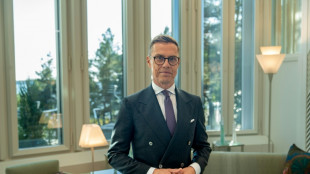
Diane von Furstenberg is a US fashion icon. But she never forgot her Belgian roots -- as evidenced by a return to Brussels, the city of her birth, to celebrate a half-century of her glamorous career.
"I really lived an American dream as a young European and it was fascinating," the 76-year-old told AFP in an interview as the Belgian capital puts on an exhibition of her work.
The show, at Brussels' Fashion and Lace Museum, is the first exhibition in Europe dedicated to the Belgian-American designer, organisers said.
Naturally, pride of place goes to von Furstenberg's signature wrap dress, which made her famous as soon as it went on sale in 1973, three years after she made New York her home.
Sought after for its simplicity and practicality, the soft jersey wrap dress has been made in several dozen iterations in bright colours, making it an enduring feature in celebrity wardrobes.
"It makes a woman confident. And if you are confident, you are beautiful," von Furstenberg said with a wide smile.
"The jersey: very practical. Doesn't crinkle. You put in a print that moves and moves with your body. That all of a sudden makes beautiful curves in your body. The shape: very simple."
At age 25, von Furstenberg was making 25,000 dresses a week to keep up with demand.
Her star never dimmed, enabling her to go into philanthropy and support her view of herself as "a big feminist".
That's a theme informing the Brussels exhibition, which is titled "Woman Before Fashion".
"What is most important to me is to use my voice, my experience, my knowledge, my resources, my connections in order to help other women to be the women they want to be," she said.
- 'A miracle' -
With her second husband, US media billionaire Barry Diller, von Furstenberg runs a foundation that annually hands out awards to personalities seen as inspiring other women.
For her own sources of inspiration, she cites first above all her mother, a survivor of the Nazi concentration camps who incarnated, for her, combativeness and a desire for freedom.
Liliane Halfin, nee Nahmias, came from a Greek-Jewish family. She was deported to Auschwitz in Poland and then to the Ravensbrueck camp in Germany as a young bride in her 20s.
When she was freed in 1945 she weighed less than 25 kilogrammes (55 pounds) and was in such poor condition that doctors recommended she postpone having children.
"She was a skeleton amongst ashes. She went to concentration camps and she wasn't supposed to survive," von Furstenberg said, adding that her own birth 18 months later was "a miracle".
After the end of World War II her parents settled in Brussels, where the future designer, then named Diane Halfin, lived until age 14 before going to boarding school in Switzerland and England.
It was during her university studies that she met her first husband, a jet-setting European prince named Eduard Egon von Furstenberg, whose name she kept after their divorce. That name is now indelibly linked to the world of fashion.
For the curator of the Brussels exhibition, Nicolas Lor, one of the keys to the success of the Diane von Furstenberg label was the combination of a dress of typically European style with material that offered comfortable wear.
"She mixed the concept of the little dress that was thought up in the 1920s with the principles of sportswear and comfort that clearly defined apparel in the United States," explained Lor, a French fashion expert who has worked at Chanel and Christian Dior.
"For me, she was American," he smiled.
The exhibition runs to January next year.
H.Gonzales--AT