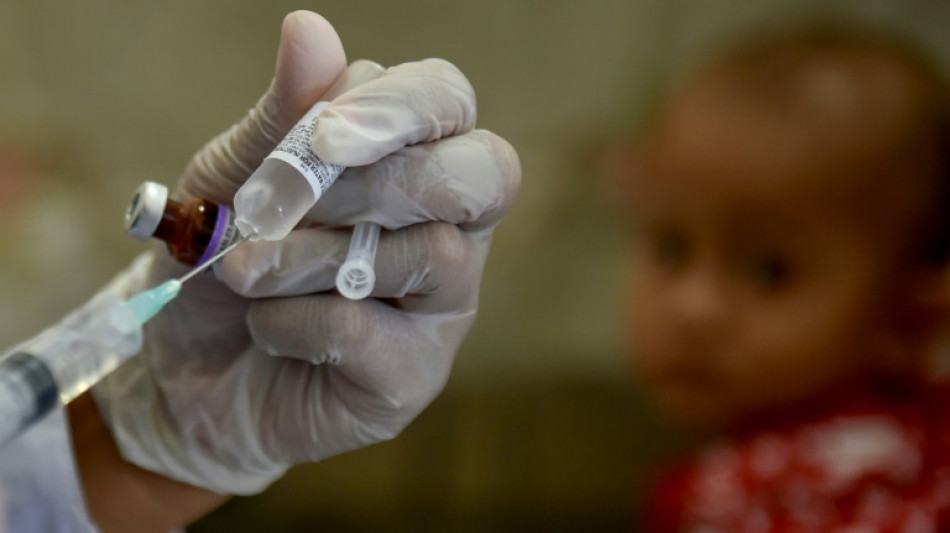
67 million children missed out on vaccines because of Covid: UNICEF / Photo: CHAIDEER MAHYUDDIN - AFP

 French court to hear Depardieu's appeal against rape trial order: sources

 The German state premier hoping to halt far-right surge
 Lebanon wants Israel security deal as prelude to peace: president to AFP
 England's Brook keen to learn from 'hero' Pietersen after stunning ton
 Saudi says Houthis target Mecca, warns of 'red line'

 Phillippines ex-leader Duterte makes first appearance at ICC
 Lebanon wants Israel security deal, Hezbollah disarmament without confrontation: president to AFP

 BASIS.pro Expands On-Chain Infrastructure with XDC Network Partnership and Zypher DAO as Auto Earn Goes Live
 Samson relishing battle with teen star Sooryavanshi for India spot
 Pickle-flavoured tart? AI inspires Japan's convenience stores

 Macau holds first closed-door national security trial
 Bank of Japan set to raise rates under pressure from inflation, US
 Zverev, Shelton back on court for Davis Cup qualifiers
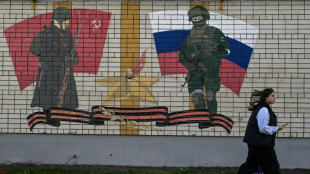 Peace is a 'dangerous' word in Russian city heading to polls
 Meta chief pushes back on AI slowdown calls

 'Resident Evil' film brings video game's ethos to the big screen
 Court orders N. Korea pay Seoul $32.5 mn for blowing up office
 US military buildup in Palau stirs war fears
 US Fed to deliver rate decision with markets betting on hike
 Saudi, Egypt demand open Red Sea as Riyadh vows response to Houthi attacks
 Physical Gold IRA Investing Guide Released by Experts (2026 Update)

 Tocvan Expands Near-Surface Gold at El Mezquite: 47.7 m of 0.8 g/t Au Including 2.8 m of 8.4 g/t Au and 54 g/t Ag

 FireFox Gold Announces Discovery of the Lammas Zone, Intersecting 21.0m at 4.13 g/t Gold More Than 650m From Previous Drilling at the Mustajärvi Project in Lapland, Finland

 Smith & Nephew Plc Announces Result of Cash Tender Offer for 2030 Bonds

 Brazil's Supreme Court clashes over handling of probe involving judge
Some 67 million children partially or fully missed routine vaccines globally between 2019 and 2021 because of lockdowns and health care disruptions caused by the Covid-19 pandemic, the United Nations said Wednesday.
"More than a decade of hard-earned gains in routine childhood immunization have been eroded," read a new report from the UN's children's agency, UNICEF, adding that getting back on track "will be challenging."
Of the 67 million children whose vaccinations were "severely disrupted," 48 million missed out on routine vaccines entirely, UNICEF said, flagging concerns about potential polio and measles outbreaks.
Vaccine coverage among children declined in 112 countries and the percent of children vaccinated worldwide slipped 5 points to 81 percent -- a low not seen since 2008. Africa and South Asia were particularly hard hit.
"Worryingly, the backsliding during the pandemic came at the end of a decade when, in broad terms, growth in childhood immunization had stagnated," the report said.
Vaccines save 4.4 million lives each year, a number the United Nations figures could jump to 5.8 million by 2030 if its ambitious targets to leave "no one behind" are met.
"Vaccines have played a really important role in allowing more children to live healthy, long lives," Brian Keeley, the report's editor in chief, told AFP. "Any decline at all in vaccination rates is worrying."
Before the introduction of a vaccine in 1963, measles killed approximately 2.6 million people each year, mostly children. By 2021, that number had fallen to 128,000.
But between 2019 and 2021, the percentage of children vaccinated against measles fell from 86 percent to 81 percent, and the number of cases in 2022 doubled compared to 2021.
- Declining vaccine confidence -
The slide in vaccination rates could be compounded by other crises, Keeley warned, from climate change to food insecurity.
"You've got increasing number of conflicts, economic stagnation in a lot of countries, climate emergencies, and so on," he said. "This all sort of makes it harder and harder for health systems and countries to meet vaccination needs."
UNICEF called on governments "to double-down on their commitment to increase financing for immunization" with special attention on accelerating "catch-up" vaccination efforts for those who missed their shots.
The report also raised concerns about a drop in people's confidence in vaccines, seen in 52 out of 55 countries surveyed.
"We cannot allow confidence in routine immunizations to become another victim of the pandemic," Catherine Russell, UNICEF's executive director, said in a statement. "Otherwise, the next wave of deaths could be of more children with measles, diphtheria or other preventable diseases."
Vaccine confidence can be "volatile and time specific," the report said, noting that "further analysis will be required to determine if the findings are indicative of a longer-term trend" beyond the pandemic.
Overall, it said that support for vaccines "remains relatively strong."
In about half of the 55 countries surveyed, more than 80 percent of respondents "perceived vaccines as important for children."
"There is reason to be somewhat hopeful that services are recovering in quite a few countries," said Keeley, who added that preliminary vaccination data from 2022 showed encouraging signs.
But even getting numbers back up to pre-pandemic levels will take years, he said, not including reaching "the children who were missing before the pandemic."
"And they are not an insubstantial number."
D.Johnson--AT