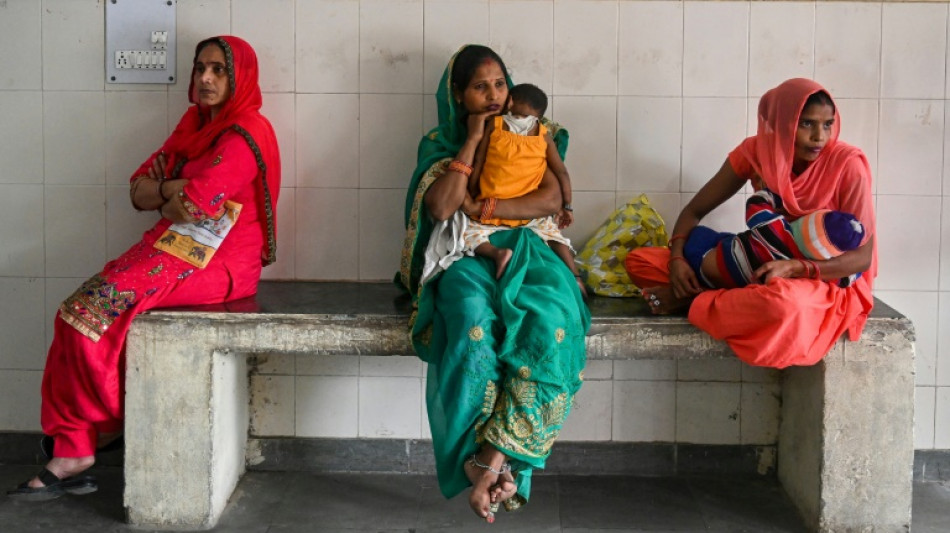
Family planning in India: A woman's burden / Photo: Oindree MUKHERJEE - AFP

 French court to hear Depardieu's appeal against rape trial order: sources

 The German state premier hoping to halt far-right surge

 Lebanon wants Israel security deal as prelude to peace: president to AFP

 England's Brook keen to learn from 'hero' Pietersen after stunning ton

 Saudi says Houthis target Mecca, warns of 'red line'

 Phillippines ex-leader Duterte makes first appearance at ICC

 Lebanon wants Israel security deal, Hezbollah disarmament without confrontation: president to AFP

 BASIS.pro Expands On-Chain Infrastructure with XDC Network Partnership and Zypher DAO as Auto Earn Goes Live

 Samson relishing battle with teen star Sooryavanshi for India spot

 Pickle-flavoured tart? AI inspires Japan's convenience stores

 Macau holds first closed-door national security trial
 Bank of Japan set to raise rates under pressure from inflation, US

 Zverev, Shelton back on court for Davis Cup qualifiers

 Peace is a 'dangerous' word in Russian city heading to polls

 Meta chief pushes back on AI slowdown calls

 'Resident Evil' film brings video game's ethos to the big screen

 Court orders N. Korea pay Seoul $32.5 mn for blowing up office

 US military buildup in Palau stirs war fears

 US Fed to deliver rate decision with markets betting on hike

 Saudi, Egypt demand open Red Sea as Riyadh vows response to Houthi attacks

 Physical Gold IRA Investing Guide Released by Experts (2026 Update)

 Tocvan Expands Near-Surface Gold at El Mezquite: 47.7 m of 0.8 g/t Au Including 2.8 m of 8.4 g/t Au and 54 g/t Ag

 FireFox Gold Announces Discovery of the Lammas Zone, Intersecting 21.0m at 4.13 g/t Gold More Than 650m From Previous Drilling at the Mustajärvi Project in Lapland, Finland

 Smith & Nephew Plc Announces Result of Cash Tender Offer for 2030 Bonds

 Brazil's Supreme Court clashes over handling of probe involving judge

Occasional screams sounded from the operating theatre in a rural Indian clinic as a heavily sedated woman named Kajal waited to have her tubes tied, long the country's preferred family planning method.
"The anaesthesia must not have kicked in," one healthcare worker said outside the facility in the northern village of Bhoodbaral, where a line of women in colourful headscarves waited to undergo the 50-minute procedure, which in India's stretched healthcare system can sometimes be risky.
India is set to become the world's most populous nation by mid-year, according to UN figures published Wednesday, overtaking China, where the population shrank last year for the first time since 1960.
The Indian government launched a nationwide family planning programme in 1952 -- long before societies around the world had even started to destigmatise birth control.
But in the decades that followed, as the pill and condoms became the go-to contraceptive methods for millions elsewhere, men in India were subjected in the 1970s to a brutal programme of forced sterilisation.
Since then the focus has shifted to women in India, with tubal ligation the preferred method of birth control.
There is a non-invasive vasectomy available for men but women like Kajal are often convinced by government healthcare workers to undergo the procedure, often with cash incentives of around $25.
Kajal, 25, said she and her husband Deepak decided she would undergo the operation since they can barely make ends meet with their three children.
"I thought it would make me weak," Deepak, a factory worker, said when asked why he chose not to have a vasectomy.
- Myths around virility -
Poonam Muttreja from Population Foundation of India said Deepak's fears about how a vasectomy -- a reversible, 10-minute procedure -- would affect him were common in what is still a "very patriarchal society".
"The most popular myth that exists among both men and women is that a man will lose his virility," Muttreja told AFP.
"This is a myth which has no science... but it is a belief. The belief is the reality for people," she said.
The health centre in Bhoodbaral sterilised more than 180 women compared with just six men from April 2022 to March this year.
"People have a misconception that no-scalpel vasectomy for males leads to impotence... This has become a taboo," said Dr Ashish Garg, the facility's medical superintendent.
- Dangerous -
Makeshift sterilisation clinics that perform tubal ligations on women are common in India, particularly in its vast rural belts where two-thirds of the population live.
Usually it is a safe procedure but in India this is not always the case.
Four women died and nine others were hospitalised last year after getting their tubes tied in the southern state of Telangana.
In 2014, at least 11 women died after sterilisations at a makeshift clinic in the central state of Chhattisgarh.
Muttreja said the government needs to do more to promote contraception.
She also said the solution to getting more men to have the operation was better education.
"It's a magical pill... Investing in health and education would have reduced the economic cost to the family and also to the nation," she said.
But Harbir Singh, a 64-year-old local resident, still believes that vasectomies rob men of their "strength" needed to work and put food on the table.
"The man has to go out and earn... The women make food and stay at home," he said.
"What will happen without the man?"
H.Thompson--AT