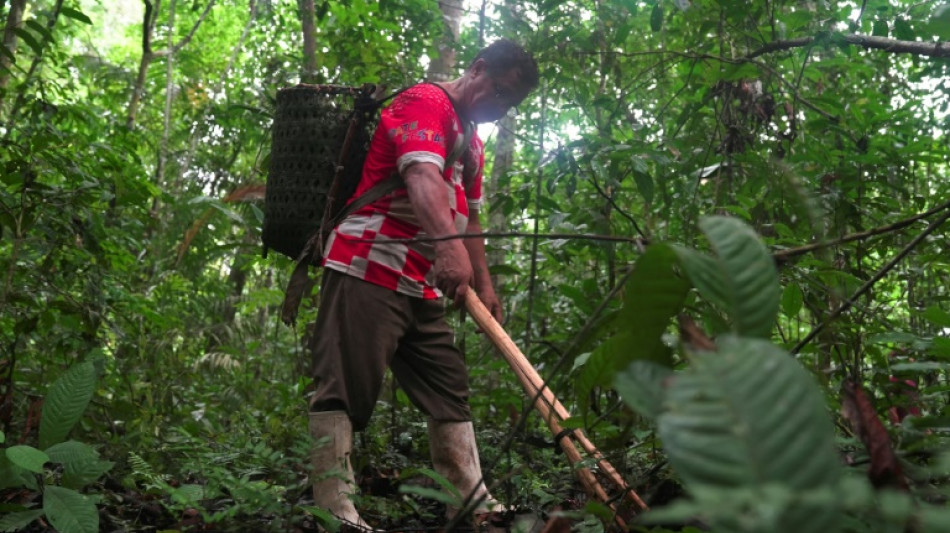
'Really hard' -- the life of an Amazon Brazil nut harvester / Photo: Martín SILVA - AFP

 French court to hear Depardieu's appeal against rape trial order: sources

 The German state premier hoping to halt far-right surge

 Lebanon wants Israel security deal as prelude to peace: president to AFP

 England's Brook keen to learn from 'hero' Pietersen after stunning ton

 Saudi says Houthis target Mecca, warns of 'red line'
 Phillippines ex-leader Duterte makes first appearance at ICC

 Lebanon wants Israel security deal, Hezbollah disarmament without confrontation: president to AFP

 BASIS.pro Expands On-Chain Infrastructure with XDC Network Partnership and Zypher DAO as Auto Earn Goes Live
 Samson relishing battle with teen star Sooryavanshi for India spot

 Pickle-flavoured tart? AI inspires Japan's convenience stores

 Macau holds first closed-door national security trial

 Bank of Japan set to raise rates under pressure from inflation, US

 Zverev, Shelton back on court for Davis Cup qualifiers

 Peace is a 'dangerous' word in Russian city heading to polls

 Meta chief pushes back on AI slowdown calls

 'Resident Evil' film brings video game's ethos to the big screen

 Court orders N. Korea pay Seoul $32.5 mn for blowing up office

 US military buildup in Palau stirs war fears
 US Fed to deliver rate decision with markets betting on hike
 Saudi, Egypt demand open Red Sea as Riyadh vows response to Houthi attacks

 Physical Gold IRA Investing Guide Released by Experts (2026 Update)

 Tocvan Expands Near-Surface Gold at El Mezquite: 47.7 m of 0.8 g/t Au Including 2.8 m of 8.4 g/t Au and 54 g/t Ag

 FireFox Gold Announces Discovery of the Lammas Zone, Intersecting 21.0m at 4.13 g/t Gold More Than 650m From Previous Drilling at the Mustajärvi Project in Lapland, Finland

 Smith & Nephew Plc Announces Result of Cash Tender Offer for 2030 Bonds

 Brazil's Supreme Court clashes over handling of probe involving judge

Assailed by mosquitoes and wary of snakes, Jorge Lengua walks watchfully through the Bolivian Amazon collecting Brazil nuts from the forest floor.
Lengua, 56, wears rubber boots to protect his ankles from stingers and fangs, and uses a long stick to pick up the softball-sized shells that contain about 20 nuts each.
"The life of a nut harvester is risky... the forest is dense, there are snakes, insects like fire ants, scorpions and millipedes," Lengua told AFP on one of his excursions.
"When it's humid like this, it's worse because there are snakes," he said and lit a cigarette, blowing the smoke around him as "this scares away mosquitoes."
"It is hard work, isn't it?" he mused. "It's really hard."
Lengua lives in the village of Luz de America on the edge of an Indigenous reserve in the department of Pando in northern Bolivia -- one of the world's largest Brazil nut exporters.
Every year, between December and March, Lengua and others from the community enter the reserve to collect the fruit of the Bertholletia excelsa tree, which can grow to a height of 60 meters (nearly 200 feet) and live for hundreds of years.
Clearing his path with a machete, Lengua collects the hard, brown shells dumped on the ground by wind and rain.
He places them in a basket on his back before dumping them on a collective heap on the forest floor.
- 'No other work' -
Some 80,000 Indigenous families make a living from Brazil nut collection in the Bolivian Amazon, according to Luis Larrea of the ACEAA Amazonian conservation association.
During the season, "this is our job... there is no other work," added Lengua.
Brazil nuts are a rare non-timber Amazon forest product with a major export market.
In 2021, Bolivia was the world's top Brazil nut exporter, according to the World Bank.
And while Brazil nut production represents only about one or two percent of Bolivian GDP, it plays an important role in forest protection, said Larrea.
As it does not involve logging, Brazil nut collection is considered sustainable as long as some nuts are left on the ground to sprout new trees.
According to a 2017 study in the journal Biodiversity and Conservation, the Brazil nut is the only globally traded seed crop collected from the wild.
However, the tree is listed as "vulnerable" on the Red List of threatened species of the International Union for Conservation of Nature, menaced by fires and other damage caused by deforestation.
The Brazil nut tree itself is protected from logging by law.
- 'Life of Amazonian men' -
When they have collected enough, Lengua and his 25-year-old son, also named Jorge, settle down under an imposing tree to slash the shells open with their machetes and remove the seeds inside.
"This is the life of Amazonian men," the older Lengua contemplated as he chewed on coca leaves for energy.
"We come to harvest the nuts, even in the rain. Sometimes we get caught in bad weather, there are strong winds and branches fall."
For each bag of 70 kilograms of nuts (about 154 pounds), which takes about eight hours to fill, a harvester earns the equivalent of about $40.
But the last years have been tough, said Lengua, citing weaker demand due to the coronavirus pandemic, the war in Ukraine and inflation.
E.Flores--AT