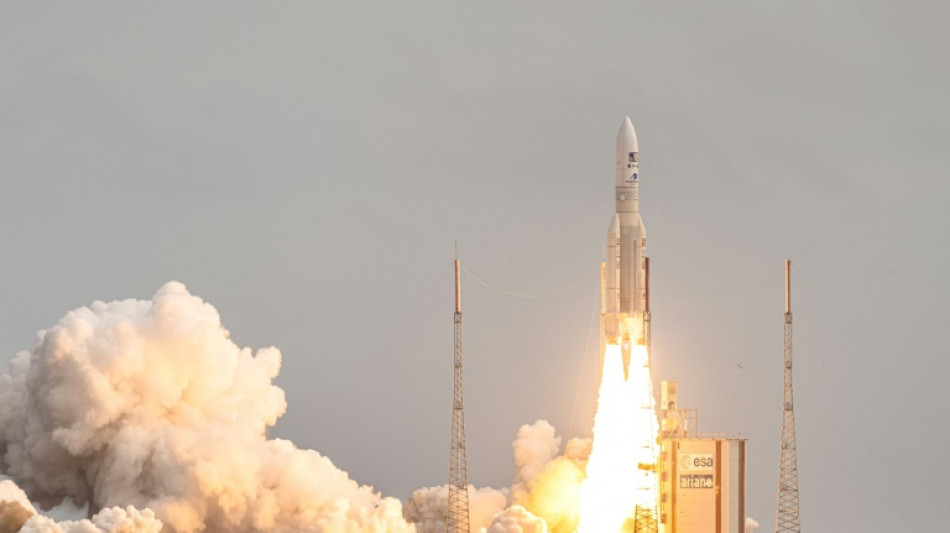
Europe's JUICE mission blasts off towards Jupiter's icy moons / Photo: jody amiet - AFP

 French court to hear Depardieu's appeal against rape trial order: sources

 The German state premier hoping to halt far-right surge

 Lebanon wants Israel security deal as prelude to peace: president to AFP

 England's Brook keen to learn from 'hero' Pietersen after stunning ton

 Saudi says Houthis target Mecca, warns of 'red line'

 Phillippines ex-leader Duterte makes first appearance at ICC

 Lebanon wants Israel security deal, Hezbollah disarmament without confrontation: president to AFP

 BASIS.pro Expands On-Chain Infrastructure with XDC Network Partnership and Zypher DAO as Auto Earn Goes Live

 Samson relishing battle with teen star Sooryavanshi for India spot

 Pickle-flavoured tart? AI inspires Japan's convenience stores

 Macau holds first closed-door national security trial

 Bank of Japan set to raise rates under pressure from inflation, US

 Zverev, Shelton back on court for Davis Cup qualifiers

 Peace is a 'dangerous' word in Russian city heading to polls

 Meta chief pushes back on AI slowdown calls

 'Resident Evil' film brings video game's ethos to the big screen

 Court orders N. Korea pay Seoul $32.5 mn for blowing up office

 US military buildup in Palau stirs war fears

 US Fed to deliver rate decision with markets betting on hike
 Saudi, Egypt demand open Red Sea as Riyadh vows response to Houthi attacks

 Physical Gold IRA Investing Guide Released by Experts (2026 Update)

 Tocvan Expands Near-Surface Gold at El Mezquite: 47.7 m of 0.8 g/t Au Including 2.8 m of 8.4 g/t Au and 54 g/t Ag

 FireFox Gold Announces Discovery of the Lammas Zone, Intersecting 21.0m at 4.13 g/t Gold More Than 650m From Previous Drilling at the Mustajärvi Project in Lapland, Finland

 Smith & Nephew Plc Announces Result of Cash Tender Offer for 2030 Bonds

 Brazil's Supreme Court clashes over handling of probe involving judge

The European Space Agency's JUICE space probe successfully launched Friday on a mission to discover whether Jupiter's icy moons are capable of hosting extraterrestrial life in their vast, hidden oceans.
The launch on an Ariane 5 rocket from Europe's spaceport in Kourou, French Guiana came after a previous attempt on Thursday was called off due to the risk of lightning.
Despite cloudy skies, the rocket took off as planned at 09:14 am local time (1214 GMT) on Friday, as guests including Belgium's King Philippe watched from the Guiana Space Centre.
A little under half an hour later, the uncrewed six-tonne spacecraft separated from the rocket at an altitude of 1,500 kilometres (930 miles), which prompted an outbreak of applause at the centre.
Stephane Israel, the CEO of French firm Arianespace in charge of the rocket, said the launch was "a success".
After a few tense minutes, ground control were relieved to receive the first signal from spacecraft.
The spacecraft then began unfurling its array of solar panels, which are a record 85 square metres, the size of a basketball court. It will need all the energy it can get near Jupiter, where sunlight is 25 times weaker than on Earth.
Carole Larigauderie, JUICE project head at France's space agency CNES, said the launch the beginning of a long journey which will "not be at all calm".
- Liquid water -
The Jupiter Icy Moons Explorer (JUICE) will take a long and winding path to the gas giant, which is 628 million kilometres (390 million miles) from Earth.
It will use several gravitational boosts along the way, first by doing a fly-by of Earth and the Moon, then by slingshotting around Venus in 2025 before swinging past Earth again in 2029.
When the probe finally enters Jupiter's orbit in July 2031, its 10 scientific instruments will analyse the Solar System's largest planet as well as its three icy moons Europa, Ganymede and Callisto.
The moons were first discovered by astronomer Galileo Galilei more than 400 years ago, but were long ignored as potential candidates for hosting life.
However, the discovery of huge oceans of liquid water -- the main ingredient for life as we know it -- kilometres beneath their icy shells has made Ganymede and Europa prime candidates to potentially host life in our celestial backyard.
JUICE will focus on Ganymede, the Solar System's largest moon and the only one that has its own magnetic field, which protects it from radiation.
In 2034, JUICE will slide into Ganymede's orbit, the first time a spacecraft will have done so around a moon other than our own.
NASA's Europa Clipper mission, which is scheduled to launch in October 2024, will focus on Ganymede's sibling Europa.
- 'Extraordinary mission' -
Neither mission will be able to directly detect the existence of alien life, but instead hope to establish whether the moons have the right conditions to harbour life.
Larigauderie pointed out that a kind of mucus had been found in a lake underneath a glacier in Antarctica, showing that life can survive in such extreme environments.
"If JUICE manages to prove that Ganymede is habitable so that we can go and find out in the future that there is life, that would be fabulous," she added.
French astronaut Thomas Pesquet, who attended the launch, told AFP that "space exploration is pushing back the frontiers of knowledge in small steps".
"If we are in a position to return to the Moon in a few years, it will be because of robotic precursors," he said. "Robotic and crewed exploration are two parts of the same effort."
The 1.6-billion-euro ($1.7 billion) mission will mark the first time Europe has sent a spacecraft into the outer Solar System, beyond Mars.
"This is an extraordinary mission that shows what Europe is capable of," said CNES chief Philippe Baptiste.
Friday marked the second-last launch for the Ariane 5 rocket, before it is replaced by the next-generation Ariane 6.
Repeated delays for the Ariane 6, as well as Russia pulling its Soyuz rockets in response to sanctions over the war in Ukraine, have left Europe struggling to find launch its mission into space.
O.Gutierrez--AT