TikTok faces ban in Montana as US backlash continues / Photo: LOIC VENANCE - AFP/File

 French court to hear Depardieu's appeal against rape trial order: sources

 The German state premier hoping to halt far-right surge
 Lebanon wants Israel security deal as prelude to peace: president to AFP
 England's Brook keen to learn from 'hero' Pietersen after stunning ton
 Saudi says Houthis target Mecca, warns of 'red line'
 Phillippines ex-leader Duterte makes first appearance at ICC
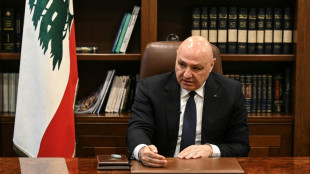 Lebanon wants Israel security deal, Hezbollah disarmament without confrontation: president to AFP
 BASIS.pro Expands On-Chain Infrastructure with XDC Network Partnership and Zypher DAO as Auto Earn Goes Live

 Samson relishing battle with teen star Sooryavanshi for India spot
 Pickle-flavoured tart? AI inspires Japan's convenience stores
 Macau holds first closed-door national security trial
 Bank of Japan set to raise rates under pressure from inflation, US

 Zverev, Shelton back on court for Davis Cup qualifiers
 Peace is a 'dangerous' word in Russian city heading to polls
 Meta chief pushes back on AI slowdown calls

 'Resident Evil' film brings video game's ethos to the big screen
 Court orders N. Korea pay Seoul $32.5 mn for blowing up office
 US military buildup in Palau stirs war fears

 US Fed to deliver rate decision with markets betting on hike

 Saudi, Egypt demand open Red Sea as Riyadh vows response to Houthi attacks

 Physical Gold IRA Investing Guide Released by Experts (2026 Update)

 Tocvan Expands Near-Surface Gold at El Mezquite: 47.7 m of 0.8 g/t Au Including 2.8 m of 8.4 g/t Au and 54 g/t Ag

 FireFox Gold Announces Discovery of the Lammas Zone, Intersecting 21.0m at 4.13 g/t Gold More Than 650m From Previous Drilling at the Mustajärvi Project in Lapland, Finland

 Smith & Nephew Plc Announces Result of Cash Tender Offer for 2030 Bonds

 Brazil's Supreme Court clashes over handling of probe involving judge
The US state of Montana on Thursday was on the verge of implementing a total ban on TikTok, after a proposal passed a key hurdle in the state's legislature.
Montana's Republican-dominated lower house overwhelmingly voted for a complete ban on the popular Chinese owned app, with a final vote set for Friday before it goes to the state's governor to become law.
If signed, the law would be unprecedented and test the legal waters for a national ban of the Chinese owned app, a fate that is increasingly being called for in Washington.
TikTok, despite its immense popularity, is caught in a battle of wills with US government and politicians, and now faces an ultimatum by the White House that it split from its Chinese owners or stop operating in America.
"We are facing a threat unlike any other from the Chinese Communist Party hiding behind TikTok where they can spy on Americans by collecting personal information by keystrokes and even user locations," said Representative Brandon Ler, defending the Montana bill.
It passed by 60 votes for and 39 against.
In a surprise move, a last minute amendment to expand the ban to US social media only narrowly failed passage, 48 for and 51 against.
Under the proposed law, Apple and Google would have to remove TikTok from their app stores and companies will face daily fines of $10,000 if found in violation.
The proposed ban would take effect in 2024, but faces almost certain legal challenges, given its unprecedented nature in the United States, possibly going all the way to the Supreme Court in Washington.
"I think there are a lot of ramifications, not the least of which is how you would do it," said University of Richmond law professor Carl Tobias.
"It is hard to see how the state would be able to defend it and win," Tobias told AFP.
When an earlier version of the bill passed in the Montana senate, TikTok decried a "disastrous precedent" that would have "serious consequences", especially on TikTok creators and Montana businesses that use the app.
"This piece of legislation is an egregious violation of Montanans' free speech rights, and it will close off Montana from the 150 million strong TikTok community in the United States," said TikTok spokeswoman Brooke Oberwetter at the time.
- 'Don't care' -
Free speech advocates also opposed the legislation.
"Passing this legislation would flout the First Amendment and would trample on Montanans' constitutional right to freedom of speech," said a letter to Montana lawmakers from the ACLU and other associations.
Montana's turn of the screws on TikTok comes as the app faces several hard-hitting, but legally tenuous, proposals of national legislation - including one bill backed by the White House that could pave the way for a ban of the app.
"Part of the problem is that politicians don't have to care about what happens after they've passed the law," said Ari Cohn, free speech counsel at TechFreedom, a think tank.
"They're all too happy to consider legislation that will get easily struck down by the courts. It's just the nature of politics, unfortunately," he told AFP.
M.O.Allen--AT