Karaage kings: judges hunt for Japan's best fried chicken / Photo: Philip FONG - AFP

 French court to hear Depardieu's appeal against rape trial order: sources

 The German state premier hoping to halt far-right surge
 Lebanon wants Israel security deal as prelude to peace: president to AFP

 England's Brook keen to learn from 'hero' Pietersen after stunning ton
 Saudi says Houthis target Mecca, warns of 'red line'
 Phillippines ex-leader Duterte makes first appearance at ICC
 Lebanon wants Israel security deal, Hezbollah disarmament without confrontation: president to AFP
 BASIS.pro Expands On-Chain Infrastructure with XDC Network Partnership and Zypher DAO as Auto Earn Goes Live
 Samson relishing battle with teen star Sooryavanshi for India spot

 Pickle-flavoured tart? AI inspires Japan's convenience stores
 Macau holds first closed-door national security trial
 Bank of Japan set to raise rates under pressure from inflation, US
 Zverev, Shelton back on court for Davis Cup qualifiers

 Peace is a 'dangerous' word in Russian city heading to polls

 Meta chief pushes back on AI slowdown calls

 'Resident Evil' film brings video game's ethos to the big screen

 Court orders N. Korea pay Seoul $32.5 mn for blowing up office

 US military buildup in Palau stirs war fears
 US Fed to deliver rate decision with markets betting on hike
 Saudi, Egypt demand open Red Sea as Riyadh vows response to Houthi attacks

 Physical Gold IRA Investing Guide Released by Experts (2026 Update)

 Tocvan Expands Near-Surface Gold at El Mezquite: 47.7 m of 0.8 g/t Au Including 2.8 m of 8.4 g/t Au and 54 g/t Ag

 FireFox Gold Announces Discovery of the Lammas Zone, Intersecting 21.0m at 4.13 g/t Gold More Than 650m From Previous Drilling at the Mustajärvi Project in Lapland, Finland

 Smith & Nephew Plc Announces Result of Cash Tender Offer for 2030 Bonds
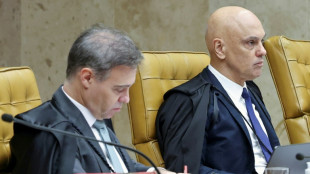 Brazil's Supreme Court clashes over handling of probe involving judge

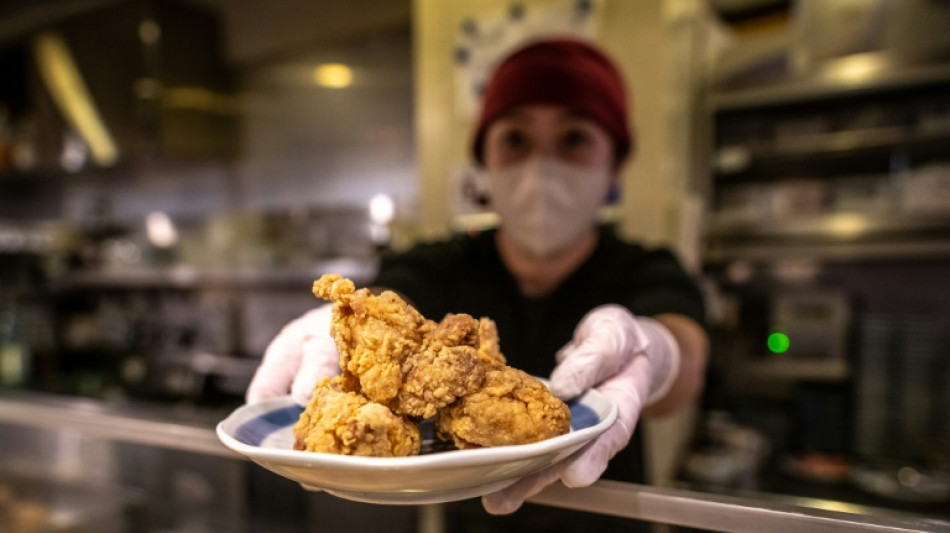
Munching their way through hundreds of golden-brown morsels, a team of judges has searched relentlessly to find the ultimate "karaage" -- the fried chicken known as "Japan's comfort food".
While a global buzz has grown around Korean fried chicken in recent years, in Japan, karaage reigns supreme.
Pronounced "kara-agay", its name refers to a technique where pieces of chicken, other meat or vegetables are marinated and coated in flour and starch before being fried.
The dish is a national obsession: winners of the Karaage Grand Prix, an annual competition to find Japan's choicest chunks, can see their sales as much as triple if their chicken wins an award.
This year, judges were appointed to replace a public vote after allegations of fowl play by some of the competing pubs, restaurants and chicken shops.
The judges met for several tasting sessions around the country -- each putting away around a kilogram of chicken a day.
Lead judge Koichiro Yagi, who also serves as managing director of the Japan Karaage Association, told AFP he was looking for fried chicken that "tells a story".
"There's an initial flavour, then a secondary flavour, then an aftertaste," he said, wearing a traditional Japanese coat bearing the slogan "karaage changes the world".
"The initial flavour draws you in with the aroma and the taste, but the real pleasure of karaage is the journey it takes you on."
The town of Nakatsu, on the southern island of Kyushu, has a reputation for producing Japan's best karaage, and its shops have won several prizes at the Karaage Grand Prix.
But competition from the rest of the country is fierce, and some cooks go to great lengths to give themselves an edge.
"There are lots of chicken shops in Nakatsu and we went there and tried each and every one," said Takehiro Matsumoto, whose Tokyo-based brand has won Karaage Grand Prix awards for the past three years running.
"It wasn't just Nakatsu -- if there was a place that people said was good, we went there and studied them all to find the best."
- 'Never get sick of it' -
The contest, now in its 14th year, hands out prizes in categories such as soy sauce or salt-based flavours -- and splits the awards between east and west Japan.
An overall winner is crowned in each category, with several lesser "gold" awards also handed out.
Until this year, winners were determined by public vote, and tales abounded of shops creating email addresses en masse to rig the system.
Kazuhiko Nakano, managing director of a pub chain that has won gold awards in different categories, said he was glad that this year's competition was decided by the judges' discerning palates.
"In the past, people would vote without even tasting it," said Nakano, adding that his firm saw an 80 percent rise in karaage sales after winning their first award in 2020.
"When you have judges, there is a standard of what is tasty."
The judges were largely drawn from food industries associated with karaage, and sampled around 25 entries a day.
Each entrant was given five minutes to present their product, while judges chewed on pineapple between bites of chicken to aid digestion.
"I've been eating karaage almost every day for more than 10 years -- I've eaten at 3,300 different karaage places," said judge Iku Arino, who styles herself as a karaage influencer.
"I never get sick of it."
After much deliberation, the judges reconvened to announce the winners at a ceremony in Tokyo this week.
Tatsuya Oyama, whose Tokyo shop "Karaage-ya Oshu Iwai" scooped the East Japan prize for best soy sauce flavour, said his award was "more meaningful" than his previous two, because it had been chosen by experts.
Lead judge Yagi said the new system had been successful but stomach-busting, and vowed to reduce the load on the panel's plates at next year's edition.
But while the champions can concentrate on turning their award-winning status into profit, Yagi said there was no such thing as the perfect karaage.
"It changes depending on the situation in which you're eating it," he said.
"It also depends on who you're eating it with and how you're eating it. Asking 'what is the perfect karaage?' is a difficult question."
W.Moreno--AT